Introduction
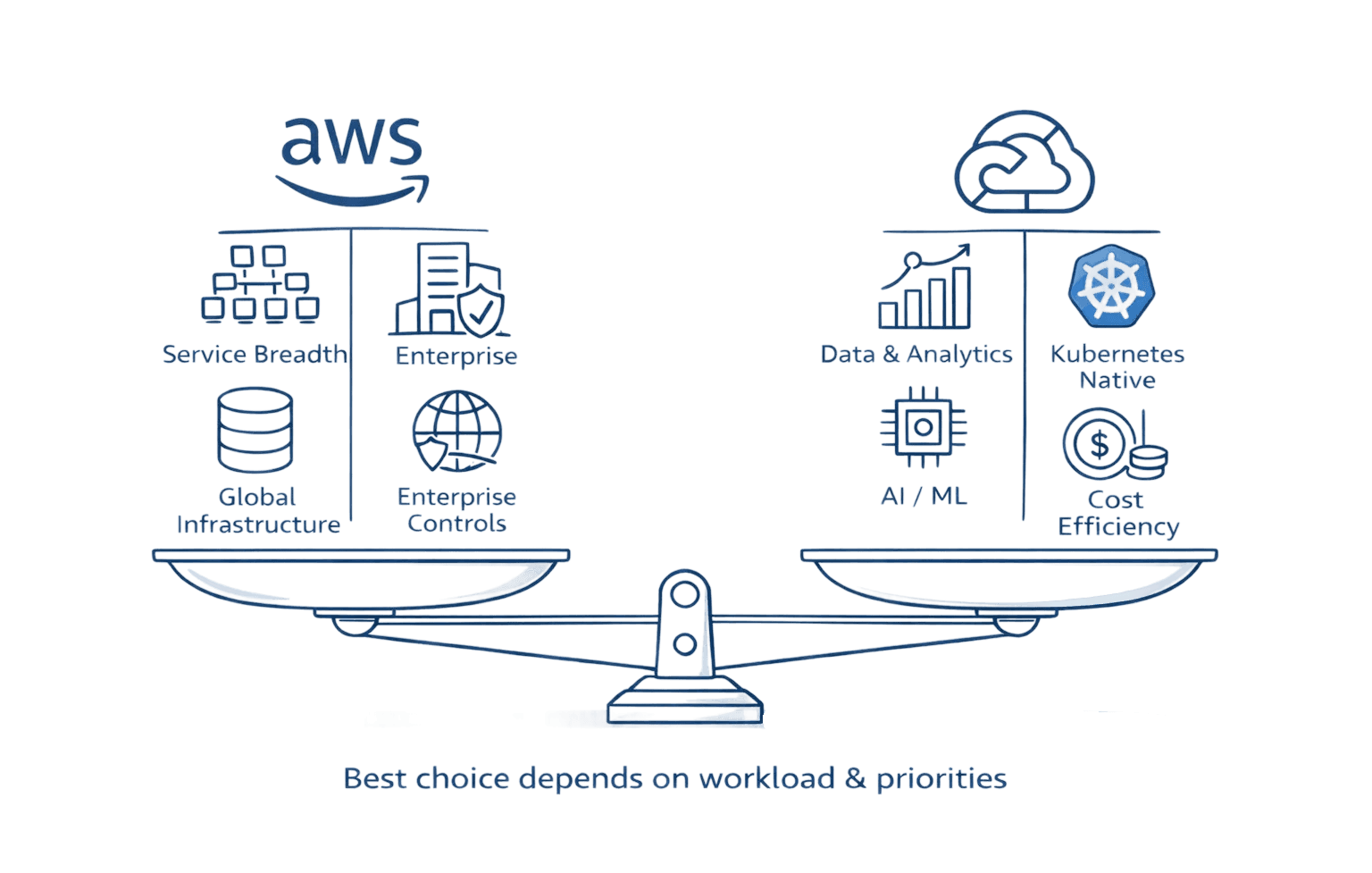
When building modern web applications, choosing between AWS and Cloudflare has become increasingly complex. AWS delivers a comprehensive ecosystem with over 240 services covering everything from databases to machine learning. Cloudflare specializes in performance and security with its edge-first architecture spanning 330 cities across 125 countries with 449 Tbps of network capacity. This comparison breaks down performance, pricing, and use cases to help you make the right choice for your infrastructure needs.
Key Insights at a Glance
Choose AWS when: You need extensive backend services, database options, machine learning capabilities, or deep ecosystem integration. AWS excels for complex infrastructure requiring granular control with 750+ global points of presence.
Choose Cloudflare when: Performance and security are primary concerns. You're serving high-bandwidth content, need predictable pricing, or want to avoid vendor lock-in. Cloudflare delivers faster edge performance with simpler architecture.
Use both together: Place Cloudflare's edge layer in front of AWS infrastructure. This hybrid approach combines AWS's backend power with Cloudflare's edge speed, often delivering 30-50% performance improvements while cutting bandwidth costs by up to 87%.
Platform Origins: Infrastructure Giant vs Edge Performance Leader
AWS launched in 2006 as infrastructure-as-a-service, evolving into the world's most comprehensive cloud platform. Today, AWS powers millions of applications with services spanning compute (EC2, Lambda), storage (S3, EBS), databases (RDS, DynamoDB), and specialized solutions for AI, analytics, and IoT. AWS now operates 750+ Points of Presence across 440+ locations globally, supplemented by 1,140+ embedded PoPs within ISP networks for ultra-low latency.
Cloudflare started in 2009 as a content delivery network and DDoS protection service. While AWS built centralized data centers, Cloudflare inverted this model with distributed edge computing. Their 330+ cities across 125 countries with 449 Tbps of network capacity reach 95% of internet users within 50 milliseconds. This massive capacity is 23 times larger than the biggest DDoS attack ever recorded, which Cloudflare mitigated at 29.7 Tbps in 2025.
The platforms now overlap in key areas: content delivery, edge computing, object storage, and security. This overlap creates tough decisions for technical teams.
CDN Performance: Speed Tests Tell the Story
Network architecture drives the performance gap between AWS CloudFront and Cloudflare CDN.
Global performance comparison:
Metric | Cloudflare | AWS CloudFront |
Edge Locations | 330+ cities, 125 countries | 750+ PoPs, 440+ locations |
Network Capacity | 449 Tbps | 268 Tbps peak recorded |
95th Percentile TTFB | 40ms globally | 216ms (Lambda@Edge) |
Network Model | Anycast (automatic) | Directed routing |
Embedded PoPs | N/A | 1,140+ within ISPs |
Cloudflare uses Anycast architecture where every point of presence handles any request globally. Traffic automatically routes to the nearest data center without configuration. CloudFront uses directed routing, offering more granular control but requiring additional setup. However, CloudFront's 1,140+ embedded PoPs deployed within ISP networks provide exceptional performance for cached content delivery, especially for high-volume streaming and game downloads.
Real-world tests reveal meaningful differences. On large networks like Cox Communications, Cloudflare delivers time-to-first-byte at the 95th percentile in 332.6ms compared to CloudFront's 404.4ms. That's a 20% improvement translating directly to faster page loads.
CloudFront particularly excels for AWS-native architectures. Distributing content from S3, EC2, or Elastic Load Balancers incurs zero data transfer charges between services, creating significant cost advantages for bandwidth-heavy workloads already on AWS. CloudFront set a record in late 2025 delivering 268 Tbps during major game releases, demonstrating massive scale capability.
Edge Computing: V8 Isolates vs Containers
Cloudflare Workers and AWS Lambda represent fundamentally different approaches to serverless computing.
Architecture comparison:
AWS Lambda runs functions in Firecracker microVMs with strong process isolation. Cold starts range from 100ms to over a second depending on runtime and memory. Lambda supports multiple languages including Node.js, Python, Java, Go, Ruby, and custom runtimes. AWS improved Lambda SnapStart in 2025, bringing Java and Python cold starts down significantly, though still not matching Workers.
Cloudflare Workers run on V8 isolates, the same technology powering Chrome's JavaScript engine. This architecture delivers near-zero cold starts (under 5ms) with a tenth of Lambda's memory overhead. Workers primarily support JavaScript, TypeScript, and WebAssembly.
Performance tests show dramatic differences. First-load upload times measured 838ms for Cloudflare Workers versus 1,519ms for AWS Lambda. At the 95th percentile globally, Workers respond in 40ms compared to Lambda@Edge's 216ms and standard Lambda's 882ms.
When to choose each:
Lambda wins for CPU-intensive workloads, complex backend processing, and applications requiring diverse language support. Memory scales from 128MB to 10GB, with execution time up to 15 minutes.
Workers excel at web-facing functions requiring minimal latency. They're ideal for request modification, API routing, and lightweight processing at the edge. Constraints include 128MB memory and 30-second timeouts (configurable to 5 minutes on paid plans).
Object Storage: The Egress Fee Revolution
Cloudflare R2 challenges AWS S3's dominance by eliminating egress fees entirely. In October 2025, Cloudflare introduced an Infrequent Access tier at $0.01/GB monthly, directly competing with S3's lifecycle tiers.
Cost comparison for 10TB monthly:
Service | Storage Cost | Egress Cost | Total |
AWS S3 Standard | $235/month | $900/month | $1,135 |
Cloudflare R2 Standard | $150/month | $0/month | $150 |
Cloudflare R2 Infrequent Access | $100/month | $0/month + $0.01/GB retrieval | $100+ |
For bandwidth-heavy workloads, the savings reach 87%. A typical scenario serving 100TB monthly costs approximately $9,000 in S3 egress fees alone versus $1,500 total in R2. The Infrequent Access tier offers even lower storage costs with a 30-day minimum storage duration and retrieval fees of $0.01/GB.
R2 uses S3-compatible APIs, meaning existing code works by simply changing the endpoint URL. Migration is straightforward with Cloudflare's R2 Super Slurper tool, which supports both AWS S3 and Google Cloud Storage. AWS waives egress fees when migrating away, eliminating the traditional exit cost barrier.
S3 still offers advantages. More storage classes exist for archival needs (Glacier), and deeper AWS ecosystem integration means zero inter-service transfer costs. In early 2025, AWS reduced S3 Express One Zone pricing by up to 85% in some regions for high-performance workloads.
Pricing Philosophy: Complexity vs Simplicity
AWS uses tiered, usage-based pricing across 240+ services. Egress fees, request charges, and resource allocation create complex bills requiring constant optimization. The model offers granular control but demands expertise to manage costs effectively. In late 2025, AWS introduced flat-rate CloudFront pricing plans ($0-$1,000 monthly) with no overages to address cost predictability concerns.
Cloudflare embraces simplicity. Generous free tiers include CDN, DNS, DDoS protection, and 100,000 daily Worker requests. Paid plans start at $5 monthly with predictable pricing and no egress fees for most services. Unlimited DDoS protection comes standard on all plans, while AWS Shield Advanced costs $3,000 monthly plus usage fees.
Lambda vs Workers pricing example (10M requests):
Lambda charges per invocation, memory allocation, and duration. A function with 128MB memory running 100ms costs approximately $2.08 for 10 million requests (after free tier).
Workers charge $5 monthly for up to 10 million requests, then $0.30 per additional million. Billing is based on CPU time, not wall-clock time. If your function waits on I/O, you're not paying during the wait. This model proves 10-200% cheaper for high-volume, low-processing applications.
Security Capabilities: Built-In vs Add-On
Cloudflare provides always-on security with unlimited DDoS protection on all plans, including free tier. Processing trillions of daily requests gives Cloudflare superior threat intelligence. In 2025, Cloudflare mitigated the largest DDoS attack ever recorded at 29.7 Tbps, demonstrating its 449 Tbps capacity advantage. Their Web Application Firewall includes managed rulesets updated automatically.
AWS requires separate services. AWS Shield Standard provides basic DDoS protection free, but Shield Advanced costs $3,000 monthly for enterprise-grade mitigation. AWS WAF charges per rule and per million requests analyzed, adding complexity to security budgets.
Both platforms offer robust security, but the cost model differs dramatically. Small teams benefit from Cloudflare's included protection, while enterprises with complex compliance needs appreciate AWS's granular control and audit capabilities.
Real-world impact: When Baselime migrated from AWS to Cloudflare in 2024, they achieved over 80% reduction in cloud costs while improving global latency and simplifying architecture from hundreds of Lambda functions to streamlined Workers.
When AWS Makes Sense
AWS is the superior choice for:
Complex backend infrastructure: Applications requiring multiple databases, message queues, data lakes, or ETL pipelines benefit from AWS's 240+ integrated services. The ecosystem depth is unmatched.
Machine learning workloads: SageMaker, Bedrock, and specialized AI services provide complete ML pipelines from training to deployment. GPU instances and managed inference endpoints support any scale.
Existing AWS investment: Teams already using EC2, RDS, or other AWS services gain significant advantages. Inter-service data transfer is free, and IAM provides centralized access control.
Regulatory compliance: AWS holds more compliance certifications than any competitor. Industries with strict data residency requirements find AWS's regional infrastructure essential.
Granular control: When you need precise configuration of networking, security policies, or resource allocation, AWS delivers unmatched flexibility.
When Cloudflare Excels
Cloudflare provides maximum value for:
High-bandwidth content delivery: Serving video, images, or downloadable content at scale benefits from zero egress fees. Organizations save 85-99% on bandwidth costs compared to traditional cloud providers.
Global web applications: When users are distributed worldwide and latency matters, Cloudflare's 330 edge locations deliver superior performance. Workers execute code within 50ms of 95% of internet users.
Startups with budget constraints: Generous free tiers and predictable pricing help early-stage companies scale without surprise bills. The free tier alone includes features AWS charges thousands for.
Multi-cloud strategies: Avoiding vendor lock-in matters for some organizations. Cloudflare's S3-compatible APIs and platform-agnostic approach maintain flexibility.
Security-first architecture: When DDoS protection, WAF, and bot management are primary concerns, Cloudflare's included security proves both effective and economical.
The Hybrid Approach: Best of Both Worlds
Modern teams increasingly combine AWS and Cloudflare for optimal results.
Common hybrid architecture:
AWS handles backend infrastructure: databases, application servers, data processing, ML models
Cloudflare provides the edge layer: CDN, DDoS protection, WAF, edge computing
R2 stores bandwidth-heavy assets: videos, images, backups, archives
This combination delivers measurable benefits. Shopify processes 3.4 trillion requests monthly across 6 million domains using Cloudflare Workers for checkout services, achieving sub-50ms response times globally while maintaining AWS for backend systems.
Implementation approach:
Point your domain DNS to Cloudflare. Configure Cloudflare as a proxy sitting between users and AWS infrastructure. Use Workers for request modification, caching logic, and authentication at the edge. Store frequently accessed files in R2 to eliminate S3 egress fees.
The result: faster performance for users, lower costs for bandwidth, and maintained flexibility to use AWS services where they excel.
Making Your Decision
The AWS vs Cloudflare choice depends on your specific requirements.
Technical decision criteria:
Infrastructure complexity: High complexity favors AWS; simple architectures suit Cloudflare
Bandwidth volume: High bandwidth makes Cloudflare's zero egress economical
Geographic distribution: Global users benefit more from Cloudflare's edge network
Existing dependencies: Current AWS usage creates switching costs
Team expertise: AWS requires more technical depth; Cloudflare is easier to learn
Financial considerations:
Calculate total cost of ownership including egress fees, which often represent 30-50% of AWS bills. For many workloads, Cloudflare delivers similar capability at 20-80% lower cost.
Strategic factors:
Consider vendor lock-in risk, compliance requirements, and long-term scalability. AWS locks you deeper into their ecosystem; Cloudflare maintains more portability.
The platform landscape in 2026 rewards teams that understand these tradeoffs. Define whether you value comprehensive depth (AWS's domain) or simplicity with performance (Cloudflare's strength), then choose accordingly. For many organizations, the answer is both.
FAQ
Q: Can Cloudflare Workers replace AWS Lambda completely?
A: No. Workers excel at edge computing and web-facing functions but Lambda supports more languages, offers deeper AWS integration, and handles complex backend processing better. Lambda provides up to 10GB memory and 15-minute execution time versus Workers' 128MB and 30-second limits.
Q: How much will I actually save switching from S3 to R2?
A: For bandwidth-heavy workloads, savings can reach 87%. Serving 10TB monthly costs approximately $1,135 on S3 versus $150 on R2. For 100TB monthly, expect $9,235 on S3 versus $1,500 on R2 (84% savings). The Infrequent Access tier at $0.01/GB offers even lower storage costs for rarely accessed data.
Q: Does Cloudflare's free DDoS protection match AWS Shield Advanced?
A: Cloudflare provides unlimited DDoS mitigation on all plans including free tier, with 449 Tbps of capacity that mitigated a record 29.7 Tbps attack in 2025. Shield Advanced costs $3,000 monthly plus usage but includes dedicated response team support for AWS-specific architectures and SLA guarantees.
Q: Which platform has better global performance for content delivery?
A: Cloudflare typically wins for end-user performance with 330 edge locations delivering 20-30% better time-to-first-byte in most regions. CloudFront excels for AWS-native content distribution with 750+ PoPs and 1,140+ embedded PoPs within ISP networks, plus zero inter-service transfer fees.
Q: Is migrating from AWS to Cloudflare difficult?
A: R2 uses S3-compatible APIs, making storage migration straightforward by changing endpoint URLs. Cloudflare provides R2 Super Slurper for free data migration from AWS S3 and Google Cloud Storage. Workers require rewriting Lambda functions in JavaScript, which varies in difficulty. Most teams adopt hybrid approaches rather than complete migration.
Q: Which platform suits startups better?
A: Cloudflare often fits startups better with generous free tiers including CDN, DNS, DDoS protection, and 100,000 daily Worker requests with no time limit. AWS offers 12-month free tier but costs escalate with egress fees and complex pricing across multiple services. Cloudflare provides predictable costs as you scale.
Q: Can I use Cloudflare with AWS-hosted applications?
A: Absolutely. Many teams use Cloudflare as security and performance layer in front of AWS infrastructure. This hybrid approach places Cloudflare's edge network between users and AWS backend services, combining Cloudflare's speed and security with AWS's comprehensive backend capabilities.
Q: How do the learning curves compare?
A: Cloudflare is significantly easier with intuitive interface and straightforward configuration suitable for users without extensive cloud experience. AWS requires more technical expertise due to vast service catalog and complex configurations but offers more granular control for teams needing advanced customization.