Introduction
Moving enterprise workloads to AWS can cost millions and take years without the right approach. Guardian Life migrated 1,200 instances in 18 months. News Corp consolidated 56 data centers down to 6. Newsweek cut operating costs by 75%. The AWS Migration Acceleration Program (MAP) made this possible.
MAP combines financial credits worth up to 25% of annual cloud spend with proven frameworks and expert support. The catch? Improper resource tagging before migration forfeits these credits entirely. AWS won't apply them retroactively.
This guide reveals how to leverage MAP's three-phase methodology to reduce Total Cost of Ownership by 36%, accelerate timelines by 5.7X, and capture every dollar of available funding.
Key Highlights
AWS MAP combines financial credits, a proven methodology, and expert support to accelerate enterprise cloud adoption.
The program offers financial incentives worth up to 25% of annual cloud spend (projected ARR) through service credits and partner cash funding with AWS Tags.
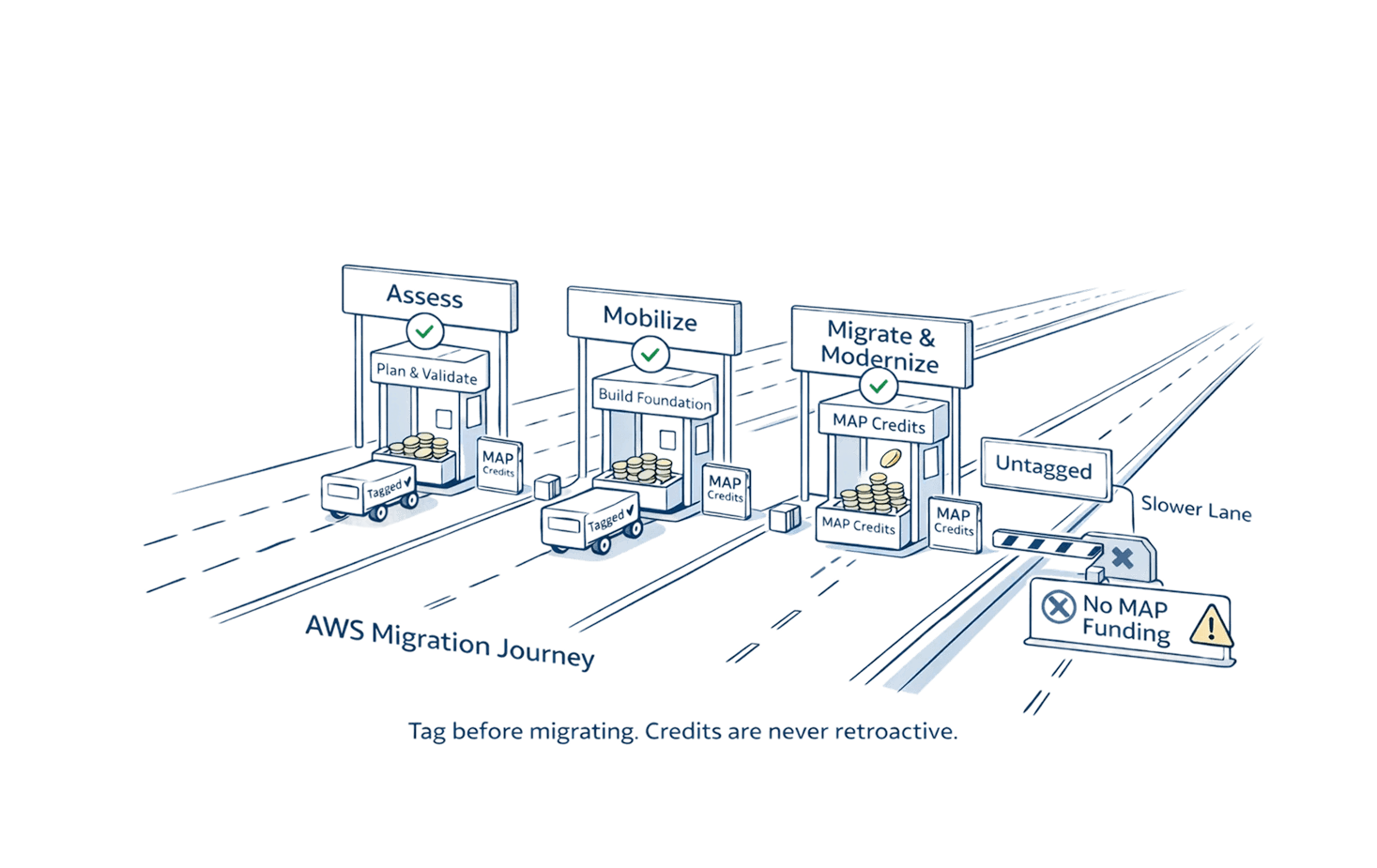
MAP enforces a structured three-phase methodology: Assess, Mobilize, and Migrate and Modernize.
The most critical requirement for funding is tagging: Resources must be tagged with the
map-migratedkey before migration completion, as credits are never applied retroactively.MAP customers report quantifiable benefits, including a 36% reduction in Total Cost of Ownership (TCO) and a 5.7X faster acceleration of migration timelines on average.
The Mobilize phase is dedicated to building a secure, Well-Architected Landing Zone and conducting a pilot migration to validate the approach.
Strategic Partner Incentives (SPIs) provide additional funding for high-value migrations, such as those involving VMware, Greenfield, or modernization efforts.
What MAP Delivers: Funding, Framework, and Expertise
AWS MAP provides three critical advantages built from thousands of enterprise migrations since 2016.
Financial incentives offset migration costs through AWS service credits and partner cash funding like AWS Savings Plans. Organizations with 100K+ in projected ARR receive 15-25% as credits, plus partner funding for professional services. A 1M ARR migration receives $150K-$250K in combined support.
Proven methodology uses a structured three-phase framework: Assess, Mobilize, and Migrate and Modernize. This framework evolved from real migrations where teams discovered what actually works.
Expert ecosystem connects you with 200+ AWS Migration Competency Partners who've completed large-scale migrations successfully.
MAP Component | Standard Migration | With MAP |
Upfront Cost Offset | 0% | 15-25% of ARR |
Migration Framework | Custom (untested) | Proven 3-phase methodology |
Expert Support | Limited | 200+ certified partners |
Timeline Acceleration | Baseline | 5.7X faster on average |
Cost Optimization | Post-migration | Integrated throughout |
Understanding MAP Credits and Funding Structure
MAP provides two types of financial support that stack together.
AWS service credits apply quarterly to your AWS bill based on migrated workload spend. You need $50K worth of properly tagged resources before credits flow. Credits range from 15-25% of annual spend.
Partner cash funding covers professional services during assessment and mobilization. MAP Lite (under 500K ARR) offers simplified funding. Standard MAP (500K+ ARR) provides milestone-based funding tied to completion.
Here's what teams miss: credits only apply to resources tagged with map-migrated before migration. One SaaS company expected $200K in credits but received $87K because engineering tagged resources after migration.
Critical: AWS won't retroactively apply MAP credits. Tag before migration or lose funding permanently.
Strategic Partner Incentives add funding for:
Greenfield migrations: 10% ARR (max $100K)
VMware migrations: 10% ARR (max $200K)
Modernization workloads: Additional credits
MAP customers report quantifiable improvements:
1.5X higher cost savings
5.7X better staff productivity
4.3X increased business agility
1.7X improved operational resilience
Phase 1: Assess - Building Your Migration Business Case
The Assess phase runs 2-4 weeks and delivers your migration roadmap across six AWS Cloud Adoption Framework dimensions: business, process, people, platform, operations, and security.
Portfolio discovery inventories applications, servers, and dependencies. Most organizations discover shadow IT here. One healthcare provider found 340 untracked instances representing $4,800 monthly.
TCO modeling compares on-premises costs against projected AWS costs. Include data transfer, reserved instances, and security tooling. Teams underestimating TCO by 20%+ face budget revisions six months into migration.
Gap analysis identifies capability shortfalls before they derail migration. Common gaps: insufficient cloud skills, lack of tagging governance, missing security controls and lack of AWS Cost Management.
Funding equals 5% of projected ARR, paid as credits 1-2 weeks after AWS approves your readiness assessment.
[DIAGRAM NEEDED: Flowchart showing Assess phase workflow - Portfolio Discovery → TCO Modeling → Gap Analysis → Business Case Approval → Credits Released]
Phase 2: Mobilize - Establishing Your Cloud Foundation
Mobilize builds operational foundation over 8-12 weeks.
Landing zone setup creates your multi-account AWS environment with security guardrails and governance controls. Design it wrong and you'll retrofit security later at 10X cost.
Well-Architected Review validates foundation against AWS best practices. This review is required for MAP funding disbursement.
Team enablement trains engineers on AWS services and cloud operating models. Successful migrations allocate 20% of mobilization time to training.
Pilot migration moves 1-3 non-critical applications to validate approach and test runbooks. Pilots reveal problems like unexpected data transfer times and missing dependencies.
Mobilize Deliverable | Purpose | Typical Duration |
Landing Zone Setup | Multi-account foundation | 3-4 weeks |
Security Baseline | Governance and controls | 2-3 weeks |
Pilot Migration | Validate approach | 2-4 weeks |
Team Training | Build cloud skills | Ongoing |
Migration Runbooks | Standardize execution | 1-2 weeks |
Funding arrives as AWS credits upon completing the Mobilize Success Criteria Report and Well-Architected Review.
The Critical Tagging Requirement Everyone Misses
This deserves its own section because improper tagging forfeits millions in MAP credits.
AWS tracks MAP-eligible spend through the map-migrated tag applied to resources. Tag format: key = map-migrated, value = your MAP agreement identifier (provided by your AWS team).
Activate the tag in AWS Billing → Cost Allocation Tags before starting migration waves. Then apply it to all eligible resources: EC2 instances, EBS volumes, RDS databases, S3 buckets, Lambda functions, and 50+ other services listed in MAP 2.0 documentation.
Automation options:
AWS Application Migration Service auto-tags launched instances with map-migrated key
CloudFormation stack tags propagate to all created resources
AWS Config rules monitor tagging compliance and alert on violations
Check progress through Cost Explorer filtered by map-migrated tag. The MAP 2.0 Dashboard (available in billing console for payer accounts) shows credit accrual against tagged spend.
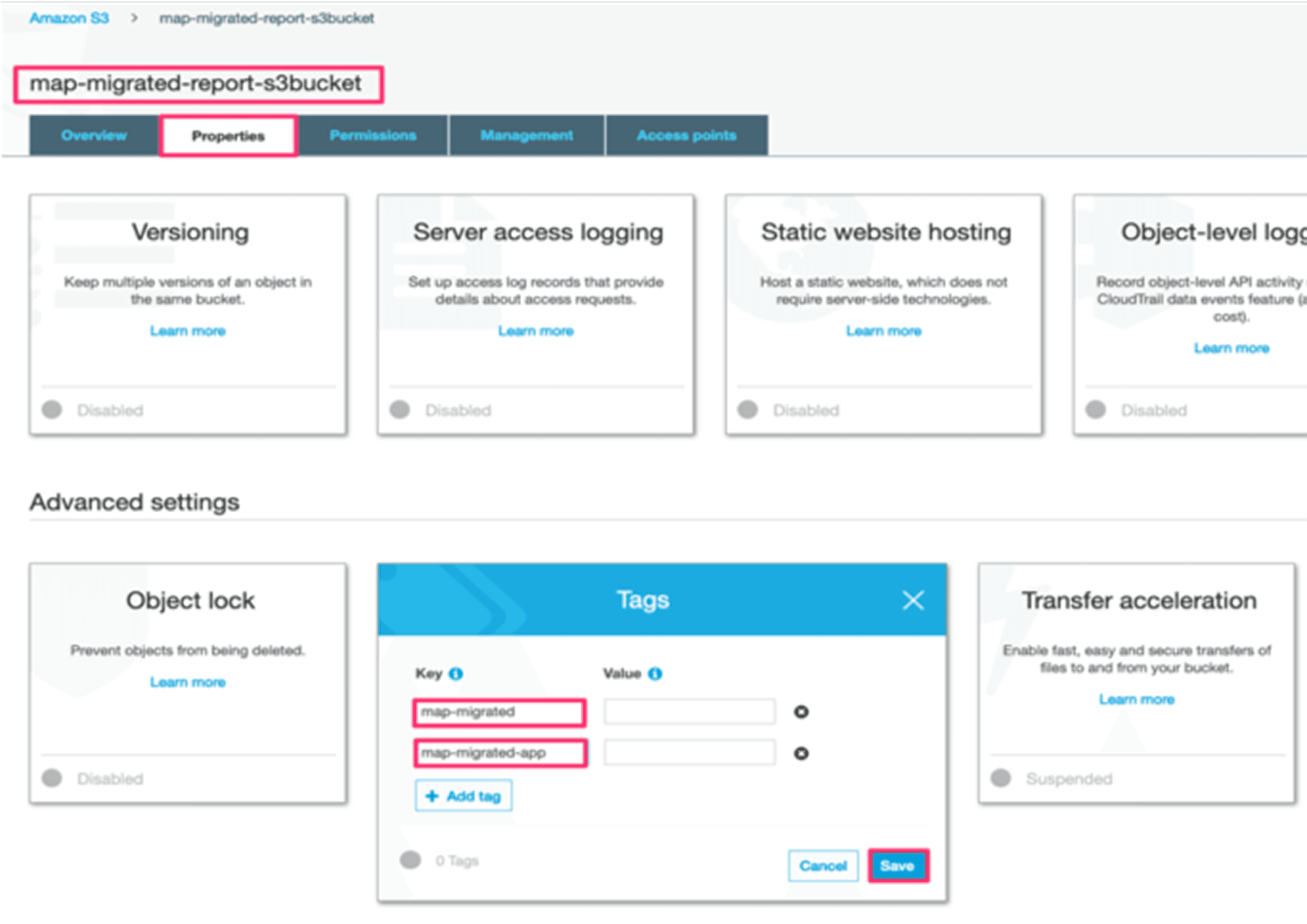
Common tagging failures:
Tagging after migration completes (credits lost permanently)
Inconsistent tag values across resources (credits not aggregated properly)
Missing tags on storage volumes while tagging compute instances (partial credit loss)
Not enabling cost allocation tags before applying resource tags (delayed credit visibility)
Set up AWS Config conformance packs to enforce tagging standards. Configure Amazon EventBridge to trigger SNS notifications when untagged eligible resources appear.
Phase 3: Migrate and Modernize - Executing at Scale
The final phase executes migration using proven patterns, typically 4-18 months depending on portfolio size.
Migration strategies follow the 6 Rs:
Rehost: Move as-is, fastest path
Replatform: Minor optimizations like managed databases
Refactor: Re-architect for cloud-native, highest value
Retire: Decommission 10-20% of applications
Retain: Keep on-premises for regulatory constraints
Repurchase: Replace with SaaS alternatives
Guardian Life rehosted 60% for speed, replatformed 25% to managed services, and refactored 15% of mission-critical applications.
Wave planning groups applications by dependencies and complexity. First waves target simple, low-risk applications. Later waves tackle complex systems with proven runbooks.
Migration factory industrializes through automation and standardized processes. ClearScale migrated 6,300 servers from 12 data centers in 10 months.
Credits are issued quarterly based on actual tagged migration spend validated against predetermined milestones.
Real-World Results: Companies Winning with MAP
Guardian Life migrated 90 applications across 1,200 instances in 18 months. The insurance provider reduced data center footprint while improving disaster recovery capabilities and application performance.
News Corp consolidated 56 data centers down to 6, moving 75% of infrastructure to AWS. The media company achieved massive cost savings while gaining global scalability for digital properties.
Georgia Technology Authority completed portal migration in 12 months, reducing infrastructure costs by 60-70%. GTA leveraged MAP funding to invest extra resources in planning, resulting in higher uptime and happier constituents.
Newsweek cut overall monthly operating costs by 75% through MAP-supported migration. The digital publisher redirected savings toward content creation and audience growth initiatives.
Across all MAP customers, AWS Finance benchmark data shows:
36% reduction in Total Cost of Ownership through Optimization and Licensing Assessments
40-60% faster migration completion compared to unstructured approaches
90%+ conversion rate from assessment to full migration among engaged customers
Avoiding Costly Migration Mistakes
Underestimating security costs and not using AWS Cost Management catches finance teams unprepared. Budget for AWS native security services and third-party tools. One financial services firm underestimated security spend by $180K annually.
Poor dependency mapping disrupts wave plans when hidden relationships surface mid-migration. Use AWS Application Discovery Service during assessment. A retail company discovered their checkout system depended on 14 unlisted backend services.
Finance-engineering misalignment creates credit expectation gaps. Finance expects credits per agreements. Engineering handles tagging implementation. Without coordination, workloads migrate untagged and credits evaporate.
Insufficient change management generates resistance. Allocate 15-20% of project effort to communication, training, and support.
Attempting migration without cloud expertise extends timelines and increases costs. Either develop capabilities through training or partner with AWS Migration Competency Partners.
FAQ: Essential MAP Questions Answered
Q: What is the minimum eligibility for AWS MAP?
A: Organizations need at least 100K in projected ARR on AWS post-migration. MAP Lite serves 100K-500K ARR with simplified approval. Standard MAP supports 500K-10M ARR with full funding.
Q: How much funding does MAP provide?
A: Typical funding ranges from 15-25% of projected ARR as AWS credits, plus partner cash. Example: 1M ARR migration receives $150K-$250K combined. VMware and modernization scenarios qualify for additional Strategic Partner Incentives.
Q: Are MAP credits applied automatically?
A: No. Credits only apply to resources tagged with map-migrated before migration. AWS won't retroactively credit workloads. Implement tagging before starting migration waves or forfeit funding.
Getting Started: MAP Activation Checklist
Immediate actions:
Calculate projected annual AWS spend post-migration
Request free migration assessment from AWS Migration Competency Partner
Review readiness across six Cloud Adoption Framework dimensions
Identify workloads migrating first based on business value and complexity
Before signing agreement:
Establish tagging governance across finance and engineering
Select migration strategies for top 20% of portfolio
Build executive sponsorship with clear business case
Allocate training budget for cloud skill development
MAP transforms enterprise cloud migration from risky expense into structured, funded program. Organizations capturing full benefits reduce costs by 36%, accelerate timelines by 5.7X, and build foundations supporting long-term innovation.
The difference between success and failure? Proper planning, rigorous tagging discipline, and alignment across finance, engineering, and business. Get these right and MAP credits offset hundreds of thousands in migration costs.
Ready to maximize your MAP investment? Schedule a migration assessment to determine eligibility and potential savings, or request a demo of cost optimization tools that track MAP credits and ensure you capture every dollar of available funding.