Introduction
AWS S3 has dominated object storage for nearly two decades, but its complex pricing model creates budget uncertainty. Organizations face unexpected bills as data volumes grow and access patterns change. Storage costs at $0.023/GB seem reasonable until egress fees ($0.09/GB), API request charges, and retrieval costs stack up. The result? Monthly bills that balloon beyond projections.
The good news: proven alternatives offer S3-compatible APIs, transparent pricing, and significant cost savings without compromising durability or performance. Teams at companies from startups to Fortune 500 enterprises now reduce storage costs by 40-80% while maintaining full compatibility with existing tools.
This guide evaluates eight battle-tested aws s3 alternatives based on real-world pricing, migration complexity, and performance characteristics.
Key Insights at a Glance
Cost savings range from 40-80% through simplified pricing and zero egress fees
S3-compatible APIs enable migration with minimal code changes across all alternatives
Wasabi and Backblaze B2 deliver lowest storage costs at approximately $6/TB monthly
Cloudflare R2 eliminates egress fees entirely for content delivery workloads
Migration timelines span 2-8 weeks depending on data volume and validation requirements
Hidden S3 costs include $0.09/GB egress, API request fees, and cross-region transfers
Multi-cloud strategies reduce vendor lock-in while optimizing for workload-specific needs
Why Organizations Are Moving Away from AWS S3
S3 remains reliable and feature-rich. But pricing complexity creates budget unpredictability that financial teams struggle to forecast.
The challenge starts with storage tiers. S3 Standard, Intelligent-Tiering, Standard-IA, One Zone-IA, Glacier, and Glacier Deep Archive each have different rates. Add egress fees for data leaving AWS, API request charges, and retrieval costs for archived data. Monthly bills become impossible to predict accurately.
A mid-sized SaaS company storing 50TB of application data discovered this firsthand. Storage costs looked reasonable at around $1,150 monthly. Then egress fees hit: $4,500 for serving 50TB to customers. API requests added another $800. Total monthly cost: $6,450 instead of the projected $1,200.
When migration makes sense:
High egress traffic (20%+ of stored data transferred monthly)
Predictable access patterns (consistent hot or cold data)
Budget forecasting requirements (need fixed monthly costs)
Multi-cloud strategy (reducing AWS dependency)
When S3 remains optimal:
Deep AWS integration with native services like Athena or Lambda
Complex lifecycle policies with Intelligent-Tiering
Compliance requirements tied to AWS certifications
Minimal egress (data stays within AWS ecosystem)
The decision hinges on your specific workload characteristics and cost drivers.
Top S3 Alternatives: Feature and Pricing Comparison
Eight providers deliver proven alternatives with production-grade reliability. Here's how they compare:
Provider | Storage Cost | Egress Fees | API Charges | S3 Compatibility | Key Differentiator |
Cloudflare R2 | $0.015/GB | $0 | $4.50/million | Full | Zero egress for CDN workloads |
Wasabi | $5.99/TB | $0 | $0 | Full | Single-tier simplicity |
Backblaze B2 | $6/TB | $0.01/GB* | Low | Full | Lowest base cost |
Google Cloud | $0.020/GB | $0.08-0.23/GB | Standard | Full | GCP ecosystem integration |
Azure Blob | $0.0208/GB | $0.087/GB | Standard | Full | Microsoft ecosystem fit |
MinIO | Infrastructure | $0 | $0 | Full | Self-hosted control |
DigitalOcean | $0.02/GB | $0.01/GB | $0 | Full | Developer simplicity |
IBM Cloud | $0.023/GB | $0.083/GB | Standard | Full | Enterprise features |
*Free through Cloudflare Bandwidth Alliance
Total cost comparison for 10TB storage + 5TB monthly egress:
AWS S3 Standard: $230 storage + $450 egress = $680/month
Cloudflare R2: $150 storage + $0 egress = $150/month (78% savings)
Wasabi: $60 flat + $0 egress = $60/month (91% savings)
Backblaze B2: $60 storage + $0 egress = $60/month (91% savings)
The math changes dramatically once egress enters the equation.
Cloudflare R2: Zero-Egress Storage for Content Delivery
Cloudflare R2 eliminates the single biggest cost driver for high-traffic applications: egress fees.
Built on Cloudflare's global network spanning 330+ data centers, R2 delivers automatic region selection based on upload location. Your data lives close to users without manual configuration. The integrated CDN distributes content globally with sub-10ms latency for most requests.
Pricing structure:
Storage: $0.015/GB monthly
Class A operations (writes): $4.50 per million
Class B operations (reads): $0.36 per million
Egress: $0 (unlimited)
For a video streaming platform serving 100TB monthly to global users, the savings are dramatic. S3 would charge $9,000 just for egress. R2 charges zero.
The S3-compatible API means existing tools work immediately. AWS SDK? Works. S3 Browser? Works. Terraform S3 backend? Works with a simple endpoint change.
Best for:
Media streaming and delivery
Static asset hosting (images, scripts, stylesheets)
Public content distribution
Any workload with read-to-write ratio above 10:1
Migration happens through R2's Super Slurper tool. Point it at your S3 bucket, and it copies everything over HTTPS with automatic retry logic. Most teams complete migrations within a week for datasets under 50TB.
[DIAGRAM NEEDED: Data flow showing how R2 automatically selects optimal storage region and serves through CDN edge locations]
Wasabi Hot Cloud Storage: Predictable Flat-Rate Pricing
Wasabi takes a radically different approach: one storage tier with one price. No cold storage. No lifecycle policies. No complicated decision trees.
Everything costs $5.99 per TB monthly. Period.
This simplicity extends to egress (free) and API requests (free). The only additional charge: early deletion within 90 days. Store data for 90+ days, and you pay exactly $5.99/TB. Nothing hidden.
How Wasabi achieves this pricing:
They bet on economies of scale and efficient data center operations. By eliminating tiering complexity and passing infrastructure savings to customers, Wasabi undercuts major cloud providers by 80%.
The trade-off? Wasabi optimizes for hot storage. If you need archival tiers with retrieval delays, look elsewhere. But for active data requiring regular access, Wasabi delivers unmatched value.
Performance characteristics:
11 nines durability (99.999999999%)
Sub-10ms first-byte latency
Unlimited throughput per account
Six global regions (US East, US West, EU Central, EU West, AP Northeast, AP Southeast)
A marketing agency storing 80TB of client assets across photo shoots, video projects, and design files switched from S3 to Wasabi. Monthly costs dropped from $2,840 to $480. Annual savings: $28,320.
Best for:
Active datasets requiring frequent access with AWS Tags
Organizations prioritizing budget predictability
Teams wanting to eliminate egress fee tracking
Backup and disaster recovery (with regular testing)
The 90-day minimum storage requirement rarely impacts typical use cases. Most production data lives longer than 90 days anyway.
Backblaze B2: Budget-Friendly Backup and Archive
Backblaze B2 competes directly with Wasabi on price while adding flexibility for archival workloads.
Storage costs $6/TB monthly. Downloads cost $0.01/GB. But here's the key advantage: free egress through Cloudflare's Bandwidth Alliance. Route downloads through Cloudflare's CDN, pay nothing for bandwidth.
This pricing model works exceptionally well for backup and disaster recovery scenarios. Data goes in (free upload), sits safely (cheap storage), and rarely comes back out. When you do need retrieval, $0.01/GB beats S3 Glacier's retrieval fees.
B2 excels at:
Offsite backups with infrequent recovery
Log archival with occasional analysis
Media libraries with CDN delivery
Snapshot storage for development environments
A software company maintaining 200TB of database backups across three-year retention periods calculated total costs:
S3 Glacier: $400/month storage + retrieval fees (variable, $1000+ during restores)
B2: $1,200/month storage + $0 egress through Cloudflare
The calculation gets interesting when you factor in testing. Most backup strategies recommend quarterly restore testing. With Glacier, testing costs add up. With B2 and Cloudflare, testing stays free.
Integration options:
Native S3-compatible API
Direct integration with backup tools (Veeam, Duplicati, Restic)
CLI and SDKs for automation
Rsync and FTP support
[DIAGRAM NEEDED: Backup workflow showing data flowing from on-premises to B2, with restore paths through Cloudflare CDN for zero egress costs]
Google Cloud Storage and Azure Blob: Enterprise Multi-Cloud Integration
Organizations already invested in Google Cloud or Microsoft Azure find natural advantages with their respective storage services.
Google Cloud Storage shines with Smart Tier auto-optimization. Upload data to a single tier, and GCS automatically moves objects between hot, nearline, coldline, and archive based on access patterns. This eliminates manual lifecycle policy management while optimizing costs automatically.
Pricing for frequent access:
Standard: $0.020/GB monthly
Nearline (30-day minimum): $0.010/GB monthly
Coldline (90-day minimum): $0.004/GB monthly
Archive (365-day minimum): $0.0012/GB monthly
Azure Blob Storage provides hybrid cloud capabilities through Azure Stack. Run identical storage services on-premises and in Azure cloud. Data moves seamlessly between environments with unified IAM and governance.
Pricing structure:
Hot tier: $0.0208/GB monthly
Cool tier: $0.0104/GB monthly
Archive tier: $0.00099/GB monthly
Both platforms offer comparable pricing to S3 for single-region storage. Multi-region advantages emerge through better regional pricing and reduced cross-region transfer costs.
Best for:
Teams already using GCP or Azure services
Organizations requiring unified IAM across infrastructure
Hybrid cloud deployments
Workloads benefiting from regional pricing variations
An analytics company running BigQuery workloads moved from S3 to GCS. Beyond storage cost parity, they eliminated cross-cloud data transfer fees ($0.09/GB from S3 to BigQuery). Processing 500TB monthly saved $45,000 in transfer costs alone.
MinIO: Open-Source Self-Hosted Object Storage
MinIO delivers S3-compatible object storage you control completely. Deploy on your infrastructure, in private cloud, or hybrid environments.
This matters for regulated industries. Financial services, healthcare, and government organizations often cannot use public cloud storage due to data sovereignty requirements. MinIO provides S3 compatibility without data leaving controlled environments.
Architecture highlights:
Kubernetes-native deployment
19.2 TiB/s throughput (properly configured clusters)
Erasure coding for data protection
Active-active replication across sites
Deployment options:
Self-managed on bare metal
Kubernetes clusters (any distribution)
Private cloud environments
Hybrid configurations with public cloud backup
A healthcare provider processing medical imaging data deployed MinIO across three data centers. Total infrastructure cost: $40,000 annually for hardware amortization and operations. Equivalent S3 storage for 500TB with HIPAA compliance: $138,000 annually. Three-year TCO savings: $294,000.
Trade-offs to consider:
You gain control and eliminate public cloud dependency. You lose managed service simplicity. Your team handles:
Infrastructure provisioning and maintenance
Security patch management
Performance tuning and optimization
Disaster recovery implementation
24x7 operational monitoring
MinIO offers enterprise support subscriptions starting at $20/TB annually. This adds dedicated engineering assistance, security advisories, and performance optimization guidance.
Best for:
Regulated industries requiring data sovereignty
Air-gapped environments
Organizations with strong Kubernetes expertise
Private cloud deployments
Hybrid cloud architectures
Migration Strategy: Switching from S3 Without Downtime
Moving production workloads between storage providers requires careful planning. Four phases minimize risk while validating assumptions.
Phase 1: Cold Data Migration (Week 1-2)
Start with archival data and infrequent-access datasets. These workloads tolerate longer cutover windows and provide migration experience with lower risk.
Steps:
Identify cold data (accessed less than monthly)
Create test bucket on target provider
Copy representative sample (1-5% of data volume)
Validate integrity with checksums
Test read performance from your applications
Migrate full cold dataset
Verify completeness and switch DNS/application configs
Monitor for 1 week before proceeding
Phase 2: Warm Data Migration (Week 3-4)
Target data accessed weekly or monthly. This represents typical production workloads without extreme performance requirements.
Configure dual-write setup: your application writes to both S3 and new provider simultaneously. This ensures data consistency during transition. Read from new provider while maintaining S3 as fallback.
Monitor error rates and performance metrics. Any issues? Roll back to S3 immediately. Clean cutover? Disable S3 writes after 72 hours of validated operation.
Phase 3: Hot Data Migration (Week 5-6)
Critical production data requiring high performance and availability. This phase demands extensive testing.
Use blue-green deployment approach:
Blue (current): S3 serving production traffic
Green (new): Alternative provider shadowing traffic
Route 10% of reads to green, monitor
Gradually increase to 50%, then 100%
Switch writes only after 72 hours of stable reads
Maintain S3 mirror for 2 weeks as rollback option
Phase 4: Final Cutover (Week 7-8)
Decommission S3 resources after confirming complete migration:
All applications point to new provider
Performance metrics meet or exceed baselines
Cost savings match projections
Team confirms operational readiness
Archive final S3 snapshot for 30-60 days before deletion. This provides insurance against unforeseen issues.
Common pitfalls:
Underestimating bandwidth requirements (factor 2-3x overhead)
Ignoring application timeout configurations (new latency profiles)
Skipping integrity validation (always checksum)
Missing IAM and access control migration
Forgetting DNS TTL reduction before cutover
Most teams complete migrations within 2-8 weeks depending on data volume and organizational change management requirements.
Optimize Multi-Cloud Storage Costs with Opsolute
Managing storage across aws s3 alternatives and multiple providers creates visibility challenges. Where is data stored? What drives costs? Which workloads need optimization?
Opsolute's Cloud Management platform solves this through unified dashboards tracking storage costs across AWS S3, Google Cloud Storage. You see total spend, growth trends, and cost allocation in real-time.
The FinOps module identifies specific optimization opportunities:
Idle resources consuming storage without access
Lifecycle policy gaps missing tier migration opportunities
Right-sizing recommendations for over-provisioned storage
Anomaly detection catching unexpected cost spikes within 24 hours
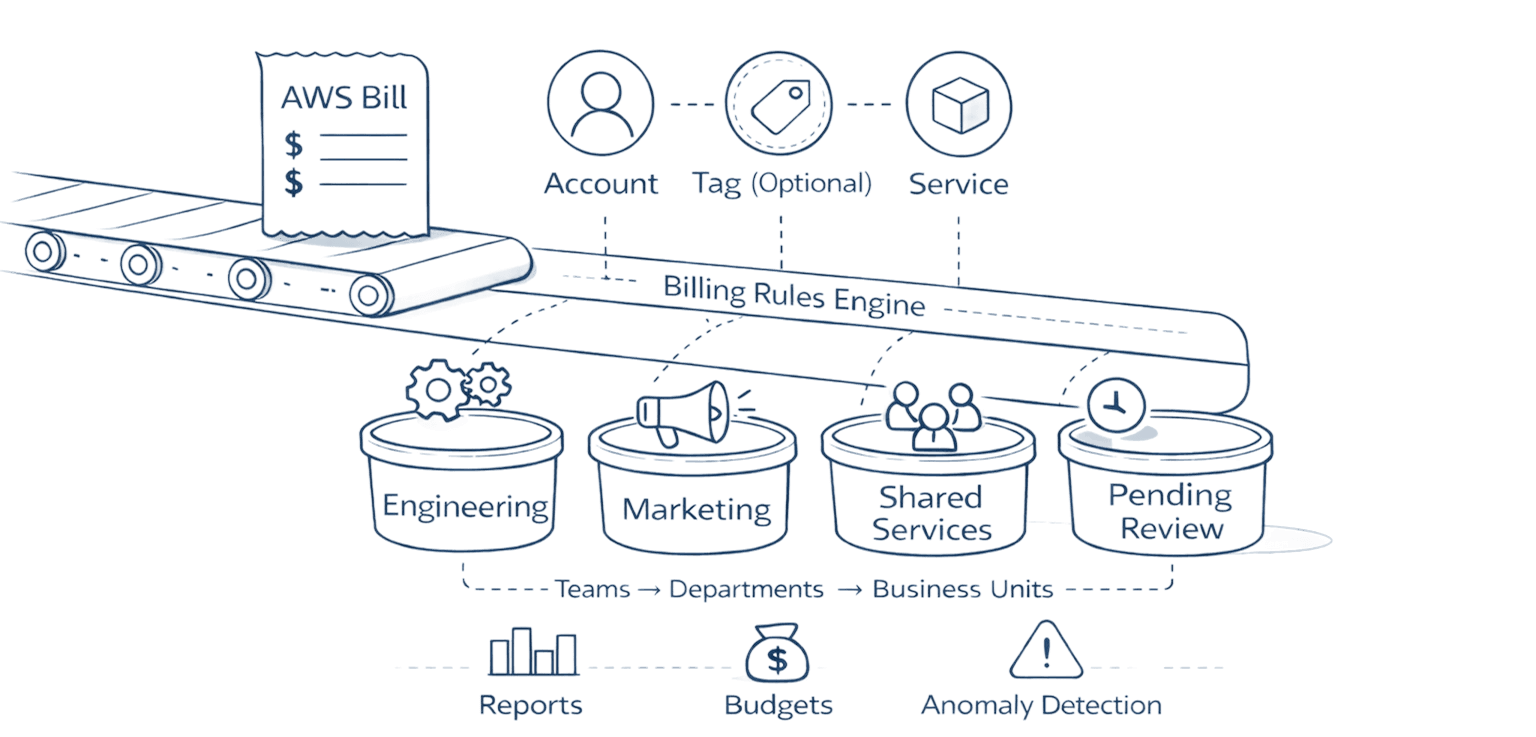
Chargeback capabilities allocate storage costs to teams, products, or projects. Finance teams gain accurate cost attribution. Engineering teams see their actual consumption and optimization impact.
Budget Guardrails prevent overruns through proactive alerts. Set monthly limits by department, receive warnings at 75% utilization, and get notified when teams approach budgets. This eliminates surprise bills from uncontrolled storage growth.
For organizations evaluating s3 alternatives, Opsolute's Infra Cost Estimator models total cost of ownership before migration.
The unified Resource Inventory tracks storage assets across all clouds with tag-based organization. Filter by provider, account, region, or custom tags. Identify untagged resources driving unallocated spend. Enable data-driven decisions about optimal storage placement for different data types.
Frequently Asked Questions
Q: What is the cheapest alternative to AWS S3?
Wasabi and Backblaze B2 offer the lowest pricing at approximately $6/TB monthly compared to S3's $23/TB. However, total cost depends on egress patterns. Cloudflare R2's zero egress fees may prove cheaper for high-traffic workloads despite slightly higher storage costs at $15/TB.
Q: Are S3 alternatives truly S3-compatible?
All featured alternatives support core S3 API operations (PUT, GET, DELETE, LIST), enabling seamless migration with existing SDKs and tools. However, advanced features like S3 Select, Intelligent-Tiering, or specific lifecycle policies may have limited support. Always test compatibility with your specific use cases before migration.
Q: How long does migration from S3 to alternatives take?
Migration timeline depends on data volume and transfer bandwidth. For 10TB of data, expect 2-4 weeks including testing. Larger datasets (100TB+) require 6-8 weeks. Most providers offer migration tools or API-based transfer services. Start with non-critical archival data to validate the process before moving production workloads.
Q: Will switching from S3 affect application performance?
Performance remains comparable for most alternatives, with some like Wasabi and MinIO offering better throughput for specific workloads. Key factors include geographic proximity to users, CDN integration, and network path optimization. Always benchmark performance with actual access patterns during testing.
Q: Can I use multiple storage providers simultaneously?
Yes. Multi-cloud storage strategies reduce vendor lock-in and optimize costs by routing different data types to appropriate providers based on access patterns. Store hot data in Cloudflare R2 for zero-egress content delivery while archiving cold data in Backblaze B2. Cloud management platforms like Opsolute provide unified visibility across providers.
Q: How do egress fees impact total storage costs?
Egress fees often exceed storage costs for high-traffic applications. S3 charges $0.09/GB for the first 10TB monthly, meaning 5TB egress costs $450 versus $0 on Cloudflare R2 or Wasabi. For typical workloads with 20-30% monthly egress, zero-egress providers save 40-60% on total storage costs.
Q: Is MinIO suitable for production workloads?
MinIO powers production workloads at Fortune 500 companies including Intel, Verizon, and Home Depot. The open-source version handles petabyte-scale deployments, while enterprise subscriptions provide 24x7 support, security patches, and performance optimization. Best suited for organizations with Kubernetes expertise and infrastructure management capabilities.
Make the Switch to Cost-Effective Storage
AWS S3 alternatives deliver proven reliability, S3 compatibility, and significant cost savings. Organizations reduce storage expenses by 40-80% through transparent pricing models and zero egress fees.
Your next steps:
Calculate current costs: Track S3 spending across storage, egress, and API requests for 3 months
Identify workload characteristics: Determine access patterns (hot/warm/cold) and egress volumes
Test alternatives: Start with cold data migration to validate compatibility and performance
Model total costs: Use tools like Opsolute's Infra Cost Estimator for accurate TCO projections
Execute phased migration: Follow the four-phase approach for production workloads
The storage landscape has matured beyond AWS dominance. Proven alternatives deliver enterprise-grade reliability at fraction of S3 costs. Your organization's data deserves optimal storage strategy aligned with actual requirements.
Schedule a free cloud cost optimization consultation with Opsolute to analyze your current S3 spend and identify migration opportunities tailored to your workloads.