Introduction
Each month, your organization is likely wasting nearly a third of its cloud budget on unused infrastructure, overallocated instances, and forgotten test environments. With global cloud spend on the cusp of breaking the $1 trillion mark in 2026, this waste is an absolute cost strain on most organizations, and their CFOs can’t turn a blind eye any longer. Cloud spend governance has become less of an aspirational goal and more of an absolute necessity, providing the mechanism by which organizations can rein in costs without introducing bottlenecks in engineering processes, which havehistoricallymade thecloudso attractive in the first place.
Key Highlights
Businesses waste 28-35% of their annual cloud budgets due to resources being spent on idleness, wrong configuration, or a lack of proper visibility.
Global cloud spending reached $840 billion in 2026, while a total of 88% of all enterprises are now operating across multi-cloud environments.
Structured cloud cost governance programs deliver 25-30% spending reductions within 90 days of implementation.
Only 23% of the organizations consider themselves "highly efficient" at managing cloud costs, even though 65% implement FinOps practices.
Automated governance frameworks reduce manual overhead while enforcing financial discipline in real time using policies.
The $1 Trillion Problem: Why Cloud Cost Governance Became Non-Negotiable
The numbers tell a stark story. Cloud spending hit $840 billion globally in 2026, marking a 21% year-over-year increase that shows no signs of slowing. But here's the uncomfortable reality: baseline waste across enterprises ranges between 28-35% of total cloud spend depending on governance maturity. For an organization spending $10 million annually, that's $3 million evaporating into digital thin air.
This isn't just an IT problem anymore. With 48% of organizations citing rising cloud costs as their top management challenge, governance has become a board-level priority. CFOs are demanding visibility. Investors are scrutinizing burn rates. The wild west days of unlimited cloud provisioning are over.
What changed? Three forces converged. First, 88% of organizations now operate in hybrid or multi-cloud environments, with 81% running critical workloads across two or more providers. Second, cloud complexity exploded as teams adopted containers, serverless architectures, and AI workloads that consume resources at unprecedented scales. Third, self-service provisioning became the norm, with hundreds of engineers spinning up infrastructure without central oversight or cost awareness.
The result is a governance gap that's bleeding companies dry.
What Cloud Cost Governance Actually Means (And What It Doesn't)
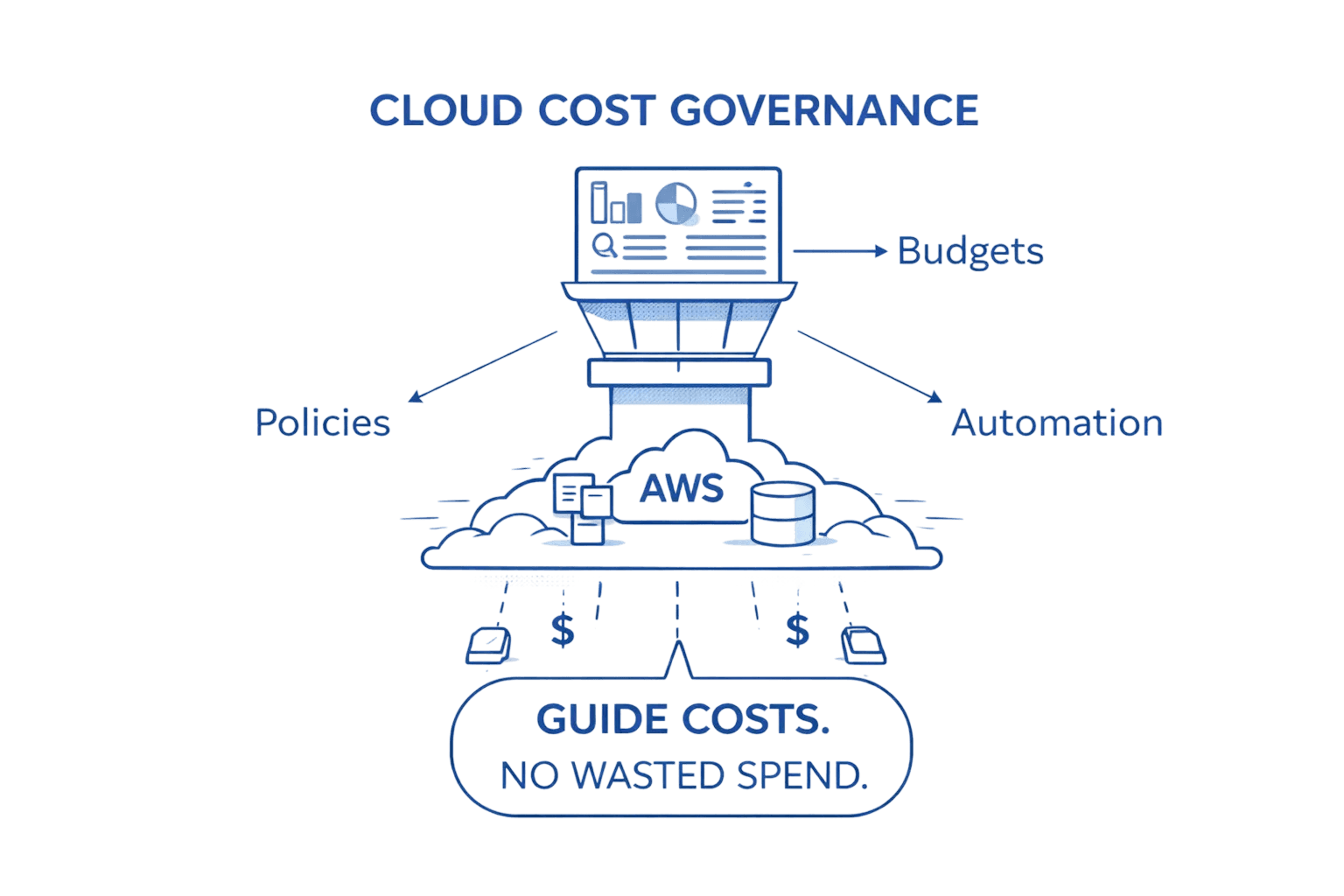
Cloud cost governance is the strategic framework that manages spending through policies, monitoring, and optimization while enabling teams to work with speed and autonomy. It's not traditional IT governance with endless approval chains. It's not simple cost-cutting that blocks innovation. And it's definitely not just installing a dashboard and hoping for the best.
Think of governance as the operating system for cloud financial management. It defines who can provision what resources, under what conditions, with what budget constraints, and with which accountability mechanisms in place. When done right, it's invisible to teams moving fast while preventing the financial chaos that uncontrolled growth creates.
The distinction matters. Cost optimization is tactical work that happens daily to reduce waste and improve efficiency through rightsizing, reserved instances, and workload placement. Cloud cost governance is the strategic layer above it that creates the policies, processes, and organizational structures that make optimization sustainable over time.
Companies confuse the two at their peril. You can optimize costs today and watch them balloon next month without governance. You can implement governance policies that become shelf-ware without optimization execution. Both must work together.
The Perfect Storm: Three Forces Driving Governance Adoption
Digital transformation accelerated dramatically through 2024-2025, with 90% of new workloads now deploying on cloud infrastructure. Companies that spent years planning migrations suddenly found themselves cloud-first or cloud-only. The velocity created unprecedented spending growth that budgets struggled to accommodate.
Multi-cloud complexity became the new normal. With 89% of enterprises using multiple cloud providers and averaging 2.4 providers per organization, teams are juggling different pricing models, service taxonomies, and optimization strategies across AWS, Azure, and GCP. Each platform operates differently, making centralized cost control exponentially harder.
Decentralized provisioning is now the standard operating model. Engineering teams expect self-service infrastructure with minimal friction. They don't want to wait weeks for approvals or navigate byzantine procurement processes. But this autonomy without guardrails creates the perfect conditions for runaway spending.
These three forces explain why dedicated FinOps teams and formal governance programs went from rare to required. Organizations realized they couldn't scale cloud usage sustainably without fundamentally changing how they manage costs.
The Four Pillars of Effective Cloud Cost Governance
Every successful governance framework rests on four foundational pillars that work together to create financial discipline without sacrificing agility.
Visibility forms the foundation. You can't govern what you can't see. This means real-time dashboards showing spending across all clouds, unified cost and usage data through specifications like FOCUS, and granular attribution down to the team or project level. Tag coverage becomes critical here. Organizations with consistent tagging report 40% better cost allocation compared to those with fragmented metadata.
Accountability creates ownership. Chargeback and showback models assign costs to the teams consuming resources, transforming cloud spending from an abstract IT line item to a concrete team budget. When engineering teams see their monthly bills and understand the financial impact of their architectural decisions, behavior changes. Smart organizations implement showback first to build awareness before moving to hard chargeback that impacts departmental P&Ls.
Optimization delivers results. This pillar encompasses everything from automated rightsizing recommendations to reserved instance planning and spot instance migration. The key is automation. Manual optimization doesn't scale. AI-driven anomaly detection catches spending spikes within 24 hours instead of discovering them at month-end. Continuous optimization programs report sustained 20-30% spending reductions compared to one-time cleanup efforts that decay over months.
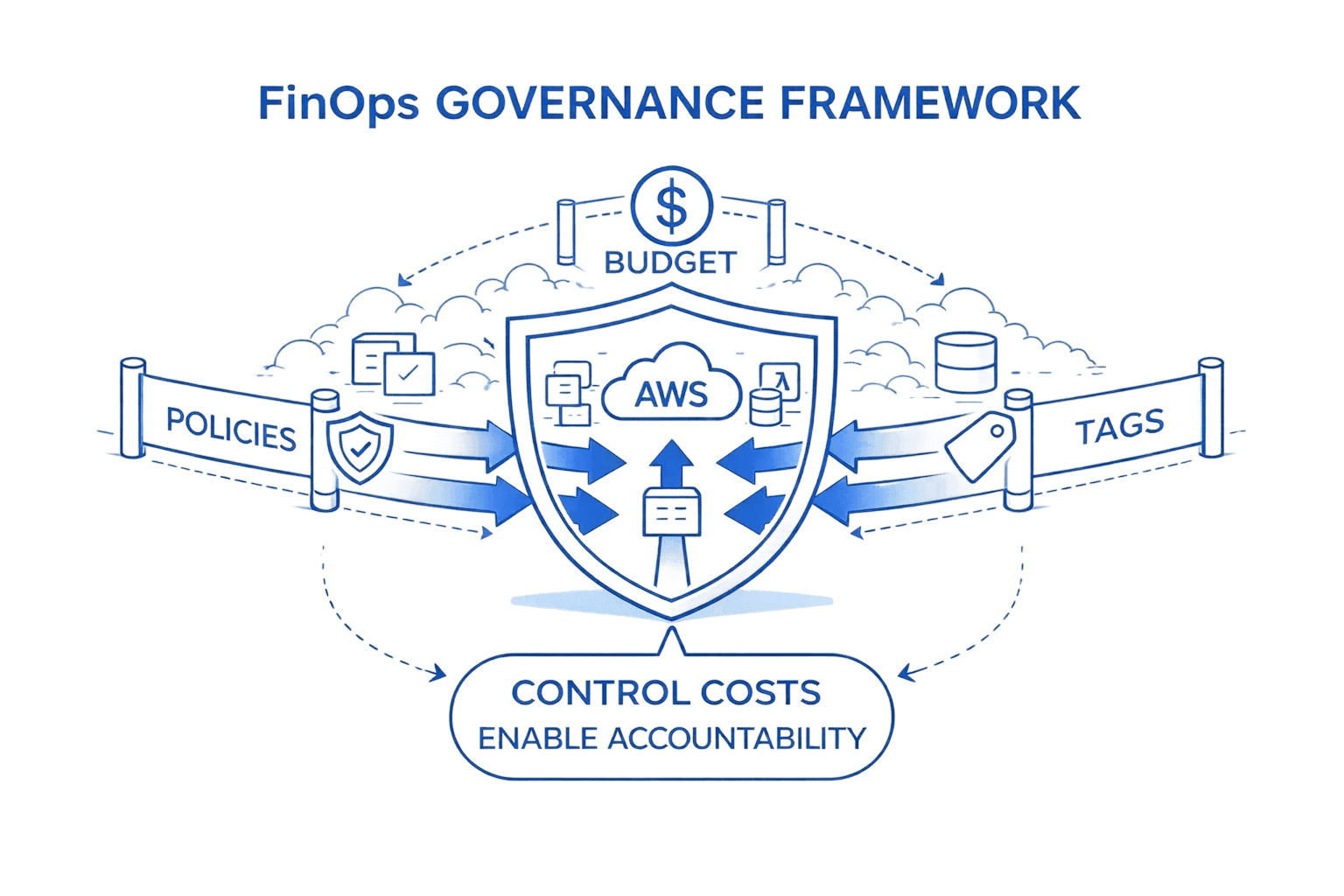
Policy enforcement maintains discipline. Budget guardrails prevent teams from exceeding allocations. Automated policies block provisioning of unapproved instance types or regions. Pre-deployment cost estimation shows teams the financial impact before resources go live. The best policies are invisible until violated, enabling speed while preventing chaos.
Building Your Governance Framework: A Practical Implementation Roadmap
Implementation follows a proven sequence that builds capability progressively while delivering quick wins that sustain executive support.
Start with cost allocation fundamentals. Implement comprehensive tagging standards across all clouds using hierarchical structures that map to your organizational model. Application, environment, team, and cost center tags provide the minimum viable metadata for attribution. Don't overcomplicate this. Five consistent tags beat 20 inconsistent ones.
Establish baseline visibility through unified dashboards that show spending across providers in a single pane of glass. Connect this to your financial systems so cloud costs appear in standard management reporting. Finance teams need to see cloud spending in their language, not cloud provider billing formats.
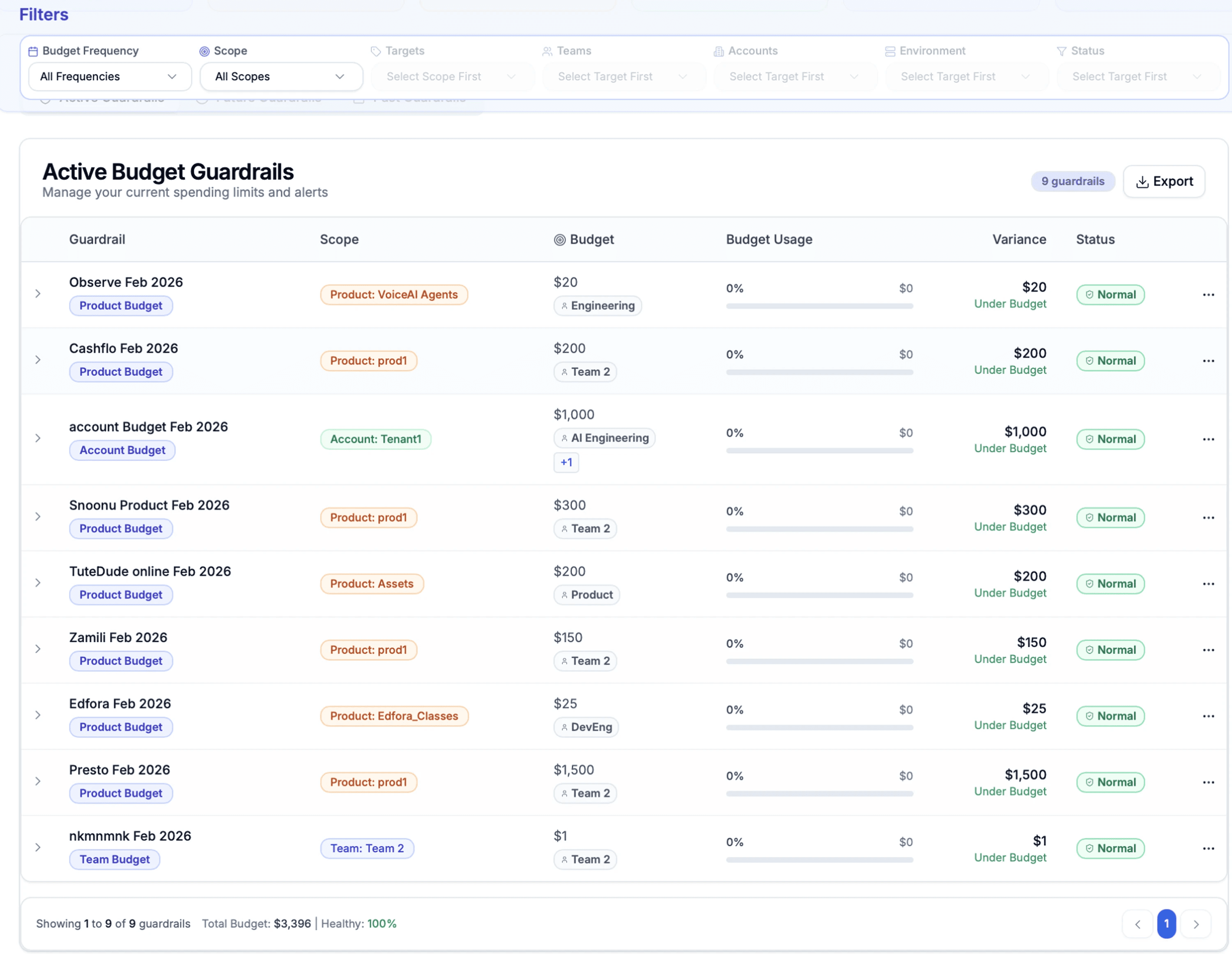
Define budget guardrails at appropriate granularity levels. Department-level budgets work for some organizations. Team-level or even project-level budgets suit others. The right answer depends on your organizational structure and decision-making model. Configure alerts at 70%, 85%, and 100% of budget to catch overruns before they happen.
Build your FinOps team deliberately. Organizations at governance maturity typically maintain dedicated teams reporting to CFOs or CTOs depending on whether financial control or technical enablement drives cloud strategy. Start small. A FinOps lead plus two analysts can support organizations spending up to $20 million annually before requiring expansion.
Deploy automated optimization continuously. Schedule scans for idle resources, rightsizing opportunities, and commitment coverage gaps. Configure automated actions for low-risk optimizations like deleting unused snapshots while flagging high-impact changes for human review. The goal is 80% automation of routine optimization work.
Automation and AI: The New Governance Enablers
Cloud cost governance in 2026 looks fundamentally different than it did even two years ago, thanks to AI and automation capabilities that transform reactive reporting into proactive control.
Anomaly detection systems now analyze spending patterns across thousands of resources and services, identifying unusual spikes within hours. When a development team accidentally provisions 100 instances instead of 10, alerts fire immediately instead of waiting for the monthly bill. Organizations using AI-driven anomaly detection report 60% faster incident response compared to manual monitoring.
Predictive cost modeling takes historical usage data and forecasts future spending with increasing accuracy. These models account for seasonal patterns, growth trends, and planned infrastructure changes to generate forecasts that inform budget planning. The best systems update predictions daily as new usage data arrives, maintaining accuracy as conditions evolve.
Automated rightsizing recommendations analyze weeks of performance metrics to suggest optimal instance types and sizes. Instead of engineers manually reviewing CloudWatch metrics, ML algorithms identify over-provisioned resources and calculate precise savings. One-click implementation of these recommendations removes friction that previously delayed optimization.
The impact is measurable. Organizations using automated governance tools report 75% reduction in time spent on cost management tasks while achieving better financial outcomes than manual approaches delivered.
Common Governance Pitfalls and How to Avoid Them
Even well-intentioned governance programs fail when they hit predictable obstacles.
Policy drift happens when governance rules become outdated but aren't updated to reflect organizational changes. Merger and acquisition activity, new cloud services, or strategic pivots all require governance model adjustments. Quarterly reviews of policies prevent drift from undermining frameworks.
Inconsistent tagging breaks cost attribution and makes chargeback impossible. When only 40% of resources carry proper tags, you can't accurately allocate 60% of spending. This destroys accountability. Automated tag enforcement at provisioning time solves this by preventing untagged resources from being created.
Overly restrictive controls create shadow IT as teams route around governance to move fast. The best frameworks enable speed through automation rather than blocking it through manual approvals. Pre-approved instance types, automated budget checks, and self-service provisioning within guardrails prevent the friction that drives teams to circumvent controls.
Lack of ownership metadata means nobody feels responsible when costs balloon. Tag every resource with an owner, team, and environment. Make ownership visible in dashboards and reports. Create accountability loops where teams review their spending monthly and explain variances.
Measuring Success: KPIs That Matter for Cloud Governance
Effective governance programs track metrics that demonstrate financial discipline and organizational maturity.
Cloud waste percentage measures the proportion of spending on idle, over-provisioned, or unnecessary resources. Organizations with mature governance typically achieve 15-20% waste compared to 32-35% industry baseline. Tracking this monthly shows whether optimization efforts are working or backsliding.
Budget adherence rate tracks how often teams stay within allocated budgets. Target 90%+ adherence across teams as governance matures. Lower rates indicate either unrealistic budgets or ineffective enforcement.
Savings plan coverage shows the percentage of eligible compute spend covered by reserved instances or savings plans. Higher coverage translates directly to lower unit costs. Mature organizations maintain 70-85% coverage for stable workloads.
Time to optimization measures how quickly teams implement cost-saving recommendations. The gap between identification and execution reveals organizational friction. Automated implementation should handle routine optimizations within 24 hours.
Tag coverage percentage tracks metadata completeness across resources. Target 95%+ tag coverage on key cost allocation tags. Anything less makes accurate chargeback impossible.
Platform Solutions: Enabling Governance at Scale with Opsolute
Doing all the manually-intensive work involved with total cloud cost governance across multiple cloud environments is a challenge that small teams are unable to handle. This is something that cloud platforms created for specialized purposes are designed to eliminate while still providing cloud visibility.
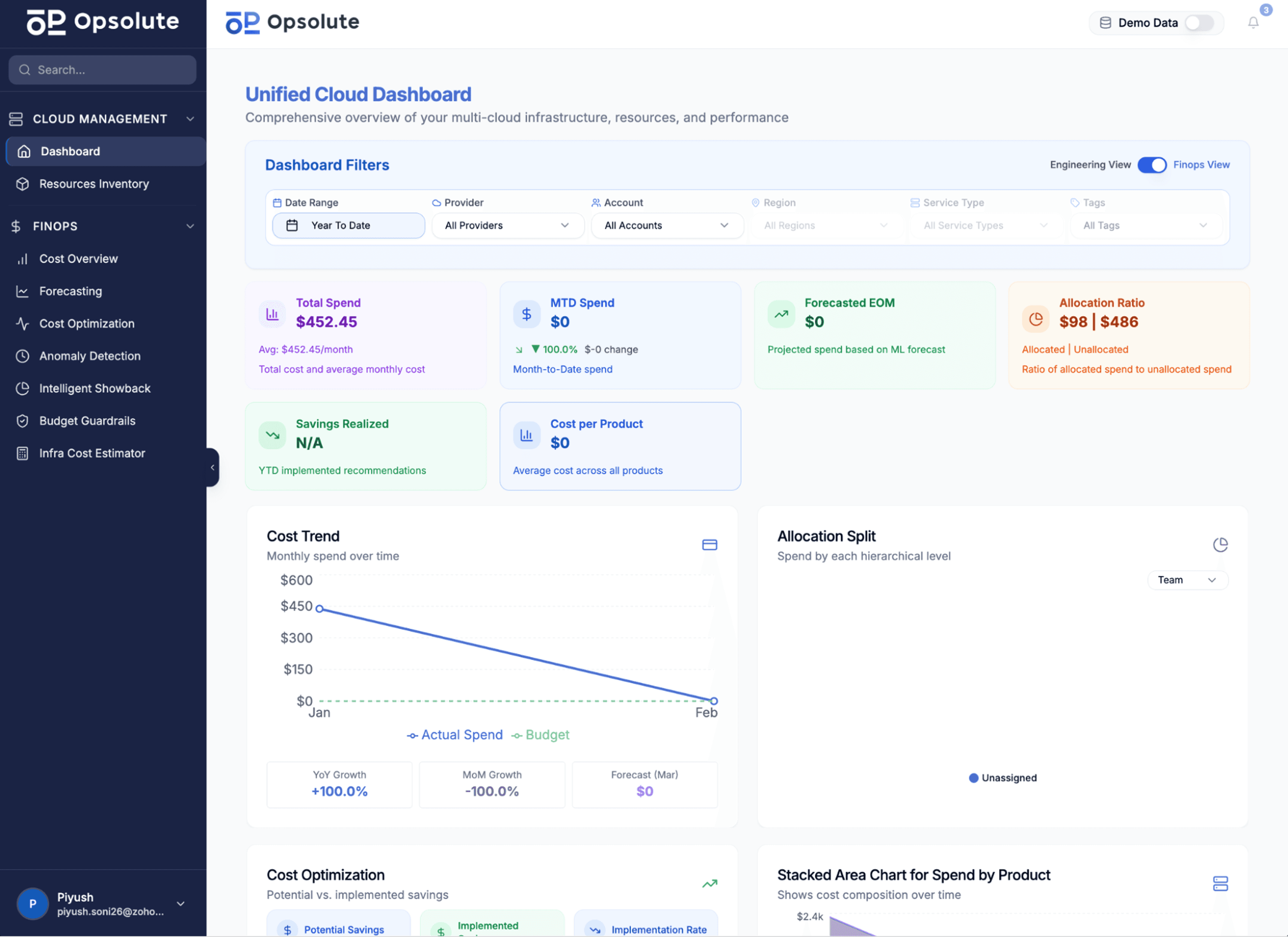
The cloud management platform provided by Opsolute allows for streamlined governance across cloud platforms such as AWS and GCP through a single dashboard that helps alleviate the problem associated with cloud management by eliminating tool sprawl for multi-cloud environments. It also allows for cost analysis through a dashboard that enables finance and technical teams to make informed decisions.
Budget guardrails provide proactive enforcement of spending limits with alerts that are configurable at the team, environment, or account level. This provides teams with early warnings when nearing thresholds, avoiding budget overruns that derail planning. It will then monitor budgets in flight, burn rates, and utilization patterns to predict a breach before it occurs.
Intelligent showback and chargeback capabilities leverage automation of cost allocation via hierarchical attribution models, which map cloud spending to organizational structures. The platform manages cross-entity adjustments, tracks claimed versus unclaimed savings, and provides complete audit trails of who reallocated what costs when. All this makes accountability transition from aspiration to operational reality.
“Anomaly detection consistently monitors spending behavior and points to unusually high increases in severity levels.” If an unexpected surge in spending does occur, this system locates the root cause and determines its effect, then notifies relevant teams in a timely manner to take necessary actions. This helps reveal billing surprises in a span of 24 hours rather than at the end of a month.
Forecasts are enriched with information about the spending habits for the next month based on trends. Budget comparison capabilities allow for the identification of differences between budgeted spending and spending that is forecasted. Resource-level forecasts have the depth necessary for prioritization at the resource or account levels.
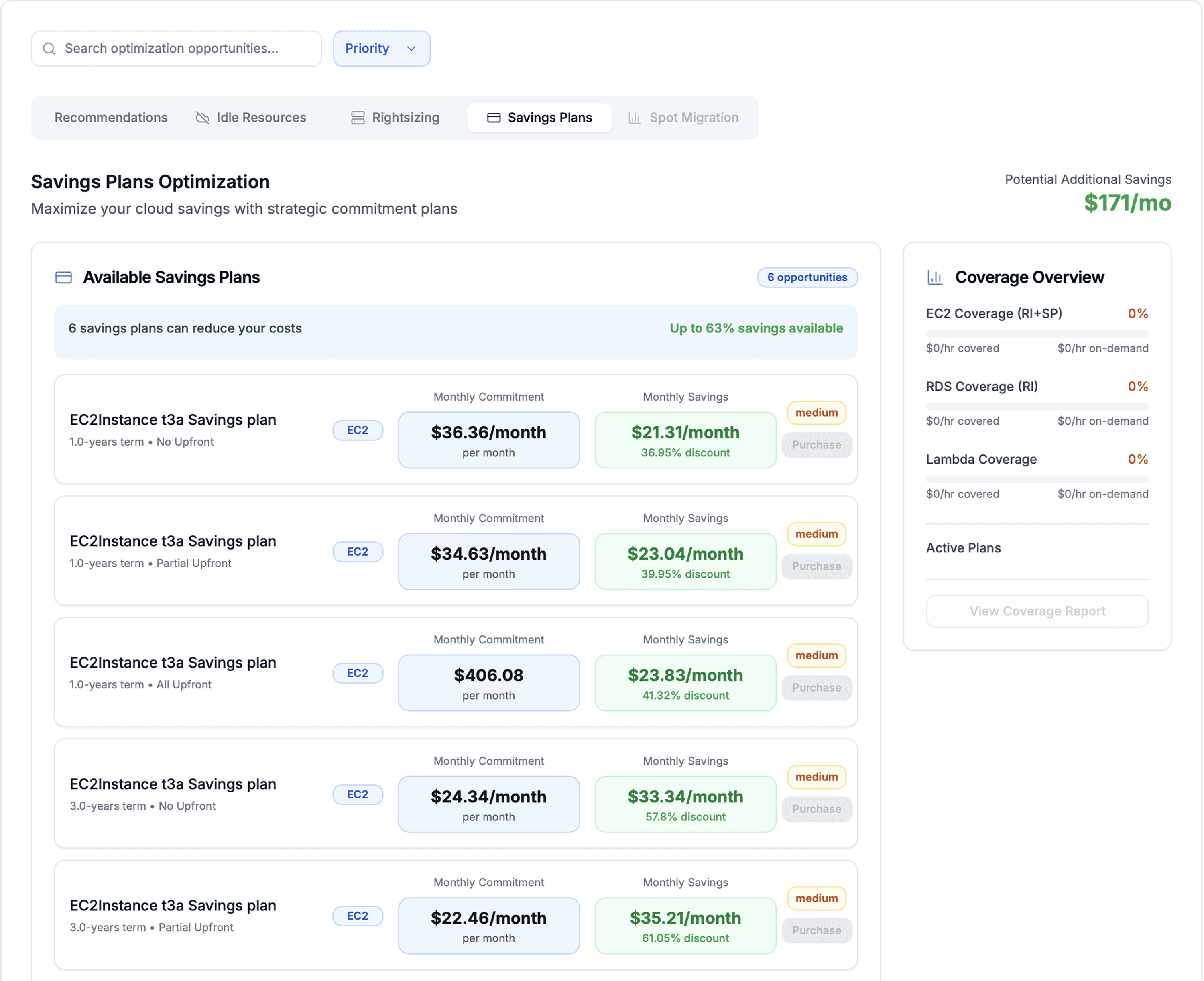
The cost optimization hub integrates all recommendations from detecting idle resources, rightsizing, savings plans, and spot migration recommendations. Savings values for estimated costs are presented as monthly and yearly impact value for a recommendation. One-click actions allow for quick execution of approved optimization suggestions.
Through the integration of automation with visibility, products such as Opsolute help make cloud cost governance really complicated for organizations that cannot build such competencies in house. Such an outcome brings about financial discipline that scales with the use of cloud rather than creating bottlenecks in innovations.
Ready to transform cloud cost governance from aspiration to operational reality? Schedule a demo to see how Opsolute's platform delivers automated governance, real-time visibility, and measurable cost reductions across your multi-cloud environment.
Frequently Asked Questions (FAQ)
Q: What is cloud cost governance?
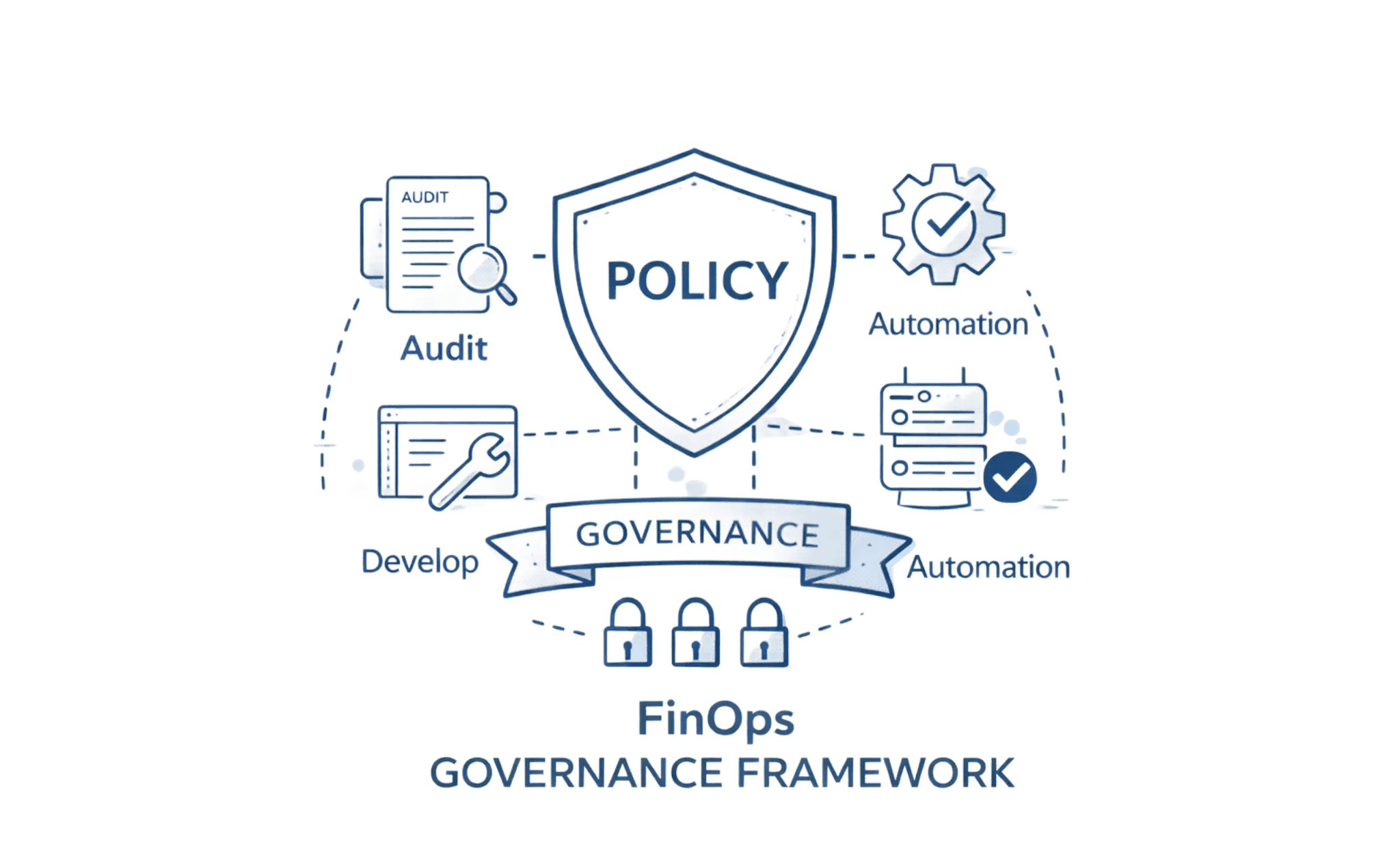
A: Cloud cost governance is the strategic framework of policies, monitoring, and automation that controls cloud spending while preserving engineering speed. It rests on four pillars: visibility (real-time spend dashboards), accountability (chargeback/showback), optimization (rightsizing, automation), and policy enforcement (budget guardrails). Unlike ad-hoc cost-cutting, governance is a continuous operating layer, not a one-time cleanup.
Q: What is a cloud cost governance framework?
A: A cloud cost governance framework is the documented set of policies, ownership rules, and automated controls that turns governance from an aspiration into an operating process. It typically defines who can provision what resources, under which budget constraints, with what tagging requirements, and which automated actions trigger when a policy is violated.
Q: What are the best practices for cloud spend governance?
A: The core best practices are: enforce tagging at provisioning time rather than after the fact, set budget alerts at 70/85/100% thresholds instead of waiting for month-end, assign every resource an explicit owner, and automate the routine 80% of optimization actions so governance doesn't rely on manual review to function.
Q: How much does cloud cost governance software typically cost?
A: Pricing for cloud cost governance platforms is usually tied to managed cloud spend under management (a percentage of spend, often 1-3%) or a flat platform fee by company size, rather than per-seat licensing. Most platforms offer a free assessment or pilot period before committing to a contract, since the ROI case depends on the waste percentage found in your specific environment.