Introduction
Organizations waste approximately 30% of their cloud budgets. That's $200 billion annually disappearing into idle instances, overprovisioned infrastructure, and resources nobody remembers spinning up. While cloud spending hit $723 billion in 2025, only 38.2% of organizations have progressed beyond basic FinOps practices.
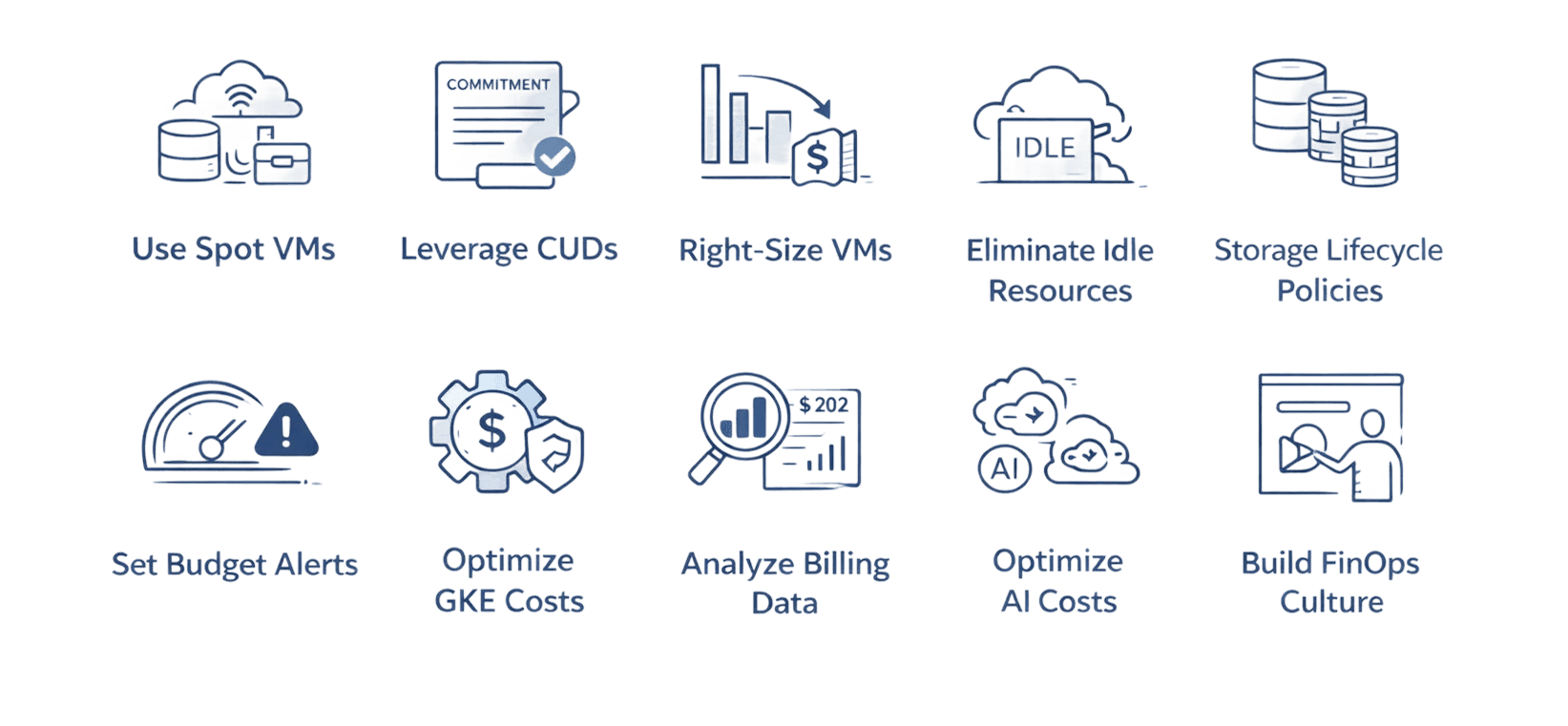
The gap isn't about technology. Teams have the tools. They lack the frameworks to use them effectively. These eight proven strategies separate efficient operations from costly chaos, helping you gain control of cloud spending while maintaining the agility your business demands.
Key Takeaways
50% of FinOps practitioners identify waste reduction as their top priority in 2026
Effective tagging strategies enable cost allocation with 90%+ accuracy
Rightsizing recommendations cut compute costs by 30-50% when properly implemented
Commitment-based discounts deliver up to 72% savings versus On-Demand pricing
AI-powered anomaly detection prevents budget surprises by flagging spikes within hours
Automated governance enables decentralized decisions without sacrificing financial control
Establish Real-Time Visibility Across Your Cloud Environment
You can't optimize what you can't see. Most organizations discover their cloud costs after monthly billing cycles close, which is too late to prevent waste. Real-time visibility transforms reactive cost management into proactive optimization.
Start with unified dashboards that aggregate spending across AWS, Azure, and GCP. Your FinOps team needs to answer basic questions instantly: Which services consumed the most resources yesterday? What drove the 40% spike in storage costs last week? Which team owns that mystery $15,000 monthly charge?
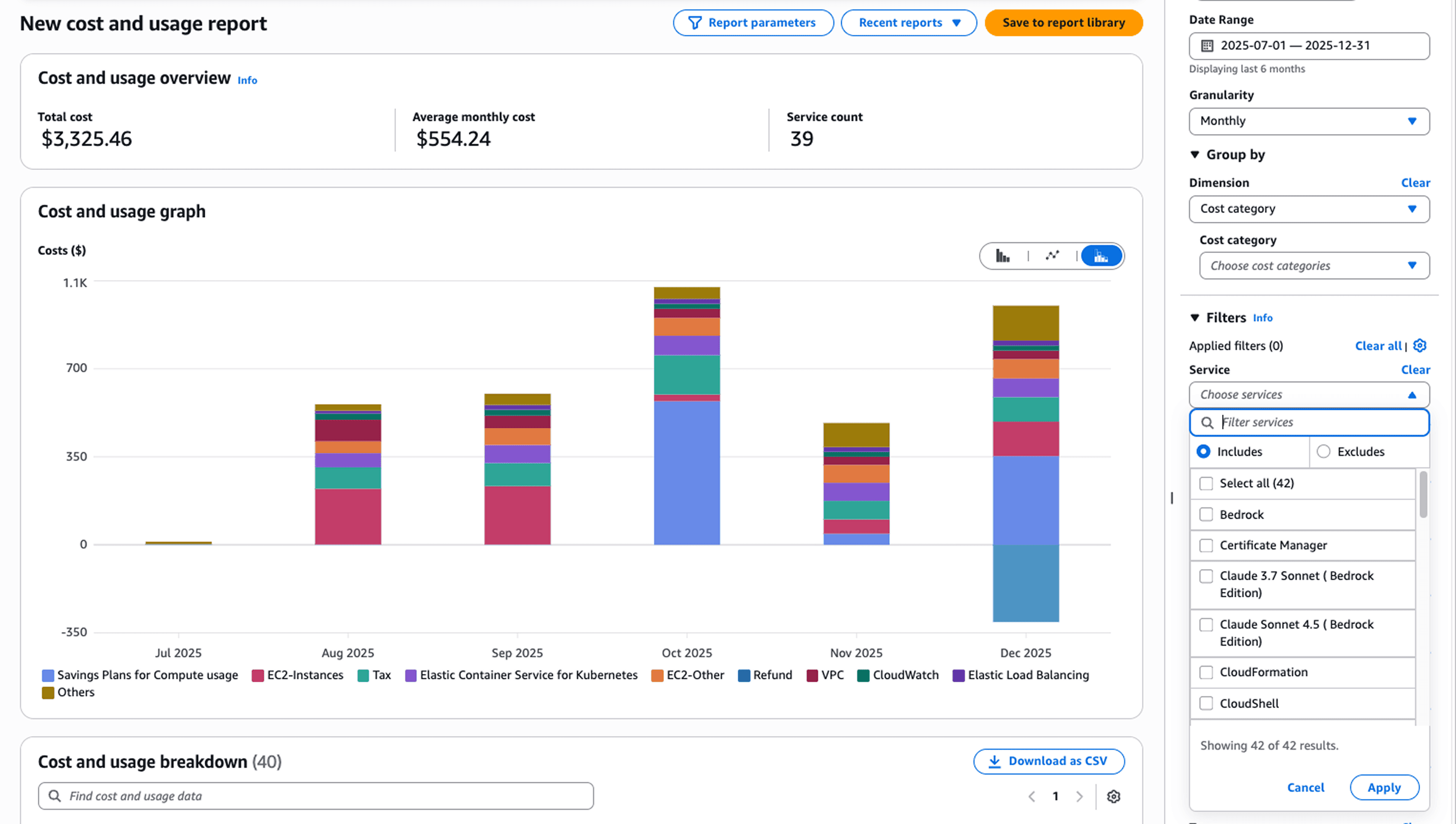
Native cloud tools provide starting points. AWS Cost Explorer, Azure Cost Management, and Google Cloud Billing offer high-level insights. But they fall short when you need granular attribution. Dedicated FinOps platforms consolidate multi-cloud data, map spending to business units, and highlight trends native tools miss.
The critical metric is cost allocation accuracy. Organizations achieving 90%+ allocation clarity make informed decisions. Those below 70% guess which projects justify investment.
Visibility Requirements by Maturity Level
Maturity | Response Time | Allocation Accuracy | Typical Tools |
Crawl | Weekly reviews | 40-60% allocated | Native cloud tools only |
Walk | Daily reviews | 70-85% allocated | Native + third-party dashboards |
Run | Real-time monitoring | 90%+ allocated | Unified FinOps platforms |
Build visibility into daily operations. Engineering teams should see cost impacts before deploying resources. Finance teams need forecasts that account for upcoming launches. When everyone understands cloud economics, optimization becomes collaborative rather than adversarial.
Implement Strategic Tagging for Accurate Cost Allocation
Tagging transforms undifferentiated cloud spending into actionable financial intelligence. Without tags, you know your AWS bill is $500,000 monthly. With proper tagging, you know the mobile app costs $180,000, the data pipeline runs $220,000, and someone forgot to shut down $100,000 in test environments.
Organizations achieving FinOps maturity maintain 90%+ tagging compliance. They enforce mandatory tags at resource creation, not as suggestions, but as deployment blockers. A virtual machine without cost center, environment, and owner tags simply won't launch.
Start with four essential tags. Cost center identifies which budget absorbs expenses. Environment separates production from development and testing. Owner assigns accountability to specific teams or individuals. Application groups related resources supporting the same business function.
The real challenge isn't defining tags. It's maintaining compliance as infrastructure scales. Manual tagging fails because developers forget, automation scripts omit tags, and IaC templates use outdated conventions. Within months, compliance drops from 90% to 40%.
Automation solves this. Tag policies trigger at resource creation, applying defaults based on account, region, or subnet. Tag recommenders analyze existing resources and suggest appropriate values. This maintains high compliance rates without manual intervention.
Consider showback and chargeback early. Showback displays costs without financial transfers, building awareness. Chargeback actually bills teams for consumption. Most organizations start with showback to build awareness, then transition to chargeback as financial accountability matures.
Master Rightsizing for Optimal Resource Efficiency
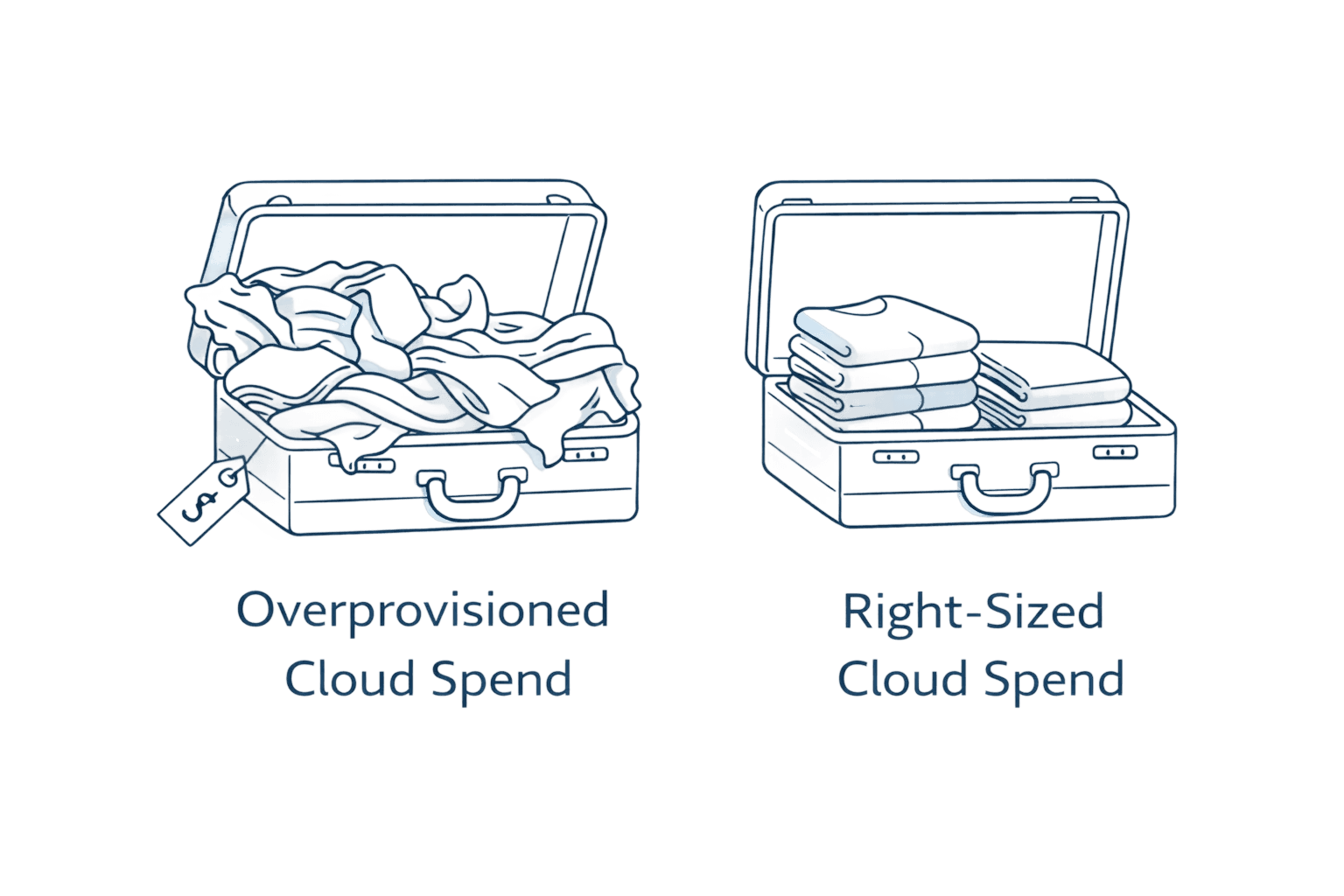
Kubernetes clusters average 10% CPU utilization. Database instances run at 15% capacity. Storage volumes sit 70% empty. This isn't poor planning but over-provisioning as insurance against performance degradation.
Rightsizing matches resource capacity to actual workload requirements. The practice cuts compute costs by 30-50% when implemented systematically. But it requires moving beyond simple CPU metrics to comprehensive utilization analysis.
Monitor four dimensions simultaneously. CPU usage reveals compute efficiency. Memory utilization identifies RAM waste. Network throughput exposes bandwidth over-provisioning. Storage I/O patterns show whether expensive high-performance volumes deliver value.
Seasonal patterns complicate rightsizing. An e-commerce platform peaks during November and December, then drops 60% in January. Rightsizing to January traffic causes November outages. The solution combines baseline sizing with auto-scaling for peaks.
Start with development and testing environments. They rarely need production-level performance. A development database running on a $500/month instance works identically on a $150/month instance. Multiply that across 50 environments and savings exceed $200,000 annually.
Production rightsizing requires caution. The sweet spot analyzes 30-60 days of metrics, accounts for seasonal peaks, and implements changes progressively.
Rightsizing Best Practice: Change 10% of resources, monitor for 48 hours, then proceed. Gradual rollouts catch issues before they impact customers.
AI-powered rightsizing improves over time. Early recommendations rely on basic utilization averages. As systems collect data, machine learning identifies patterns human analysts miss. Confidence scoring helps prioritize actions, with high-confidence recommendations implementing automatically while medium-confidence ones require human review.
Optimize Commitment-Based Discounts Strategically
On-Demand pricing offers flexibility at premium cost. Savings Plans and Reserved Instances deliver up to 72% discounts by committing to consistent usage. Organizations waste billions annually because they either over-commit to capacity they don't use or under-commit leaving savings on the table.
Commitment Discount Comparison
Discount Type | Flexibility | Discount Level | Best For |
On-Demand | Full flexibility | 0% (baseline) | Variable workloads, testing |
1-Year RI (No Upfront) | Limited | 30-40% | Moderately predictable usage |
3-Year RI (All Upfront) | Locked | 60-72% | Stable, multi-year workloads |
Compute Savings Plan | High flexibility | 40-55% | Dynamic multi-service usage |
EC2 Instance Savings Plan | Medium flexibility | 50-65% | Consistent instance families |
Start conservative. Analyze baseline usage over 60 days, excluding temporary spikes and planned migrations. Focus on 24/7 workloads unlikely to change. Production databases, authentication services, and core APIs make excellent commitment candidates.
Commit to 60-70% of baseline usage initially. This prevents over-commitment if workloads shift while capturing meaningful savings. As confidence grows, increase commitments incrementally.
Compute Savings Plans offer the best flexibility for dynamic environments. They discount any compute usage (EC2, Fargate, Lambda) across any region or instance type. You maintain operational flexibility while securing discounts.
Avoid commitment waste through automated management. Monitor utilization rates weekly. Commitments running below 85% utilization waste money because you're paying for capacity you don't use. Commitments exceeding 95% utilization leave savings on the table as additional workloads run at On-Demand prices.
Deploy AI-Powered Anomaly Detection and Alerting
Manual cost reviews discover problems after they've inflated monthly bills. By the time finance flags a $40,000 overage, engineering teams spent three weeks troubleshooting the wrong services. AI-powered anomaly detection catches spending spikes within hours, not weeks.
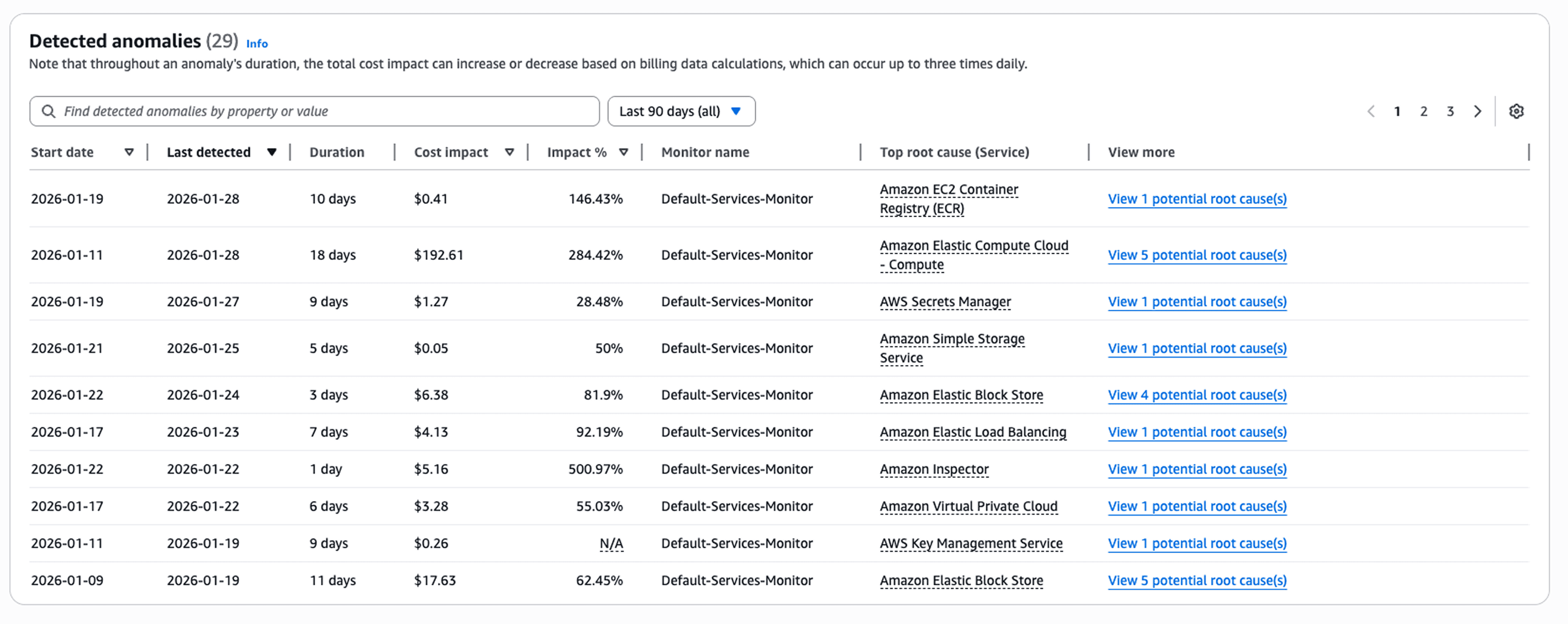
Traditional alerting uses static thresholds. "Alert when daily spending exceeds $5,000" generates false positives every time traffic increases normally. AI learns baseline patterns, accounting for weekly cycles, seasonal trends, and gradual growth. It flags the unexpected, not the predictable.
Context matters. A 200% spending increase looks identical for a $100 daily service and a $10,000 daily service. But $200 variance rarely justifies urgent investigation while $20,000 variance demands immediate action. Severity classification (critical, high, medium, low) routes alerts appropriately.
Route alerts based on resource tags. Cost center and team tags automatically notify responsible parties. A spike in mobile app infrastructure alerts the mobile team, not the entire engineering organization. Focused alerts get faster responses than broadcast notifications.
Integrate with ticketing systems. High-severity anomalies automatically create Jira or ServiceNow tickets, assign them to appropriate teams, and track resolution. This transforms anomaly detection from reactive fire-fighting into managed incident response.
Critical Alert Configuration: Flag anomalies exceeding 20% of daily baseline in production accounts. Auto-create tickets for amounts over $500. This balance catches meaningful issues without alert fatigue.
AI improves over time. Early implementations generate false positives as models learn normal patterns. After 90 days of training data, accuracy improves dramatically. After six months, the system predicts spending patterns better than humans can.
Establish Budget Guardrails and Governance Frameworks
Budget guardrails prevent surprises without blocking legitimate work. They transform from restrictive controls into enablers of innovation by creating financial boundaries teams navigate confidently.
Set budgets at multiple levels. Enterprise-wide budgets track total cloud spending against IT budget allocations. Business unit budgets ensure marketing, engineering, and product teams operate within allocated resources. Project budgets prevent individual initiatives from consuming disproportionate resources.
Alert at 70%, 85%, and 95% of budget consumption. The 70% alert serves as early warning so teams can adjust spending patterns before limits become constraints. The 85% alert triggers management review to determine whether increased allocation is justified. The 95% alert requires approval for additional spending.
Budget Alert Strategy
Threshold | Action | Owner | Timeframe |
70% consumed | Review spending trends | Team Lead | 48 hours |
85% consumed | Justify continued spending | Director | 24 hours |
95% consumed | Approve additional budget | VP/CFO | Immediate |
Hard limits versus soft limits represents a philosophical choice. Hard limits block resource creation once budgets exhaust, preventing overages entirely. Soft limits alert stakeholders but allow continued provisioning, maintaining operational flexibility while flagging variance.
Most mature FinOps practices use soft limits for production environments and hard limits for development and testing. Production systems shouldn't fail because monthly budgets exhaust. Development environments shouldn't consume unlimited resources without accountability.
Policy-as-code automates enforcement. Terraform policies can block deployment of expensive instance types in non-production accounts. AWS Service Control Policies prevent teams from launching resources in unauthorized regions.
Foster Cross-Functional Collaboration and Shared Responsibility
FinOps succeeds or fails based on culture, not technology. Organizations with sophisticated tools but siloed teams waste as much as those with basic tools and collaborative cultures. The difference is shared responsibility for cloud costs.
Traditional IT operations separated financial accountability (finance owns budgets) from technical decisions (engineering provisions resources). Cloud collapses this separation because engineers make thousand-dollar decisions dozens of times daily. Finance can't review every deployment. Engineers need financial context to make cost-effective choices.
Establish a centralized FinOps team reporting to both CTO and CFO. This positioning signals that cloud financial management bridges technology and business objectives. The team includes cloud engineers who understand technical architecture, financial analysts who track budgets and forecasts, and product managers who align spending with business priorities.
Create shared accountability models where teams own both delivery and cost. Engineering estimates resource requirements before building features. Product managers evaluate feature value against implementation costs. Finance provides pricing data and budget guidance.
Regular cadence drives continuous improvement. Weekly reviews identify spending trends and optimization opportunities. Monthly business reviews align cloud spending with strategic priorities. Quarterly planning sessions set budgets and adjust allocation based on business changes.
Training bridges knowledge gaps. Engineers need to understand cloud economics, which includes how pricing models work, which services cost most, and how architectural decisions impact spending. Finance teams need cloud literacy about what resources do, why costs fluctuate, and which metrics indicate efficiency.
Leverage Automation to Scale FinOps Practices
Manual FinOps processes don't scale. They worked when cloud environments had 50 resources. At 5,000 resources across three cloud providers, manual reviews become impossible. Automation transforms reactive cost management into proactive optimization.
Start with automated tagging compliance. New resources should inherit tags from the VPC, subnet, or account context. If developers must manually tag every resource, compliance drops below 60% within months. Automated tagging maintains 90%+ compliance with zero manual effort.
Schedule resource management automatically. Development environments rarely need to run 24/7. Automated schedules stop non-production instances at 6 PM and restart them at 8 AM. This single practice cuts development infrastructure costs by 60% without affecting productivity.
Implement policy-driven cleanup. Resources untagged for 30 days get flagged for investigation. Instances stopped for 60 days get terminated automatically. Unattached EBS volumes older than 90 days get deleted after owner notification. Automated cleanup prevents forgotten resources from accumulating costs indefinitely.
Commitment management shouldn't require manual spreadsheets tracking utilization rates and expiration dates. Automated systems monitor commitments continuously, alert when utilization drops below 85%, and recommend new purchases when On-Demand usage consistently exceeds 20% of compute spending.
Organizations operating at FinOps "Run" maturity achieve 70%+ automation rates. Tagging runs automatically. Rightsizing recommendations get implemented with minimal human review. Commitment purchases happen based on AI analysis of stable workload patterns. Budget guardrails enforce themselves.
The goal isn't eliminating humans from FinOps. Automation handles repetitive tasks, freeing FinOps teams for strategic work. Instead of manually rightsizing instances, they optimize architectural patterns. Rather than tracking down resource owners, they design better governance frameworks.
Accelerate FinOps Maturity with Unified Platforms
Organizations implementing individual best practices see incremental improvements. Those using unified platforms accelerate from Crawl to Run maturity in minimal time rather than years because integrated capabilities compound.
Unified platforms like Opsolute consolidate cloud management, FinOps, and cost optimization into cohesive workflows, so teams access everything through unified interfaces.
Real-time dashboards provide instant visibility across AWS and GCP environments. The Cost Optimization hub estimates monthly and annual savings potential across multiple categories, detecting idle resources and providing rightsizing recommendations. Anomaly detection with real-time monitoring flags unexpected spending spikes automatically, with severity classification routing critical alerts immediately.
Budget guardrails create financial boundaries without blocking legitimate work, applying multi-dimensional limits at account, environment, and team levels. Intelligent showback and chargeback mechanisms attribute costs hierarchically across business units, teams, and projects. The Infrastructure Cost Estimator helps teams understand expenses before building resources, shifting cost conversations from post-deployment cleanup to pre-deployment planning.
While no platform eliminates the need for FinOps expertise, unified solutions compress maturity timelines significantly. Organizations that would spend 18-24 months building custom dashboards and implementing automation can achieve operational FinOps in just months using integrated platforms.
Frequently Asked Questions About FinOps Best Practices
Q: What is FinOps and why is it important for cloud cost optimization?
A: FinOps (Financial Operations) is a cultural practice that brings together finance, technology, and business teams to manage cloud costs collaboratively. It's essential because cloud spending exceeded $723 billion in 2025, with approximately 30% wasted on idle resources and inefficient architecture. FinOps provides the framework to maximize cloud value while maintaining financial control.
Q: How do I calculate the right commitment level for Reserved Instances or Savings Plans?
A: Analyze your baseline compute usage over 60 days, excluding temporary spikes and planned migrations. Focus on steady-state workloads that run 24/7. Begin conservatively at 60-70% of baseline usage, then incrementally increase as you gain confidence. Use automated commitment management tools to continuously optimize coverage without manual intervention.
Q: What percentage of cloud resources should be tagged for effective cost allocation?
A: Organizations should target 90%+ tagging compliance, accounting for the fact that some cloud resources are inherently untaggable like data transfer and NAT Gateway usage. Start with mandatory tags for high-impact categories including environment, cost center, owner, and project. Use policy enforcement at resource creation to prevent untagged deployments.
Q: How quickly should teams detect and respond to cloud cost anomalies?
A: Leading organizations operating at FinOps Run maturity detect anomalies within hours, while Walk maturity teams typically respond within a day. Automated anomaly detection with real-time alerting is critical because delays in detection directly correlate to wasted spending. Implement context-relevant thresholds (typically 20-30% above normal daily spend) and route alerts directly to responsible teams.
Q: Should we prioritize rightsizing or commitment discounts first?
A: Always rightsize before making commitment purchases. Rightsizing reduces your baseline compute footprint, ensuring you don't commit to paying for resources you don't need. Once rightsized, implement commitments on the resulting steady-state usage. This sequence prevents locking in costs for over-provisioned infrastructure and maximizes the value of your discount commitments.
Q: What's the difference between showback and chargeback in FinOps?
A: Showback provides cost visibility to teams without financial transactions, making spending transparent but not transferring budget responsibility. Chargeback actually bills teams for their cloud usage, enforcing stricter accountability by making teams financially responsible for their consumption. Most organizations start with showback and transition to chargeback as FinOps maturity increases.
Q: How do we balance engineering agility with cost controls?
A: Implement progressive budget guardrails that increase spending limits as projects prove value, rather than blanket restrictions. Create pre-approved spend zones for experiments, use automated alerts instead of hard blocks for non-critical environments, and establish clear escalation paths for legitimate exceptions. The goal is enabling fast innovation with appropriate financial boundaries.
Q: Which FinOps tools are essential for getting started?
A: Start with native cloud provider tools (AWS Cost Explorer, Azure Cost Management, GCP Cloud Billing) for basic visibility, then add third-party platforms as complexity grows. Essential capabilities include multi-cloud cost aggregation, automated tagging enforcement, anomaly detection, commitment management, and integration with existing workflows like Slack and Jira.
Taking Action on FinOps Best Practices
Cloud costs will keep growing. Gartner projects spending will exceed $1 trillion by 2027, with AI workloads consuming 30% of compute capacity. Organizations that implement effective FinOps best practices today position themselves to scale efficiently tomorrow.
Start with visibility by implementing real-time dashboards and tagging resources systematically. Move to optimization through rightsizing based on actual utilization and implementing commitment-based discounts strategically. Build governance that enables rather than restricts by setting budget guardrails and fostering cross-functional collaboration.
The organizations thriving in 2026 don't just track cloud costs but have embedded financial accountability into engineering culture. They've automated repetitive optimization tasks and transformed FinOps from a finance initiative into a competitive advantage.
Ready to transform your cloud cost management? Opsolute's comprehensive platform helps organizations implement these FinOps best practices efficiently, reducing waste while maintaining the agility your business demands. Request a demo to see how unified cloud management accelerates your journey from reactive cost tracking to proactive optimization.