Introduction
Cloud spending hit $723 billion in 2025, yet organizations waste 32% of their cloud budget. That's over $230 billion disappearing into idle resources, oversized instances, and untracked spending. But the real problem? Most companies catch these issues only during monthly billing reviews, when it's too late to course-correct.
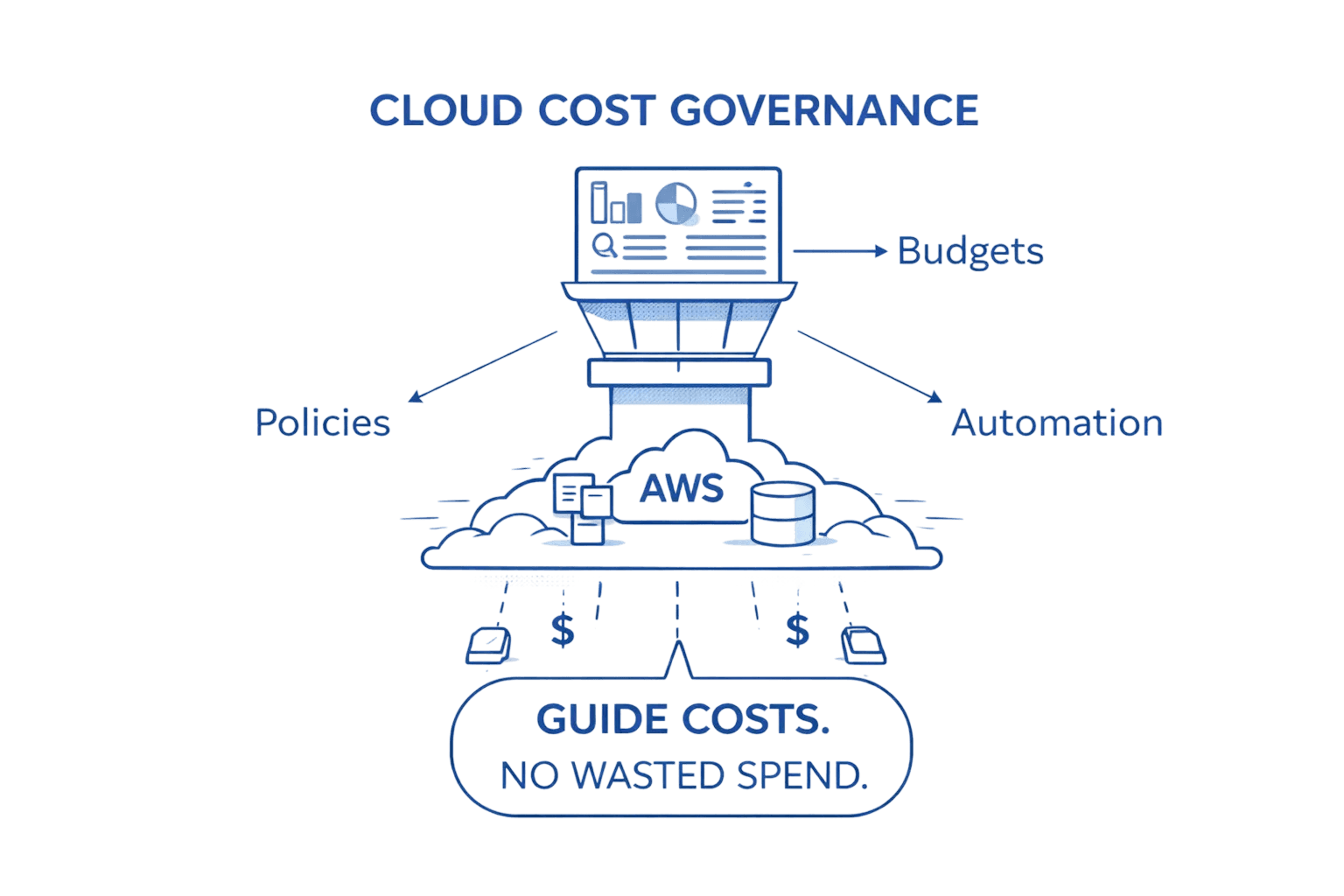
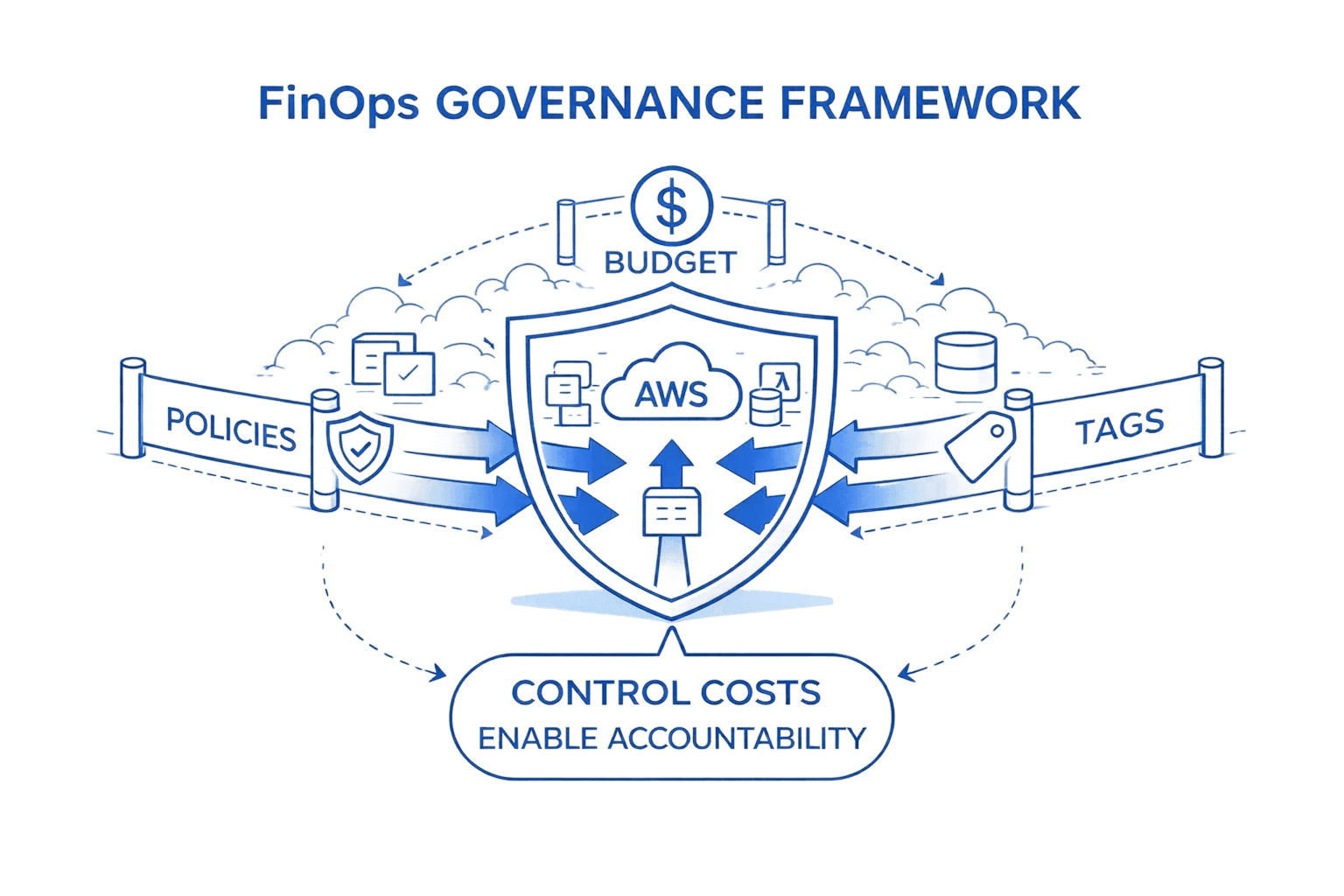
FinOps governance changes this equation. It transforms cloud financial management from reactive cost-cutting into proactive value optimization by establishing clear policies, automated guardrails, and accountability frameworks. When done right, governance doesn't slow teams down. It gives them clear boundaries within which to innovate confidently.
What FinOps Governance Actually Means
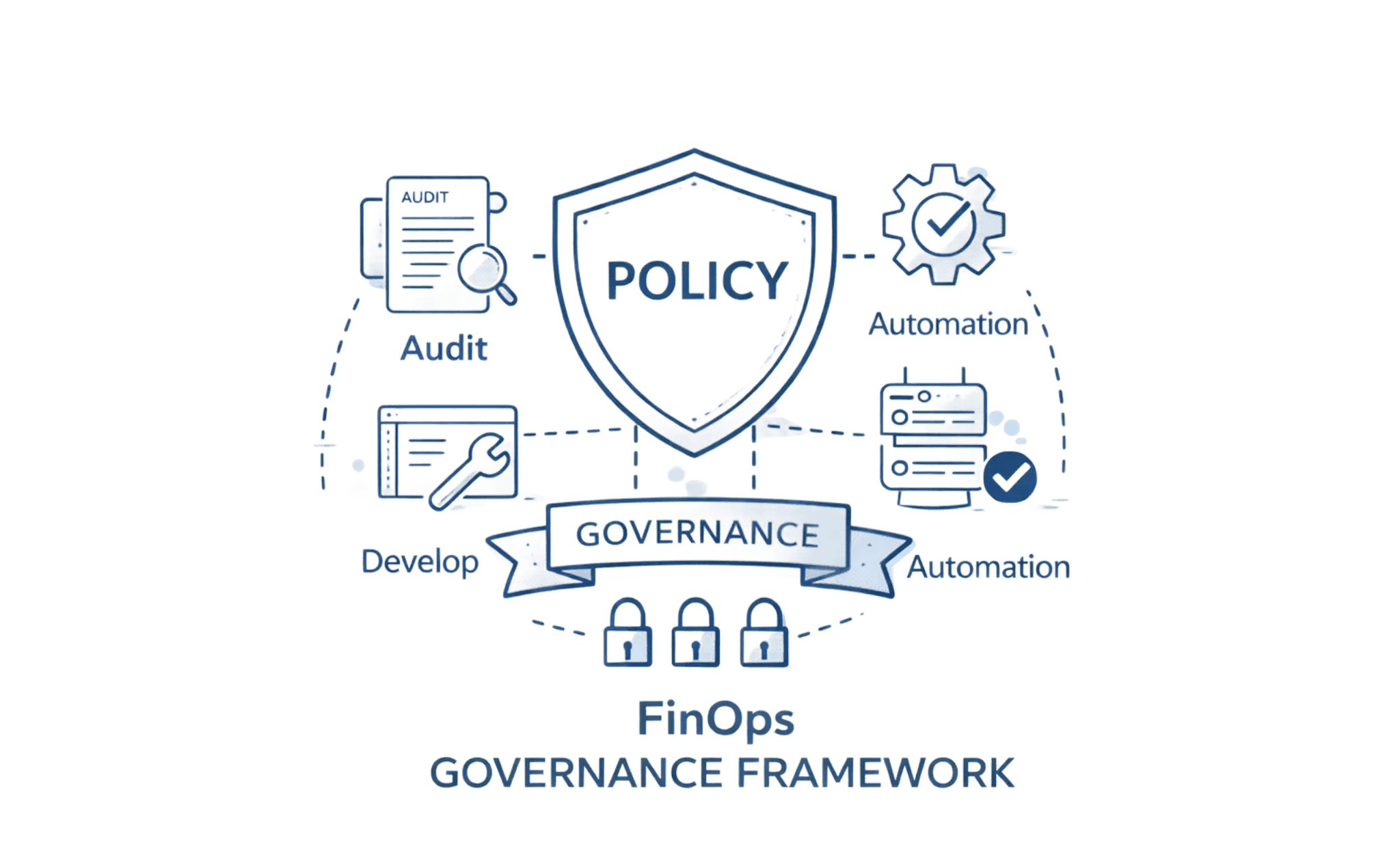
FinOps governance is the enforcement mechanism that turns FinOps principles into operational reality. Think of FinOps as the philosophy and best practices for cloud financial management, while governance provides the concrete policies and controls that make those practices stick.
Without governance, optimization becomes a one-time exercise. Teams cut costs, celebrate the savings, then watch spending creep back up within months. The pattern repeats because there's no structural accountability preventing waste from reaccumulating.
Governance establishes and sustains the FinOps culture necessary for long-term success. It defines who owns which decisions, how resources get approved, when teams must intervene, and what consequences follow non-compliance. Policy statements declare intent ("we will tag all resources"), while governance mechanisms ensure it actually happens (automated rejections for untagged resources).
Key governance components:
Roles and responsibilities mapped to specific teams and individuals
Decision-making processes defining approval flows and escalation paths
Enforcement mechanisms ranging from automated controls to manual reviews
Reporting structures making accountability visible across the organization
The Three Pillars: Guidelines, Guardrails, and Automation
FinOps governance operates through three distinct mechanisms, each suited to different maturity levels and organizational needs.
Guidelines provide advisory best practices without mandatory requirements. They offer recommended approaches for teams to follow voluntarily, creating cultural alignment without heavy-handed enforcement. Use guidelines when you're building awareness and haven't yet established baseline compliance.
Guardrails establish formal processes with mandatory compliance requirements. They define acceptable pathways and reject non-compliant actions. A guardrail might prevent provisioning instances larger than a certain size without approval, or reject resource creation without required tags. Guardrails work when you need consistent compliance but teams still require some flexibility.
Automation implements policy controls directly into systems, making compliant behavior the default path. Instead of asking teams to remember tagging standards, automation applies tags automatically based on account context. Rather than hoping teams right-size instances, automation adjusts resources based on utilization patterns.
Mechanism | When to Use | Example | Trade-off |
Guidelines | Building awareness, limited enforcement needed | Recommended instance types for workload patterns | Relies on voluntary compliance |
Guardrails | Consistent compliance required, flexibility maintained | Block creation of untagged resources | Can create approval bottlenecks |
Automation | High maturity, repeatable patterns identified | Auto-scaling based on usage, automated tagging | Requires upfront investment |
The maturity progression typically flows from guidelines to guardrails to automation. Start with recommendations, enforce critical policies manually, then automate everything that follows predictable patterns.
From Crawl to Run: Building Governance Maturity
The FinOps maturity model follows a "Crawl, Walk, Run" approach that enables organizations to start small and grow in scale, scope, and complexity as business value warrants. Each stage represents increasing sophistication in how governance operates.
Crawl stage organizations have limited reporting and basic policies in audit mode. They allocate at least 50% of resources and achieve forecast accuracy within 20% variance. At this stage, you're gathering baseline data, identifying quick wins like unused elastic IPs, and building stakeholder awareness. Policies flag violations but don't block actions yet.
Walk stage organizations implement standardized policies with active enforcement. They allocate at least 80% of resources, achieve 15% forecast accuracy, and maintain around 70% commitment coverage. Cross-functional collaboration begins, with regular reviews between finance, engineering, and business teams. Guardrails prevent the most egregious waste while automation handles routine optimization.
Run stage organizations achieve full automation and ongoing compliance. They allocate more than 90% of cloud spend with 12% forecast accuracy. All difficult edge cases are addressed, governance is embedded in daily operations, and teams operate with shared accountability for cloud value.
The goal is not to reach Run maturity in every capability, but to perform each at the appropriate level for your environment. If Walk-level anomaly detection catches your cost spikes effectively, investing heavily in Run-level sophistication diverts resources from capabilities that would deliver more value.
Establishing Accountability Through Clear Policies
Effective governance policies must be specific, measurable, and tied to business outcomes. Vague aspirations fail because teams can't act on them and can't tell if they're succeeding.
Good policy statement: "Achieve 80% coverage of steady-state compute workloads with Savings Plans or Reserved Instances within 6 months, reducing effective hourly rates by 40-60%."
Poor policy statement: "Optimize cloud costs through best practices."
The difference is clarity. The good policy defines what (80% coverage), when (6 months), and why (40-60% rate reduction). Teams know exactly what success looks like and can measure progress weekly.
Policy ownership must be explicit. Assign each policy to a specific individual or team, not vague groups like "IT." Define decision-making authority at the appropriate level. Should individual developers approve instance types, or does that require team lead sign-off? Can engineers terminate resources, or must finance approve first?
Critical policies to establish early:
Resource tagging standards - Which tags are mandatory, what values are acceptable, who enforces compliance
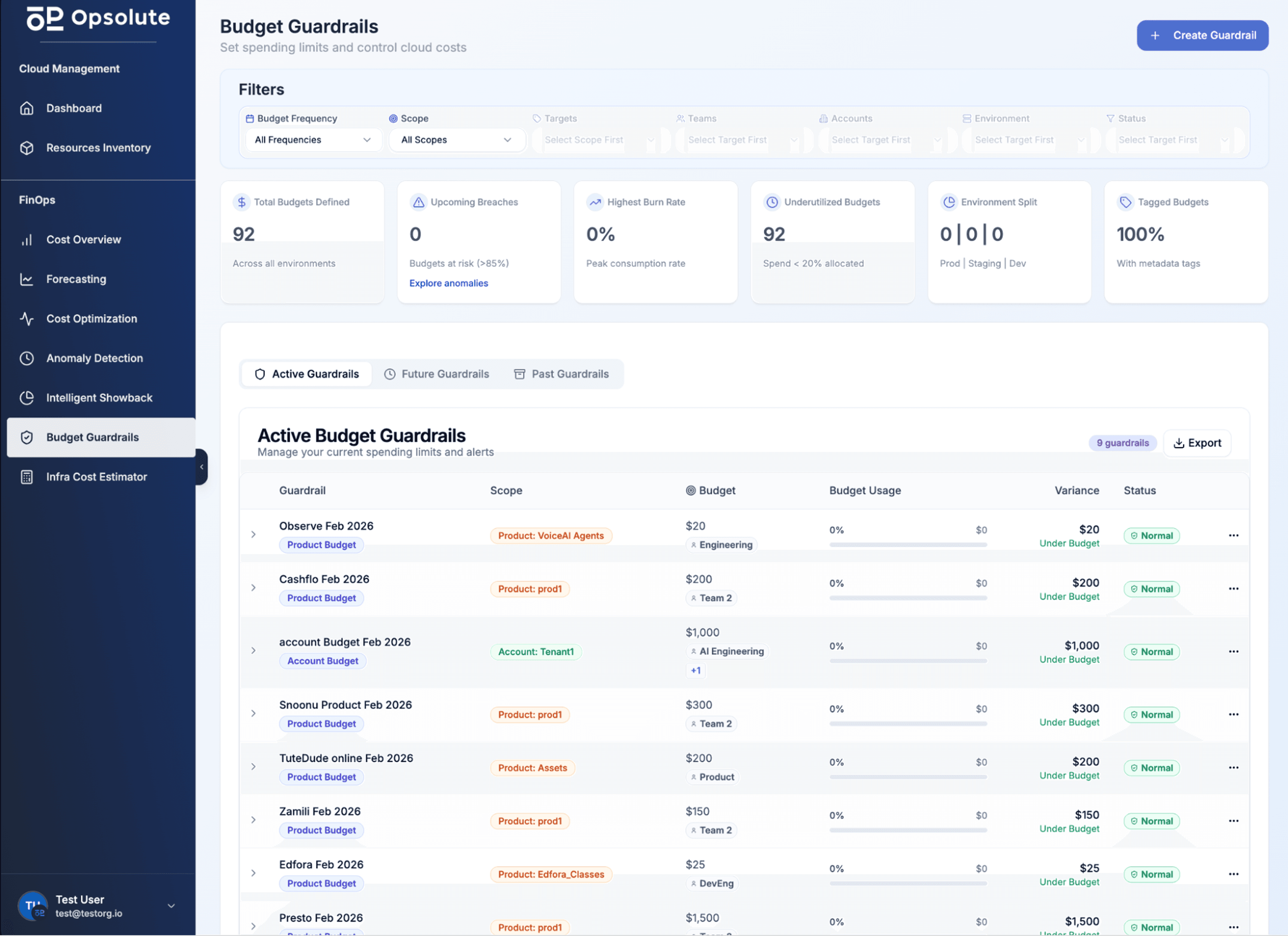
Budget thresholds - Spending limits by team/project/environment, alert timing, escalation procedures
Commitment purchasing - Who can commit to Savings Plans or Reserved Instances, approval requirements, coverage targets
Resource lifecycle - Maximum age for temporary resources, decommissioning processes, retention requirements
Optimization priorities - Which cost optimization actions require approval versus automatic execution
Measuring Success: KPIs That Drive Behavior
FinOps governance requires measurable indicators that track progress and drive behavioral change. Tagging and ownership frameworks improve cost traceability by 45% on average, while enterprises with predictive analytics for cost forecasting achieve 30% higher budget accuracy.
Start with three to five strong indicators rather than dozens of weak ones. Every KPI you track should connect to specific actions teams can take.
Essential governance KPIs:
Policy Compliance Rate
Percentage of resources adhering to governance policies. Target 95% tagging compliance before advancing to complex multi-dimensional metrics. Track weekly, report monthly, and investigate any sudden drops.
Budget Variance
Aim to keep forecasted versus actual spend within 5-10%. Variances exceeding 15% signal forecasting problems or uncontrolled growth requiring immediate attention.
Commitment Coverage
Target 60-80% coverage of steady-state workloads with discounted pricing. Track utilization rates alongside coverage, ensuring commitments don't create waste through underutilization.
Time Saved Through Automation
Measure hours previously spent on manual tasks now automated through governance policies. This demonstrates governance ROI beyond direct cost savings.
Anomaly Response Time
Track how quickly teams detect and respond to unexpected spending spikes. Governance should reduce this from days to hours.
Automation: From Recommendations to Autonomous Action
Manual governance processes can't scale with modern cloud consumption. By 2027, AI-driven cost optimization tools will manage more than 80% of real-time pricing decisions. Teams implementing automation see 20-30% cost reductions while accelerating innovation.
Modern governance platforms integrate financial policies through automation with sensible defaults developers can adjust while remaining compliant. Instead of blocking engineers with approval gates, automation provides guardrails within which teams operate freely.
Key automation capabilities:
Auto-tagging based on account context, deployment pipelines, or resource relationships
Anomaly detection using machine learning to flag unusual spending patterns within 24 hours
Automated rightsizing that adjusts instance types based on utilization without manual intervention
Lifecycle management that terminates temporary resources after defined periods
Budget enforcement blocking resource creation when teams approach spending limits
The shift from advisory recommendations to autonomous enforcement represents governance maturity. At Crawl, platforms generate recommendation reports teams review manually. At Run, platforms execute approved optimizations automatically, requiring human intervention only for edge cases.
Building Cross-Functional Collaboration
FinOps governance succeeds or fails based on collaboration between finance, engineering, IT operations, and business leadership. Only 23% of organizations consider themselves highly efficient at managing cloud costs, largely because teams operate in silos with conflicting incentives.
Common collaboration breakdowns:
Finance shoulders all budgeting responsibility while engineers consume resources without visibility into costs
Engineering optimizes for performance while finance optimizes for cost, creating perpetual tension
Business leaders set aggressive growth targets that clash with cost reduction mandates
IT operations maintains stability while developers push rapid iteration
Strategies for effective alignment:
Hold monthly cross-functional reviews where teams examine spending trends, optimization opportunities, and policy effectiveness together. Share both successes and challenges openly.
Create shared success metrics that align incentives. Instead of measuring engineering only on feature velocity and finance only on cost reduction, both teams should track unit economics like cost per customer or cost per transaction.
Establish cost ownership at the team level, making engineers responsible for the budget impact of their architectural decisions. When teams own both the spending and the outcomes, they naturally balance performance against cost.
Build FinOps education programs ensuring all personas understand cloud pricing models, optimization opportunities, and how their decisions impact spend. Cultural transformation takes 12-18 months, but the results persist.
Multi-Cloud Governance Challenges
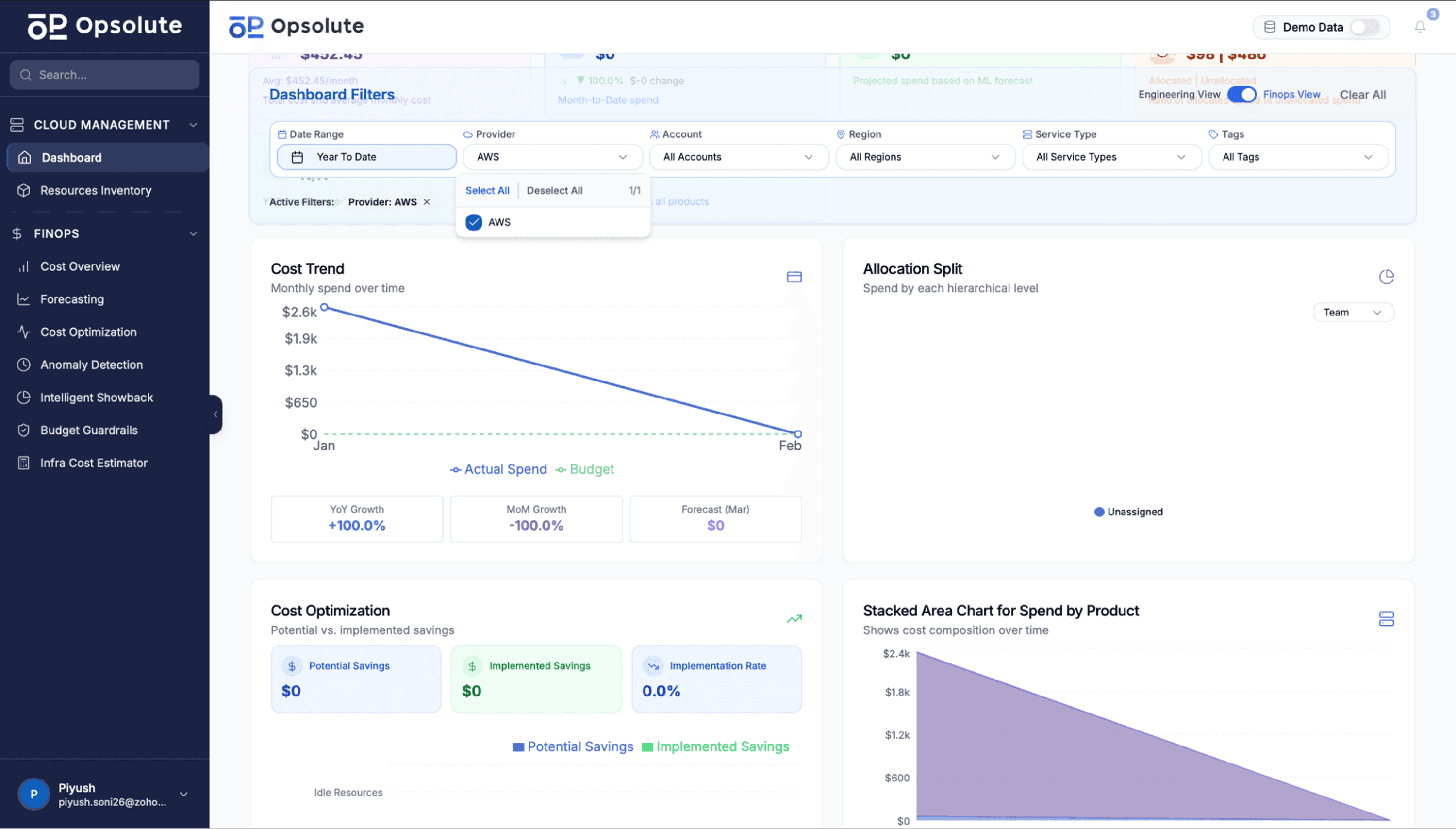
Nearly 80% of companies incorporate multiple public clouds, each with distinct pricing models, discount instruments, and native cost visibility tools. Without unified governance frameworks, this fragmentation leads to inconsistent practices and duplicated effort.
Multi-cloud governance priorities:
Standardized tagging across providers using a unified taxonomy that works regardless of cloud vendor. Define mandatory tags once, enforce consistently everywhere.
Normalized cost views that translate provider-specific concepts into common metrics. Reserved Instances on AWS, Committed Use Discounts on GCP, and Reserved VM Instances on Azure all serve the same purpose but require different management approaches.
Provider-agnostic KPIs that measure governance effectiveness consistently. Track commitment coverage, budget variance, and policy compliance the same way across all environments.
Centralized policy enforcement using tools that apply governance rules across AWS, Azure, and Google Cloud simultaneously. Avoid requiring teams to learn three separate systems for the same governance function.
2026 Trends: AI, Sustainability, and Cloud+ Governance
Three major trends are reshaping FinOps governance in 2026.
AI Infrastructure Creates Unprecedented Cost Challenges
Organizations face up to 30% underestimated AI-specific project costs, requiring governance expansion to cover model training expenses, inference scaling, and data pipeline costs. AI workloads exhibit unpredictable usage patterns that traditional forecasting models can't handle effectively. Teams must establish policies for GPU utilization, implement anomaly detection tuned to AI workload characteristics, and create forecasting models accounting for rapid scaling.
Sustainability Becomes Mainstream Governance Requirement
50% of FinOps teams anticipate increased collaboration with sustainability teams as GreenOps moves from niche concern to core requirement. 2026-ready tools treat GreenOps as inherent to FinOps, providing sustainability metrics and optimization capabilities. Governance frameworks now address carbon intensity alongside cost, enabling teams to optimize for both financial and environmental impact.
Cloud+ Expands Governance Beyond Infrastructure
The FinOps Framework 2025 update introduces Scopes extending governance beyond traditional cloud IaaS to encompass SaaS management, on-premises software, and all technology spend. Organizations must evolve governance frameworks to address these new cost categories with the same rigor previously applied only to cloud infrastructure.
Practical Roadmap: Implementing Governance Successfully
Implementation follows a structured approach that demonstrates quick wins while building long-term capabilities.
Phase 1: Foundation (Months 1-3)
Establish baseline metrics showing current spend, waste, and compliance levels. Define initial governance goals tied to measurable outcomes. Gain stakeholder buy-in by quantifying the cost of inaction. Implement audit-mode policies that flag violations without blocking actions, building awareness without disrupting operations.
Phase 2: Expansion (Months 4-9)
Standardize policies based on Phase 1 learnings. Begin active enforcement for critical policies like tagging compliance and budget guardrails. Formalize cross-functional collaboration through regular reviews. Map governance efforts to business value, demonstrating ROI through realized savings and improved forecast accuracy.
Phase 3: Optimization (Months 10-18)
Achieve full integration where governance becomes embedded in every technology decision. Implement automated compliance reviews providing trending insights. Operate with all activities aligned to strategy and goals, requiring minimal manual intervention for routine governance functions.
Accelerating Success with the Right Platform
While governance requires organizational commitment, the right platform transforms implementation from a multi-year struggle into an accelerated journey. Modern FinOps platforms provide the infrastructure for automated policy enforcement, real-time compliance visibility, and actionable insights connecting governance efforts to business outcomes.
When evaluating governance capabilities, prioritize comprehensive cost allocation mechanisms that map every dollar to teams, projects, and business units. Look for budget guardrails with configurable threshold alerts that prevent overruns before they occur. Ensure anomaly detection systems flag unusual patterns within hours, not weeks. Seek intelligent forecasting that enables proactive planning rather than reactive responses.
Platforms like Opsolute address these governance needs through integrated capabilities spanning budget guardrails with real-time enforcement, anomaly detection that tracks spending pattern deviations across multiple severity levels, and intelligent showback mechanisms enabling hierarchical cost attribution. The platform's forecasting engine provides resource-level predictions grouped by service, account, or team, while chargeback functionality ensures cost accountability aligns with organizational structure.
The key differentiator is native integration. Rather than requiring teams to switch between dashboards for visibility, optimization, and enforcement, effective platforms embed governance directly into existing workflows. This approach achieves higher adoption because compliance becomes the path of least resistance rather than an additional burden.
Frequently Asked Questions
What is the difference between FinOps and FinOps governance?
FinOps is the operational framework and cultural practice maximizing business value from cloud through collaboration between finance, engineering, and business teams. FinOps governance provides the policies, processes, and enforcement mechanisms putting those principles into action, ensuring cloud usage aligns with business objectives through measurable accountability.
How do I know if my organization needs FinOps governance?
You need governance if you experience unpredictable cloud costs, lack clear accountability for spending, struggle to sustain optimization efforts over time, face challenges allocating costs to teams, or operate in multiple cloud environments without standardized practices. Organizations with monthly cloud bills exceeding $50,000 benefit significantly from governance structures.
What are the most important KPIs for measuring governance effectiveness?
Critical KPIs include policy compliance rate (percentage of resources adhering to defined policies), budget variance (keeping actual versus forecasted spend within 5-10%), tagging compliance coverage (target 80-95%), commitment coverage percentage (60-80% of eligible workloads), and time saved through automation. Focus on three to five strong indicators rather than tracking dozens.
Should governance policies be enforced automatically or require manual approval?
The most effective governance combines automated enforcement for clear-cut policies with human oversight for complex decisions. Start with audit-mode policies to understand impact, then automate straightforward controls like rejecting untagged resources. Reserve manual approval for high-impact decisions like commitment purchases or architectural changes. Over-reliance on approvals creates bottlenecks.
How do I get engineering teams to adopt governance policies without creating friction?
Involve engineers in policy definition from the start. Demonstrate quick wins making their work easier. Provide self-service tools with automated guardrails rather than approval gates. Frame governance as empowerment through clear boundaries, not restriction. Assign cost ownership to teams consuming resources. Celebrate teams operating efficiently within policies.
What is the ROI of implementing FinOps governance?
Organizations with formal governance policies achieve 15-30% reduction in cloud waste, 20-40% improvement in forecast accuracy, 60-80% reduction in time spent on manual cost reporting, and measurable increases in commitment coverage. Beyond direct savings, governance delivers improved business agility, faster innovation cycles, and stronger alignment between technology investments and business outcomes.
How does FinOps governance handle AI and machine learning workload costs?
AI governance extends traditional frameworks to address unique characteristics including model training expenses, inference scaling patterns, data pipeline costs, and GPU utilization. Establish policies for AI resource allocation, implement anomaly detection for unexpected usage spikes, create forecasting models accounting for AI workload unpredictability, and define clear ownership for AI infrastructure costs.
FinOps governance transforms cloud financial management from a reactive expense problem into a proactive value driver. By establishing clear policies, automated enforcement, and cross-functional accountability, organizations gain the visibility and control needed to maximize cloud ROI while enabling teams to innovate at speed. The investment pays for itself many times over through sustained optimization, improved forecast accuracy, and alignment between technology decisions and business objectives.
Start where you are. Establish baseline metrics, define initial policies, demonstrate quick wins, then expand systematically as business value warrants the investment.