Introduction
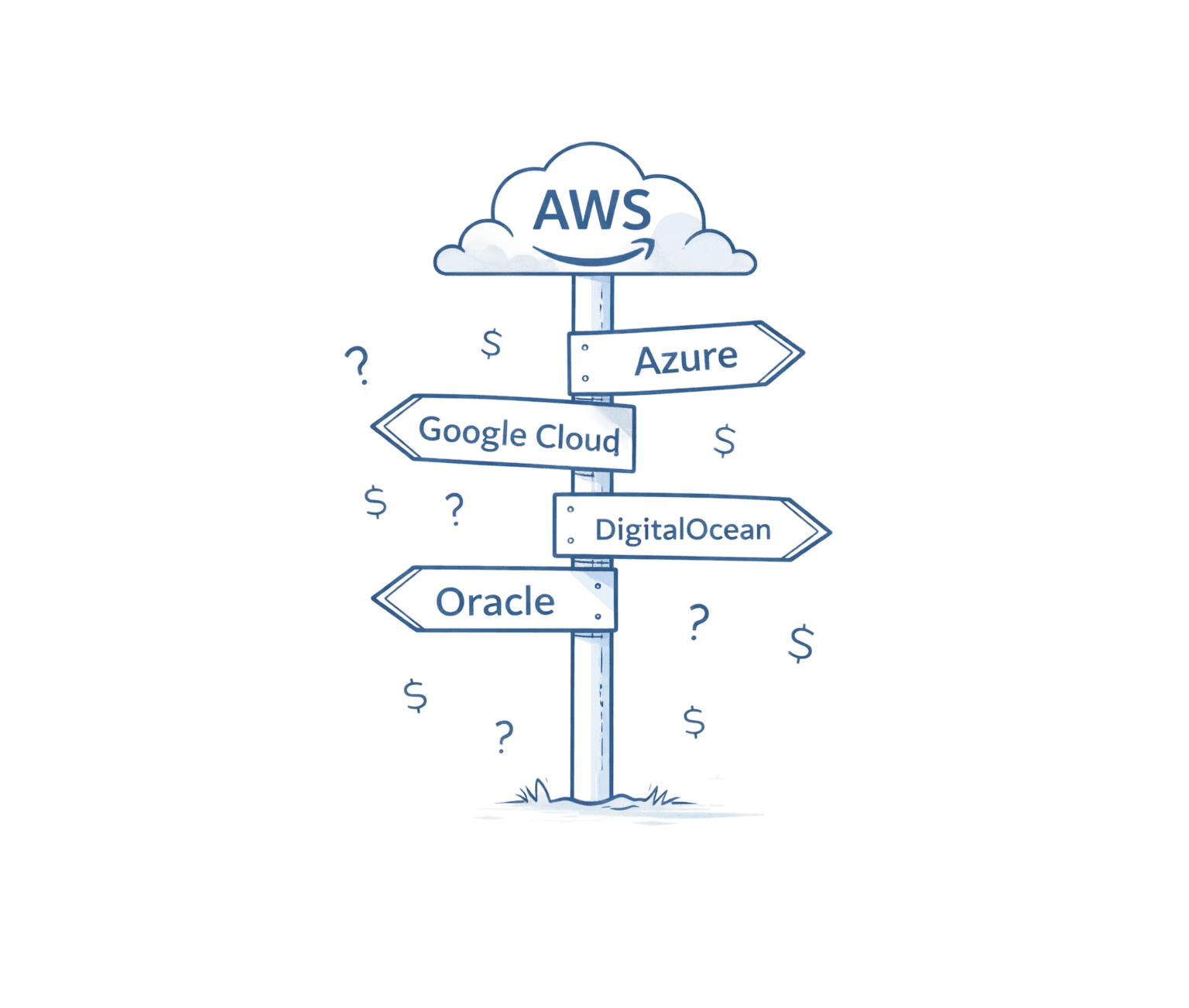
Choosing between Amazon Web Services and Google Cloud Platform represents one of the most strategic technology decisions your organization will make in 2026. AWS commands 31% of the global cloud market with over 240 products, while GCP has rapidly grown to 12% market share by leveraging Google's strengths in data analytics, machine learning, and competitive pricing that runs 25-50% cheaper on many instances. This guide examines both platforms across critical dimensions to help you select the right cloud provider.
Key Highlights
AWS holds 31% market share with 240+ services across 30+ regions while GCP commands 12% with 150+ services across 38 regions
GCP pricing runs 25-50% cheaper than AWS Savings Plans on comparable instances with automatic sustained use discounts up to 30%
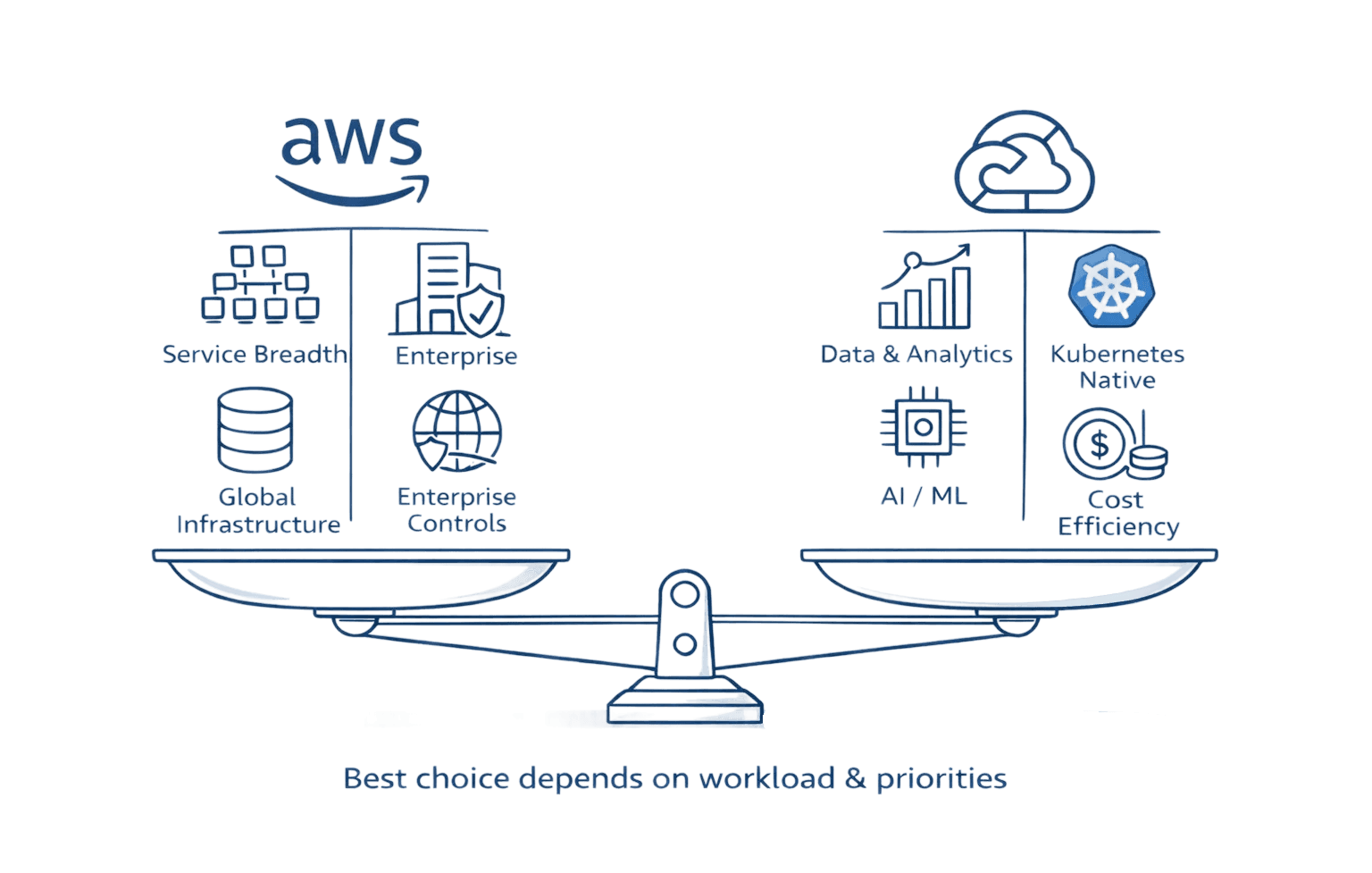
AWS excels in enterprise infrastructure and service breadth while GCP leads in data analytics, AI/ML, and Kubernetes
Both platforms offer robust security with shared responsibility models and extensive compliance certifications
AWS suits enterprises needing maximum flexibility while GCP fits startups, data-driven companies, and AI-focused workloads
Market Position and Cloud Ecosystem Overview
AWS launched in 2006 and pioneered the cloud services industry. After nearly two decades, it maintains leadership with the largest global infrastructure and most comprehensive service catalog. The platform processes workloads for Netflix's 100,000+ server instances and powers NASA's mission-critical infrastructure.
GCP entered in 2008 with a different strategy. Instead of competing on breadth, Google focused on depth in specific areas. The platform leverages the same infrastructure powering Google Search and YouTube. Companies like Spotify, Target, and Goldman Sachs chose GCP specifically for data analytics capabilities in using AWS Cost Management and machine learning infrastructure.
What does this mean for your selection? If you need comprehensive service coverage across every possible use case, AWS delivers unmatched variety. If your workloads center on data processing, analytics, or machine learning, GCP's specialized strength often outweighs AWS's broader catalog.
Global Infrastructure and Availability
AWS operates over 30 regions with 93 availability zones spanning 245+ countries. This massive footprint provides superior geographic coverage for global operations. When you need low-latency service in a specific region, AWS probably has infrastructure there.
GCP expanded to 38 regions with 106 zones reaching 200+ countries. The smaller footprint initially seems disadvantageous, but Google compensated with something AWS doesn't have: a private global fiber network. Google owns the actual cables connecting its data centers, including 20 subsea cable projects like the Topaz cable running from Vancouver to Japan.
This infrastructure difference shows up in performance. AWS provides more geographic options. GCP provides faster inter-region connectivity. For applications requiring global data synchronization, GCP's private network often delivers lower latency than AWS's reliance on public internet between regions.
Core Services: Compute, Storage, and Database
AWS EC2 provides over 500 instance types supporting diverse workload requirements. This variety means you can precisely match specifications to needs, but it also means navigating complex selection decisions.
GCP Compute Engine offers a streamlined approach with custom machine types. Instead of choosing from hundreds of predefined configurations, you specify exactly how many vCPUs and how much memory you need. Want 12 vCPUs and 48GB RAM? Just configure it. This flexibility eliminates the "almost right" problem where the next instance size wastes resources.
Storage Services
AWS S3 dominates object storage with 11 storage classes and mature ecosystem integration. The service processes trillions of requests monthly. S3's longevity means virtually every tool integrates with it.
GCP Cloud Storage delivers competitive pricing with four storage classes. Where GCP differentiates is seamless BigQuery integration. Data stored in Cloud Storage can be queried directly through BigQuery without moving it, enabling analytics workflows that would require additional ETL steps on AWS.
Database Services
AWS RDS supports the widest range of database engines including PostgreSQL, MySQL, Oracle, SQL Server, MariaDB, and Aurora. This breadth matters when migrating legacy applications requiring specific database versions.
GCP Cloud SQL excels in ease of use and automated management. BigQuery stands out as GCP's marquee database service. This serverless data warehouse processes petabytes of data with SQL queries running in seconds. Netflix uses BigQuery to analyze 500+ billion events daily. AWS Redshift provides similar capabilities but requires more hands-on cluster sizing and management.
The database decision often determines platform choice for data-intensive applications. Companies with existing database expertise lean toward AWS. Companies building new analytics infrastructure often choose GCP for BigQuery's serverless simplicity.
Pricing Models and Cost Optimization
AWS Tags employs complex, flexible pricing with multiple discount mechanisms. Reserved Instances offer up to 72% savings for 1-3 year commitments, but require predicting future usage accurately. Spot Instances provide up to 90% discounts for interruptible workloads. This complexity provides sophisticated optimization for teams with FinOps expertise. However, organizations without this expertise often overspend by 30-40%.
GCP uses transparent, simplified pricing with automatic benefits. Sustained Use Discounts of up to 30% apply automatically when instances run consistently. No planning required. Committed Use Discounts offer up to 57% savings for 1-3 year commitments. Per-second billing ensures you only pay for actual usage.
Research consistently shows GCP typically runs 25-50% cheaper than AWS on comparable instance types. This cost advantage attracts startups and cost-conscious enterprises. However, AWS's sophisticated discount options can match GCP pricing for organizations willing to invest in cost optimization.
The pricing choice reflects your organization's cost management capability. Teams with limited FinOps resources often save more with GCP's automatic discounts. Large enterprises with dedicated cost optimization teams can extract maximum value from AWS's complex pricing mechanisms.
Machine Learning and AI Capabilities
AWS offers comprehensive AI/ML breadth through Amazon SageMaker for end-to-end model development, AWS Bedrock for accessing foundation models from providers like Anthropic, and specialized services including Rekognition for computer vision and Lex for natural language processing.
AWS Bedrock deserves special attention. This managed service lets you access and customize foundation models without managing infrastructure. Need Claude 3 for your application? Bedrock provides API access with options for fine-tuning on your data.
GCP leverages Google's deep AI research expertise through Vertex AI, providing a unified platform with superior AutoML capabilities. Where GCP truly differentiates is custom Cloud TPUs delivering significant performance advantages for deep learning workloads. TPUs are custom-designed chips for machine learning that can accelerate certain neural network architectures by 10x compared to GPUs.
BigQuery ML brings machine learning directly into the data warehouse. Data analysts can build and train models using SQL without moving data or learning Python. This accessibility democratizes ML within organizations.
The AI platform choice depends on your maturity and objectives. AWS excels in breadth of AI services and enterprise ecosystem integration. GCP leads in cutting-edge machine learning innovation and data analytics integration. Organizations focused on advanced ML research or building AI-native products often choose GCP for technical advantages.
Security, Compliance, and Enterprise Features
Both AWS and GCP follow shared responsibility security models where the provider secures underlying infrastructure while customers secure their data and applications.
AWS offers AWS Shield for DDoS protection, Secrets Manager for credential storage, and Amazon Inspector for security assessments. The platform achieved extensive compliance certifications including ISO 27001, SOC 2, PCI DSS, HIPAA, and GDPR. AWS holds a slight advantage in global compliance coverage with certifications across more regions. For top-secret government workloads, AWS GovCloud provides infrastructure meeting stringent federal security requirements.
GCP provides Google Cloud Armor for DDoS protection, Secrets Manager for sensitive data, and Security Command Center for threat detection. The platform achieves similar core compliance certifications but emphasizes privacy-centric compliance. GCP runs on over 90% carbon-free energy with real-time sustainability metrics for environmentally conscious organizations.
For most enterprises, both platforms meet security and compliance requirements. AWS provides more granular control for complex security postures. GCP provides privacy-focused features and environmental sustainability metrics.
Developer Experience and Ease of Use
AWS presents a steeper learning curve due to its vast service catalog and quirky naming conventions. The AWS console has evolved over 18 years with additions rather than redesigns, resulting in inconsistent interfaces. However, AWS benefits from extensive documentation and the largest community. Almost any question you have, someone else asked before.
GCP provides a more streamlined, intuitive interface with straightforward service names and cleaner console design. Need virtual machines? Compute Engine. Object storage? Cloud Storage. The naming is logical and consistent.
Developer-friendly tools like Cloud Shell make GCP easier for teams new to cloud computing. GCP's strong open-source support through Kubernetes makes it appealing for modern DevOps practices. Google invented Kubernetes and contributes heavily to cloud-native technologies.
The learning curve difference matters most for small teams and startups. GCP's simplified approach gets teams productive faster. Large enterprises with dedicated cloud teams can absorb AWS's complexity and benefit from its comprehensive capabilities.
Best Use Cases and When to Choose Each Platform
Choose AWS When:
Large enterprises requiring maximum service variety. AWS's 240+ services provide comprehensive coverage. You won't hit limitations requiring workarounds.
Global infrastructure reach is critical. Companies operating worldwide need infrastructure in many regions. AWS's 30+ regions provide unmatched geographic coverage.
Complex hybrid cloud architectures matter. AWS Outposts brings AWS services into your data center. VMware Cloud on AWS provides seamless integration with existing VMware infrastructure.
Choose GCP When:
Startups with limited cloud expertise. GCP's automatic sustained use discounts and transparent pricing help budget-constrained startups control costs. The cleaner interface reduces learning curve.
Data-driven companies prioritizing analytics. If BigQuery's serverless data warehouse matches your requirements, it alone can justify choosing GCP. Organizations processing terabytes of data often find BigQuery's price-performance superior.
AI-focused organizations needing cutting-edge ML. Vertex AI's unified platform and access to Cloud TPUs provide advantages for advanced machine learning. Companies building AI-native products benefit from GCP's technical leadership.
Tech companies embracing Kubernetes. GKE represents the gold standard for managed Kubernetes. Organizations committed to cloud-native architectures often find GCP's container-first approach more natural.
Many enterprises adopt multi-cloud strategies to leverage both platforms. This approach maximizes value but increases operational complexity.
How Opsolute Simplifies Multi-Cloud Management
Managing costs across AWS and GCP becomes exponentially more complex than single-cloud operations. Different pricing models and distinct billing structures make unified visibility nearly impossible with native tools.
Opsolute provides centralized cloud management across AWS and GCP through a unified dashboard. Real-time visibility shows spending across all providers with department-wise cost distribution. This eliminates manual spreadsheet work.
The platform's FinOps capabilities directly address pricing complexity. Cost optimization recommendations identify idle resources, suggest right-sizing opportunities, and analyze savings plan coverage across both AWS Reserved Instances and GCP Committed Use Discounts.
Anomaly detection monitors spending patterns and alerts you to unusual cost increases before they appear on monthly bills. Budget guardrails prevent overspending by enforcing limits across accounts and environments.
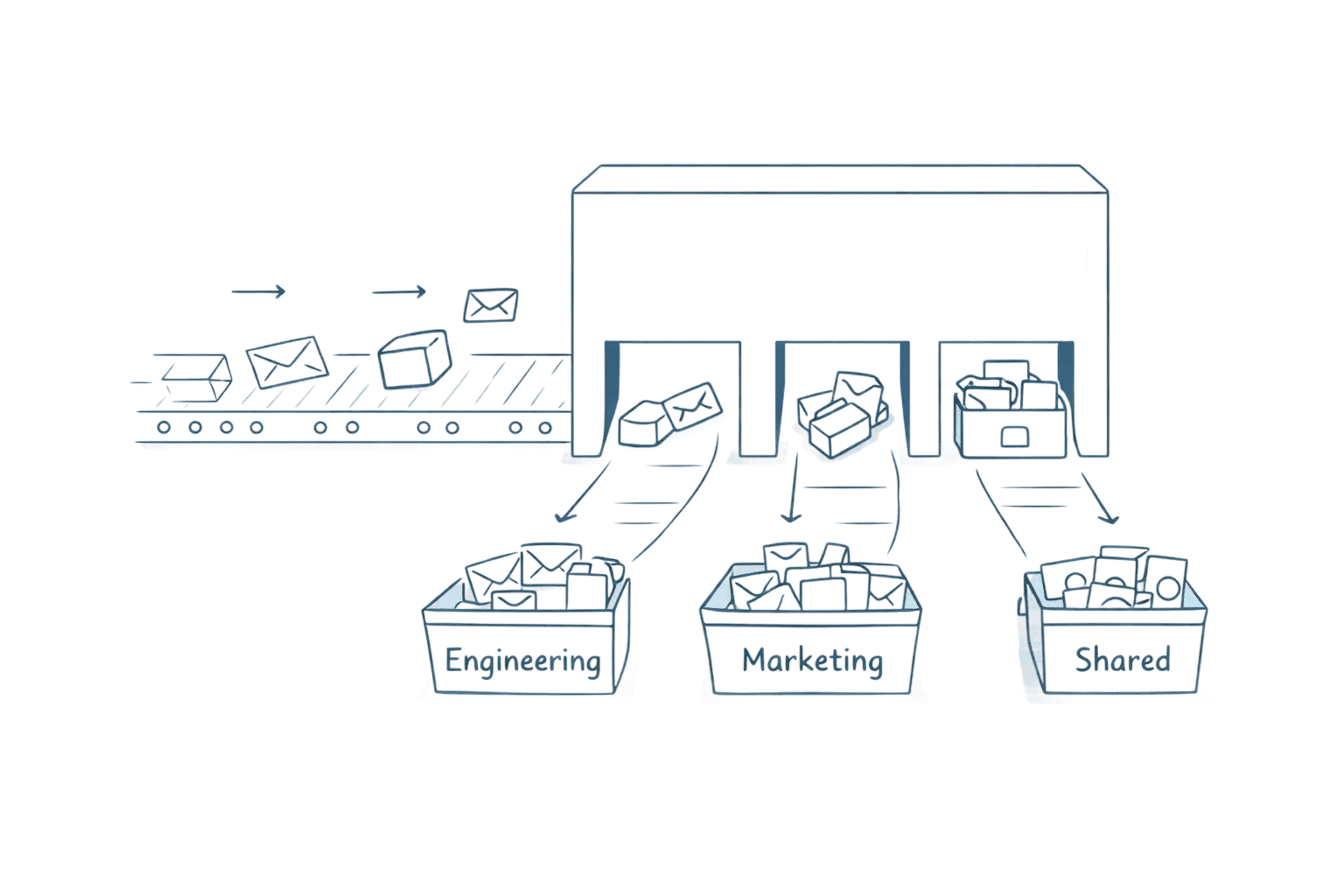
The intelligent showback feature attributes costs across teams and projects even when resources span multiple clouds. When your data pipeline reads from AWS S3 but processes in GCP BigQuery, Opsolute properly allocates costs to the responsible team.
FAQ
Q: Which cloud platform is cheaper, AWS or GCP?
GCP typically costs 25-50% less than AWS on comparable instance types primarily due to automatic sustained use discounts. However, AWS offers sophisticated discount options through Reserved Instances that can reduce costs by up to 72% with proper planning. The actual cost difference depends on your specific workload patterns and optimization efforts.
Q: Is AWS more reliable than GCP for enterprise workloads?
Both platforms offer enterprise-grade reliability with strong SLA commitments exceeding 99.99% uptime. AWS benefits from larger global infrastructure with more availability zones. GCP leverages Google's high-performance private fiber network. Neither platform shows a clear reliability advantage.
Q: Which platform is better for machine learning and AI applications?
GCP holds advantages for cutting-edge AI/ML through Vertex AI's unified platform, AutoML capabilities, and custom Cloud TPUs. AWS provides broader AI service variety through SageMaker and Bedrock for foundation models. Choose GCP for data science innovation, AWS for enterprise AI deployment with diverse integration needs.
Q: Can I use both platforms simultaneously?
Many organizations adopt multi-cloud strategies using AWS for certain workloads while leveraging GCP's strengths in data analytics and machine learning. This approach increases operational complexity and requires teams skilled in both platforms.
Q: Which startup programs offer better benefits?
Google for Startups Cloud Program provides up to $200,000 in credits over 2 years compared to AWS Activate's $100,000, making GCP more generous for early-stage companies. However, AWS offers a larger ecosystem of partner integrations and broader third-party tool support.
Conclusion
The AWS vs GCP decision isn't about finding the universally "better" platform. AWS dominates in service breadth and global infrastructure. GCP leads in data analytics, machine learning innovation, and transparent pricing. Both deliver enterprise-grade reliability and security.
Your choice should align with specific business requirements. Large enterprises with diverse workloads benefit from AWS's comprehensive service catalog. Startups and data-driven companies often find GCP's simplified pricing and analytics capabilities more valuable.
Start by identifying your three most critical requirements. Rank both platforms against your actual needs rather than general features. Consider trying both platforms for non-critical workloads before committing fully.
For organizations running multi-cloud infrastructure, invest in proper cost management tools. Platforms like Opsolute unify cost tracking, optimization, and governance across both providers, reducing spending while maximizing the value of your cloud investments.
Ready to optimize your cloud costs across AWS, GCP, or both? Schedule a cloud strategy consultation to discover how Opsolute's unified platform can help.