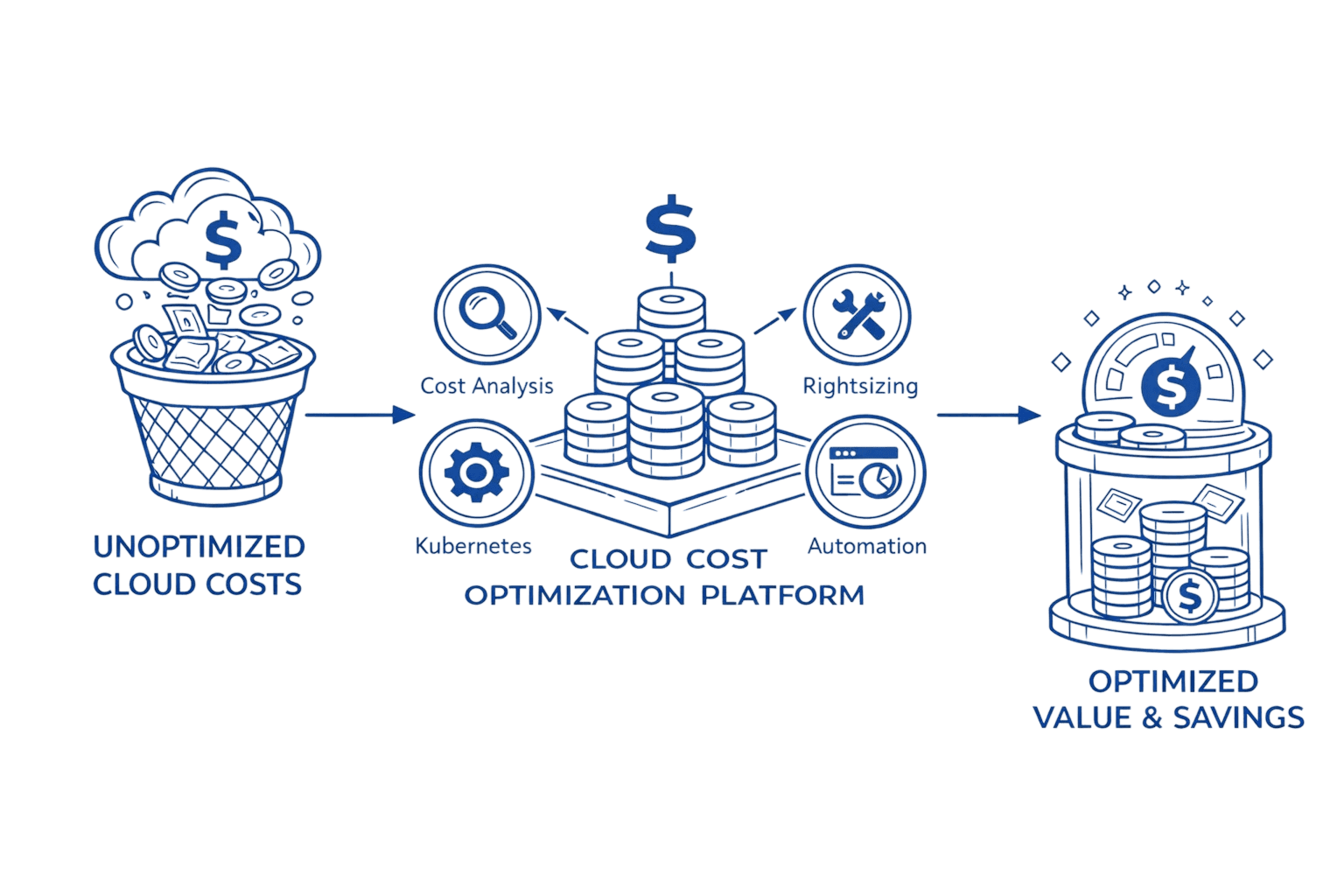
Most teams start their AWS cost optimization journey the same way: rightsizing. Downsize the oversized EC2 instances, clean up the idle EBS volumes, call it done.
That gap between "we rightsized" and "our costs are actually under control" is where most FinOps programs stall. Rightsizing catches the obvious waste once, but it says nothing about the $340 spike that happens on a random Tuesday, the Savings Plan purchased two years ago for an architecture that no longer exists, or the Bedrock spend nobody's tracking because it's new and doesn't fit the old reporting model. You can rightsize perfectly and still be flying blind on everything that happens after.
This guide walks through seven wins good AWS cost optimization tools deliver once you're past rightsizing, backed by real AWS feature updates, real recovery numbers, and the categories of spend that manual review consistently misses.
Key Highlights
Rightsizing alone typically catches 25 to 40% in compute savings, but it's a one-time pass, not an ongoing system.
AWS Cost Anomaly Detection now uses rolling 24-hour windows, catching spend spikes in hours instead of the 18 to 26 days it typically takes teams to spot them on an invoice
AWS's AI-powered cost investigation, launched June 2026, uses Amazon Q to correlate CloudTrail events and pinpoint the exact API call or IAM principal behind a cost spike
AWS FinOps Agent entered public preview in June 2026, the first AWS-native agentic tool that answers cost questions in natural language and auto-investigates anomalies
Cost Anomaly Detection expanded to third-party Bedrock models like Anthropic Claude in August 2026, closing a major blind spot in GenAI cost visibilit.y
AWS's free native tool stack (Cost Explorer, Compute Optimizer, Budgets, Anomaly Detection) typically surfaces $10,000 to $50,000 in annual savings for mid-size deployments on its own
Automated commitment management goes beyond one-time Savings Plan purchases to continuously rebalance coverage as usage shifts.
Cost allocation done well turns an aggregated AWS bill into team- and workload-level accountability, which is what actually sustains savings long after the initial cleanup.
To see how allocation ties into this beyond rightsizing, start with cloud cost control strategies built for continuous, not one-time, optimization.
Win 1: Catching Cost Spikes Before They Hit the Invoice
Rightsizing fixes what's already wrong. It does nothing for what goes wrong next week. This is where anomaly detection earns its place as a distinct win, not an extension of rightsizing.
Example: A team's AWS Cost Anomaly Detection caught a $340-per-day spike in EC2 costs on a Tuesday. The root cause: an engineer had launched 20 c5.4xlarge instances for a load test and forgotten to terminate them. Without anomaly detection, that spike would have surfaced on the invoice three weeks later. Cost avoided by catching it early: $7,140.
That gap, hours versus weeks, is the whole point. AWS improved its Cost Anomaly Detection algorithm to compare spend using rolling 24-hour windows instead of incomplete calendar-day comparisons, which reduces both false positives and detection lag. Most teams, without this kind of tooling, typically discover cost spikes 18 to 26 days after they start, by which point the spike has often already compounded into a real number.
Win 2: Root-Cause Investigation Without Hours of Manual Digging
Knowing a cost spike happened is only half the problem. Knowing why used to mean manually correlating billing data with CloudTrail logs and resource activity, work that could easily eat an afternoon.
In June 2026, AWS launched AI-powered cost investigation inside Cost Anomaly Detection, using Amazon Q to determine whether a cost change is usage-driven or rate-driven, identify the contributing services and accounts, and for usage-driven changes, correlate the spike back to the specific API calls and IAM principals responsible. What used to take hours of manual CloudTrail correlation now produces a plain-language explanation in minutes.
This is the difference between a tool that tells you cost went up and one that tells you which engineer, which service, and which specific action caused it, which is a fundamentally different kind of win than anything rightsizing alone can deliver.
Win 3: Natural-Language Cost Answers, Not Just Dashboards
The newest capability in this space is conversational. AWS FinOps Agent entered public preview on June 9, 2026, the first AWS-native agentic tool built specifically for FinOps practitioners and engineering teams. It answers cost questions in natural language, pulls rightsizing, idle resource, and Savings Plans recommendations directly from AWS Cost Optimization Hub and Compute Optimizer, and when it detects a cost anomaly, investigates the root cause automatically, posting findings to Slack or opening a Jira ticket without manual triage.
This shifts cost management from something a FinOps specialist has to query a dashboard for, to something any engineer can ask a plain-language question about and get an answer, which meaningfully lowers the bar for who can actually act on cost data day to day.
Win 4: Continuous Commitment Optimization, Not a One-Time Purchase
Rightsizing tells you how big an instance should be. It says nothing about whether your Reserved Instances or Savings Plans still match what you're actually running. Commitments purchased once, based on a snapshot of usage, tend to drift out of sync with reality as architecture changes, workloads move to Kubernetes, or new managed services replace what a commitment was originally sized for.
Good AWS cost optimization tools treat commitment management as a continuous process: monitoring coverage against current usage, flagging where purchased capacity no longer matches real consumption, and rebalancing recommendations as the environment evolves. This is a distinct win from rightsizing because rightsizing operates at the resource level, while commitment optimization operates at the portfolio level, matching pricing strategy to actual usage patterns over time, not just at purchase.
Win 5: Closing the AI and GenAI Cost Blind Spot
AI workloads have created a genuinely new category of cost that traditional rightsizing tools were never built to see. In August 2026, AWS extended Cost Anomaly Detection to cover third-party foundation models running on Amazon Bedrock, including provider-hosted models like Anthropic Claude, with alerts that break down root cause by account, region, service, and usage type. Teams running production generative AI workloads now get the same automatic anomaly coverage on Bedrock model spend that they've long had on EC2 and S3.
This matters because GenAI spend behaves nothing like traditional compute. Token costs, model selection, and inference frequency don't map cleanly to instance-based rightsizing logic at all. A tool that only rightsizes EC2 and EBS volumes has no visibility into a workload where the entire cost driver is which model got called, how many tokens it processed, and how often. Closing that blind spot is a win rightsizing was never designed to deliver in the first place.
Win 6: Turning an Aggregated Bill Into Team-Level Accountability
Rightsizing optimizes resources. It doesn't tell you who's accountable for keeping them optimized after the fact. That requires allocation, organizing AWS spend by team, product, or business unit so cost ownership is clear, not just technically correct.
AWS Cost Categories supports up to 50 categories and 500 rules each, with multi-level hierarchy support that rolls costs up from teams to departments to business units, and split-charge rules that fairly divide shared costs like logging, support, and networking using even, fixed, or proportional methods. Done well, this turns "AWS costs increased 18%" into "Team X's spend increased 18%, driven by this specific service," which is the level of accountability that actually sustains savings, since someone with the context to act on it now owns the number. For a full breakdown of how to set this up, see the complete guide to AWS Cost Categories.
Win 7: Free Native Tooling That Punches Above Its Weight
It's worth saying plainly: a meaningful share of this value doesn't require paid tooling at all. AWS's own free stack, Cost Explorer, Compute Optimizer, Budgets, and Cost Anomaly Detection, typically identifies $10,000 to $50,000 in annual savings for mid-size AWS deployments on its own, with Compute Optimizer alone recommending rightsizing across EC2, Lambda, EBS, and ECS for savings in the 25 to 40% range on covered resources.
The win here isn't a specific feature; it's recognizing that a lot of organizations pay for third-party FinOps platforms without first exhausting what AWS already provides for free. Getting real value out of AWS cost optimization tools starts with using the native stack fully, and layering additional capability, deeper allocation, cross-account visibility, workload-level attribution, on top of that foundation rather than around it.
Why These Wins Compound
None of these seven wins operate in isolation. Anomaly detection is only useful if root-cause investigation can explain what it finds. Commitment optimization only holds if allocation makes clear who's responsible for the usage driving it. And AI cost visibility only matters if it feeds into the same governance process as everything else, rather than living in its own separate silo. This is the broader point covered in 15 essential cloud cost optimization metrics: the value comes from tracking these signals together, not from any single metric or tool in isolation.
Where Opsolute Fits In
This is exactly where Opsolute extends beyond what native AWS tooling and one-time rightsizing efforts can deliver on their own. Instead of treating anomaly detection, commitment tracking, and allocation as separate reports, Opsolute connects them to the same underlying infrastructure signal, so a cost spike, a stale commitment, and an unowned workload all trace back to one coherent picture instead of three disconnected dashboards.
That means moving from "AWS costs increased 18% this month" to "this specific workload changed, this team owns it, and here's the commitment mismatch driving the extra spend," continuously, not as a quarterly cleanup. That's the compounding value these seven wins are supposed to deliver, and it's difficult to sustain without infrastructure-aware tooling behind it.
Final Takeaway
Rightsizing will always be the starting point for AWS cost optimization, but it was never meant to be the whole strategy. The real, sustained savings come from what happens after: catching spikes in hours instead of weeks, investigating root cause automatically, keeping commitments matched to real usage, extending visibility into AI workloads, and turning allocation into accountability that actually holds. Good AWS cost optimization tools deliver all seven, continuously, which is what separates a one-time cleanup from a cost program that actually sticks.
Want to see what's driving your AWS bill beyond the obvious rightsizing wins? Explore Opsolute and connect your cloud costs to the infrastructure, workloads, and teams behind them.