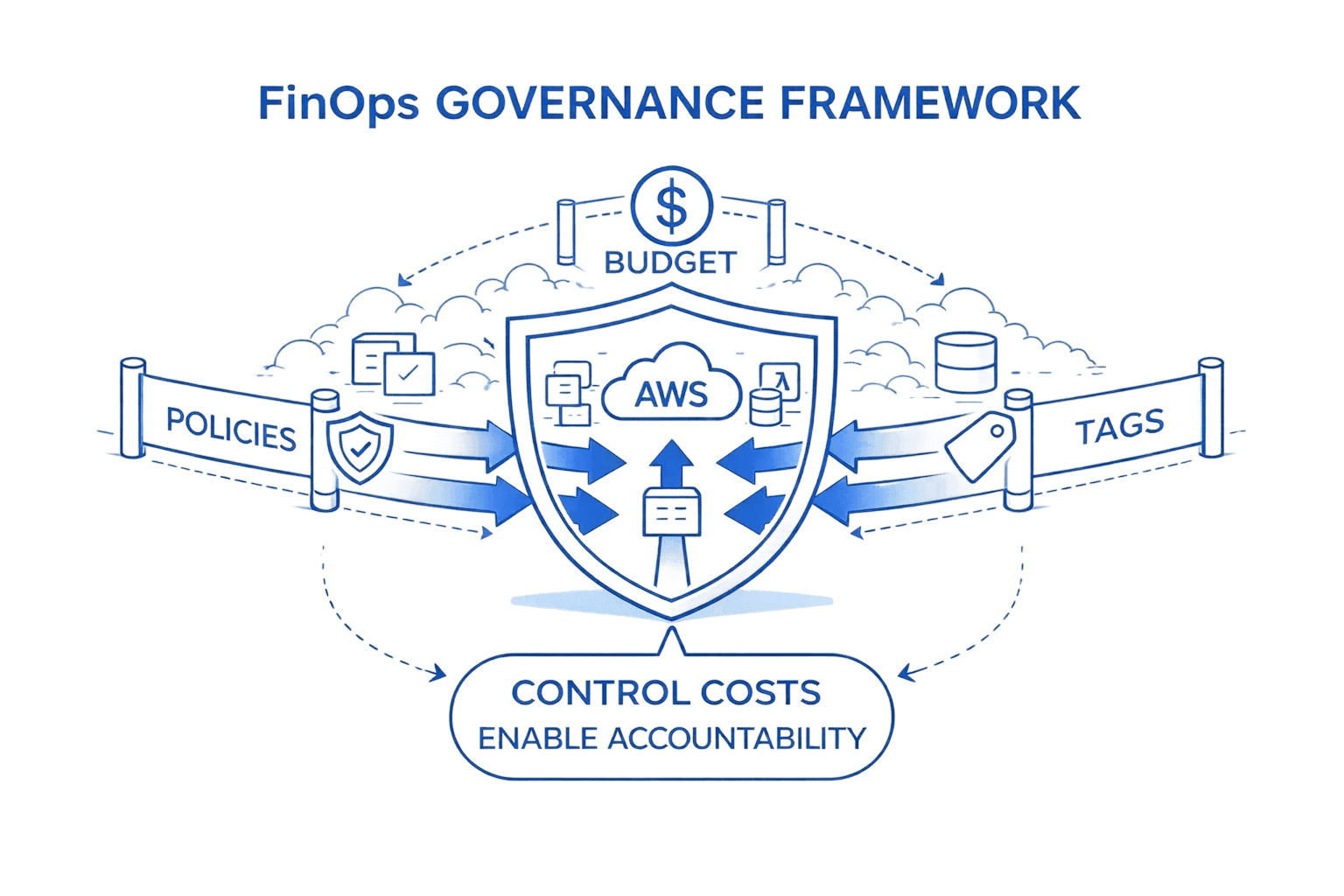
Somewhere in your cloud environment right now, there's an oversized instance nobody remembers spinning up, a storage bucket with no owner, and a budget alert that's been muted since March. None of it looks like a crisis. No outage, no support ticket, no red flag in the dashboard. It just quietly bills you every single month, and by the time it shows up as a line item someone actually questions, it's already cost far more than the five minutes it would have taken to catch it early.
That's the uncomfortable truth about cloud cost governance: the mistakes that hurt the most are rarely dramatic. They're the small, structural gaps in tagging, ownership, monitoring, and process that compound quietly until finance asks why the bill jumped 30%, and nobody has a clean answer.
According to Flexera's 2026 State of the Cloud Report, cloud waste climbed to 29% this year — the first increase in five years, reversing a trend that had been improving. That reversal isn't happening because teams stopped caring about cost. It's happening because governance programs have blind spots, and blind spots are expensive.
Below are seven of the most common and most quietly expensive cloud cost governance mistakes, backed by current data, along with what to do about each one.
Why These Mistakes Are So Easy to Miss
Cloud cost governance failures rarely announce themselves. Unlike a security breach or a production outage, an ungoverned cost problem doesn't trigger a page at 2 a.m. — it just accumulates on a monthly invoice that's already too large and too complex for anyone to fully audit line by line.
That's precisely why cloud cost governance has to be proactive and structural, not reactive. The seven mistakes below are the ones that show up again and again across FinOps maturity assessments, and each one has a real, measurable cost attached to it.
Mistake #1: Treating Tagging as Optional
The Mistake
Tagging gets deprioritized because it feels like busywork — until someone tries to answer "which team owns this $40,000 line item" and can't.
Why It Happens
Tagging policies are usually introduced early, then quietly abandoned as teams move fast, spin up resources ad hoc, and skip the tagging step under deadline pressure. Enforcement is rarely automated, so drift is constant.
The Cost of Ignoring It
Industry analysis from LeanOps finds that 30–50% of cloud resources have no tags, incomplete tags, or inconsistent tags, effectively making a third to half of most cloud budgets invisible to cost attribution. The same analysis found that organizations reaching 90%+ tag coverage identify waste 30% faster than those without it, and cut cloud spend 20–40% more effectively as a direct result.
How to Fix It
Make tagging a deploy-time gate, not a best-effort request. Enforce required tags (owner, environment, cost center, project) through infrastructure-as-code policies and automated compliance scans, and report tag coverage as a governance KPI — not a one-time cleanup project.
Mistake #2: Governing Cost Without a Clear Owner
The Mistake
A governance policy exists on paper, but no single person or team is accountable for enforcing it, reviewing exceptions, or answering for spend when it drifts.
Why It Happens
Cost sits at the intersection of engineering, finance, and platform teams — and when everyone is partially responsible, in practice no one is fully responsible.
The Cost of Ignoring It
Flexera's 2026 report shows where mature organizations have landed on this: 71% now have a Cloud Center of Excellence (CCOE) or equivalent governing structure, and 63% rely on a dedicated FinOps team to own cost management and governance directly. Organizations without this structure are the ones still discovering surprise charges after the fact, because nobody was watching in real time.
How to Fix It
Assign explicit ownership at both the policy level (who sets the rules) and the resource level (who's accountable for what they provision). A RACI matrix for cloud cost — even a simple one — closes more governance gaps than most tooling investments.
Mistake #3: Treating Governance as a One-Time Project
The Mistake
A governance policy gets written, rolled out, and then left untouched for a year or more while the underlying cloud environment changes constantly.
Why It Happens
Governance often launches as an initiative with a start and end date, when in reality cloud environments, services, and pricing models shift monthly.
The Cost of Ignoring It
This is exactly why Flexera found that 59% of organizations are actively expanding their FinOps teams just to regain control of spend they'd previously thought was under control. Governance that isn't revisited becomes stale governance — and stale governance is functionally the same as no governance at all.
How to Fix It
Put governance on a recurring cadence: quarterly policy reviews, monthly budget-vs-actual reconciliation, and a standing process for retiring rules that no longer match your architecture (e.g., policies written before your team adopted Kubernetes or serverless).
Mistake #4: Relying on the Monthly Invoice to Catch Problems
The Mistake
Cost anomalies are treated as a "we'll notice when the bill comes" problem instead of a real-time monitoring problem.
Why It Happens
Budget alerting and anomaly detection require setup and tuning, so teams under-invest in it relative to how much it actually saves.
The Cost of Ignoring It
The numbers here are stark. Data compiled by Turbo360 shows that 54% of cost spikes are discovered through monthly invoicing rather than real-time alerts, and the average undetected anomaly runs for 18 days before anyone catches it — with only 26% caught within 24 hours. Anomalies left undetected for more than two weeks cost enterprises an average of $138,000 per incident, while teams using active budget alerts detect problems 4.1x faster than those relying on invoice review alone. Detected within 48 hours, remediation costs run 73% lower than issues caught after two weeks.
How to Fix It
Set budget thresholds and anomaly alerts at the service and team level, not just at the account level, and route them to the people who can actually act — not a shared inbox nobody checks.
Mistake #5: Ignoring Idle and Underutilized Resources
The Mistake
Overprovisioned, idle, or "just in case" resources are left running because turning them off feels riskier than paying for them.
Why It Happens
Utilization data is often scattered across multiple dashboards, and without a consolidated view, idle resources simply don't get noticed until an audit — if one happens at all.
The Cost of Ignoring It
This mistake compounds fast at the infrastructure layer. Datadog's research found that more than 80% of container spend is wasted on idle resources, and data from Kube Today shows 56.5% of teams still set resource requests/limits manually rather than using autoscalers, versus just 32.2% who've automated it. At the macro level, this is a meaningful driver behind Flexera's finding that overall cloud waste rose to 29% in 2026 — the underlying inefficiency compounds fastest at the infrastructure and container layer.
How to Fix It
Run scheduled right-sizing and idle-resource audits (not just at renewal time), and default non-production environments to auto-shutdown schedules rather than relying on someone remembering to turn them off.
Mistake #6: Leaving Engineers Out of Cost Accountability
The Mistake
Cost governance is treated as a finance or FinOps-team problem, with the engineers actually provisioning resources kept largely out of the loop.
Why It Happens
Cost visibility tools are often built for finance reporting, not for the engineering workflows where provisioning decisions actually get made — so cost never becomes part of an engineer's day-to-day feedback loop.
The Cost of Ignoring It
This gap shows up directly in workforce data. Harness found that 55% of developers admit they ignore cost management in their day-to-day work, and Zesty's research shows 42% of CIOs and CTOs cite resource utilization as their top cloud challenge — a symptom of decisions being made without cost context at the point of provisioning.
How to Fix It
Surface cost estimates directly in the tools engineers already use — CI/CD pipelines, IaC plan outputs, PR reviews — so cost becomes a visible tradeoff at decision time, not a surprise discovered downstream by someone else.
Mistake #7: Never Extending Governance to Cover AI and GPU Spend
The Mistake
Cost governance policies were built for compute, storage, and networking — and haven't been updated to account for GPU-hours, inference costs, and token-based LLM spend, which behave completely differently.
Why It Happens
AI adoption has outpaced governance updates. Most policies simply predate the AI workloads now running in production.
The Cost of Ignoring It
This is the fastest-growing blind spot in cloud cost governance today. Flexera's 2026 data shows GenAI usage surged to 58% of organizations, up from 50% the prior year — and separate FinOps industry reporting found that a majority of AI teams are already exceeding their allocated budgets, in large part because inference and training costs scale unpredictably and don't fit neatly into legacy budget models.
How to Fix It
Treat AI/GPU spend as its own governance category with its own budgets, tagging conventions, and approval thresholds — rather than trying to force it into policies designed for a pre-AI cloud footprint.
The Common Thread
None of these seven mistakes are exotic. They're the ordinary, unglamorous gaps that show up when cost governance is treated as a policy document instead of an operating discipline — something reviewed once, then left to run on autopilot while the underlying environment keeps changing underneath it. The fix, in every case, is the same shift in posture: from reactive to proactive, from one-time to continuous, and from finance-owned to shared across the teams actually generating the spend.
Stop Losing Money to Governance Gaps You Can't See
If any of these seven mistakes sounded familiar, that's normal — most organizations are carrying at least two or three of them right now, quietly, in the form of untagged resources, stale budgets, or an AI workload nobody's watching closely enough. The gap between "we have a cost governance policy" and "our cost governance policy is actually working" is exactly where Opsolute helps.
Talk to Opsolute about auditing your current cloud cost governance program — tagging coverage, ownership gaps, anomaly detection, and AI/GPU cost exposure — and get a clear, prioritized plan to close the gaps before they show up on your next invoice.