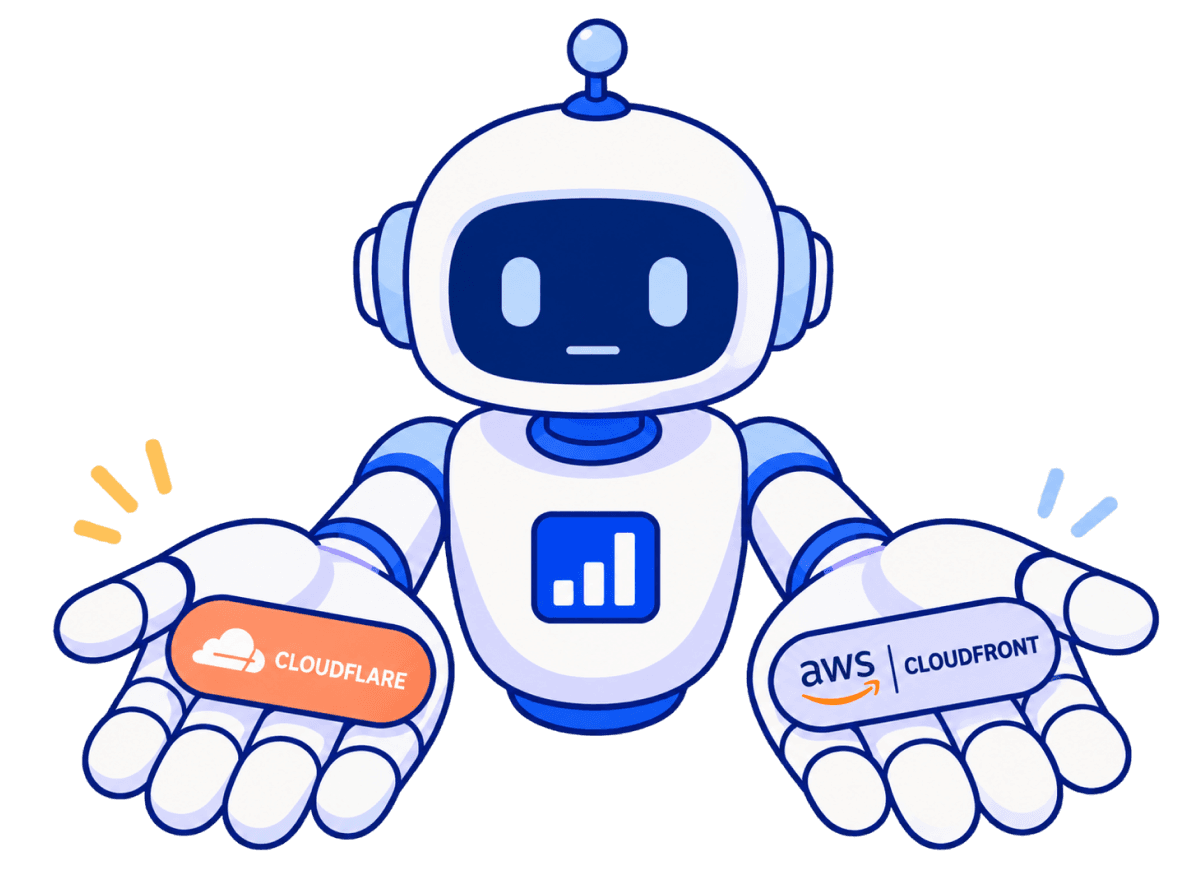
Cloudflare vs CloudFront is usually framed as a CDN pricing battle. Cloudflare offers simple, predictable pricing. AWS CloudFront offers deep AWS integration.
But if your real goal is reducing your AWS bill, the question is more complicated: which CDN actually lowers your total infrastructure cost? The cheapest CDN on paper may not be the cheapest architecture. A company can save on CDN delivery and still see its AWS bill rise from higher origin traffic, data transfer, cache misses, or load balancer usage.
And with AWS's new CloudFront flat-rate pricing, the old assumption that "Cloudflare is always cheaper than CloudFront" no longer holds.
Cloudflare vs CloudFront: The Short Answer
If your infrastructure is AWS-native, CloudFront can be highly cost-efficient. AWS charges zero fees for data transfer from eligible AWS origins to CloudFront, and it integrates directly with S3, ALB, and other AWS services.
If you operate across multiple clouds or have unpredictable bandwidth needs, Cloudflare's cost model is compelling: it markets unlimited bandwidth and a cloud-independent architecture.
Neither CDN automatically reduces your AWS bill. The real calculation is:
CDN cost + origin cost + data transfer + compute + security + storage + operational overhead = total cost
That's the number FinOps teams should actually compare.
Why CDN Cost Optimization Matters More in 2026?
Internet traffic isn't shrinking. Cloudflare reported global traffic grew 19% in 2025, with over 25 record-breaking DDoS attacks. Meanwhile, the 2026 State of FinOps report found 98% of respondents now manage or plan to manage AI spend, up from 63% in 2025, as FinOps expands into SaaS, licensing, and private infrastructure.
A request path is no longer just User → CDN → Website. It now looks like User → CDN → WAF → API → ALB → EKS → S3 → Database → AI service. A CDN decision touches several layers of your AWS bill at once.
CloudFront vs Cloudflare Pricing: What's Changed
CloudFront's usage-based pricing used to be its biggest disadvantage. In November 2025, AWS introduced flat-rate CloudFront pricing, bundling delivery, WAF, DDoS protection, DNS, logging, and edge compute into monthly plans with no overage charges:
Free: $0/month
Pro: $15/month
Business: $200/month
Premium: $1,000/month (expanded in May 2026 with configurable tiers from 500M to 6B requests and 50TB to 600TB/month)
The old logic, "Cloudflare = predictable, CloudFront = variable", no longer holds. Both can now offer predictable pricing, depending on plan and architecture.
Cloudflare vs CloudFront: Where Each One Wins
CloudFront: AWS-native workloads. A SaaS company running S3, EKS, ALB, RDS, and WAF benefits structurally from CloudFront sitting inside the AWS ecosystem, zero-fee origin transfer plus reduced ALB traffic, EKS processing, and database queries as cacheable content gets served at the edge.
Cloudflare: multi-cloud workloads. A company spanning AWS, Azure, GCP, and third-party infrastructure benefits from one edge layer across environments. Cloudflare's unlimited bandwidth and products like Cache Reserve reduce origin fetches and egress costs even for AWS-hosted apps. Here the question shifts from "how do I reduce CloudFront costs?" to "how do I control network costs across my entire infrastructure?"
Real Example: A 50TB SaaS Workload
A platform serving 50TB/month of images, docs, and JS bundles has two options. Cloudflare may look cheaper on the CDN invoice alone. But once you add AWS origin traffic, S3 requests, cache misses, load balancer traffic, WAF, DNS, and logging, the CDN price is only one piece of the puzzle. This is the most common mistake: comparing CDN invoices instead of total infrastructure cost.
Cache Hit Ratio Matters More Than CDN Price
Consider an ecommerce platform with 100M monthly requests and a 95% cache hit ratio. If a configuration change drops that to 75%, millions of additional requests now hit the AWS origin, triggering more EKS pods, ALB processing, database queries, and autoscaling.
The CDN didn't get more expensive. The architecture got more expensive because caching got less effective. Track cache hit ratio → origin requests → resource utilization → cost, not the CDN bill in isolation.
S3 + CDN Cost Optimization
For an organization storing 100TB in S3 with repeated file requests, effective caching means User → Edge cache → Cache hit instead of User → Edge → S3 → Response. The metric that matters isn't "how much did CDN delivery cost", it's "how much origin activity did the CDN eliminate."
Flat-Rate CloudFront Changes the Debate
AWS's flat-rate plans bundle CDN, WAF, DNS, logging, and edge compute into one price, plus S3 storage credits depending on tier. A company might pick Cloudflare for predictable CDN costs, but if it already needs AWS WAF, DNS, and CloudFront separately, bundled flat-rate pricing could produce a lower total bill. The answer depends entirely on usage.
Don't Ignore Security Costs
If a company normally serving 10TB/month gets hit with an 80TB bot attack, unwanted requests that reach application infrastructure drive up compute, database activity, logging, and bandwidth, well beyond the CDN line item. CloudFront's flat-rate plans are built for predictable pricing during spikes, and include Shield Standard DDoS protection at no extra charge. Cloudflare bundles CDN and DDoS protection similarly. Security has to be part of any Cloudflare vs CloudFront pricing comparison.
The Metric That Matters: Cost Per Delivered GB
A better comparison: (Total CDN + origin cost) ÷ GB successfully delivered. Factor in CDN delivery, origin transfer, origin compute, security, storage, and operational overhead for both options. The winner isn't the lowest CDN line item; it's the lowest total cost per delivered GB.
What About AI Workloads?
For an AI SaaS app, a single upload can trigger CDN → WAF → API → EKS → S3 → document processing → vector database → LLM → response. Effective caching and edge security prevent unnecessary requests from reaching the application, avoiding compute, storage, database, and unnecessary AI inference costs. This is why cloud cost optimization is shifting from resource-level to workload-level thinking, reinforced by the FinOps Foundation's finding that 98% of teams now manage AI spend.
Cloudflare vs CloudFront: Which Should You Choose?
Choose CloudFront if: your infrastructure is primarily AWS, S3 is a major origin, you use ALB/EKS/ECS, you want native AWS integration and flat-rate pricing, and reducing origin traffic is a priority.
Choose Cloudflare if: you operate across multiple clouds, bandwidth is unpredictable, you want a cloud-independent edge layer, and you want to consolidate edge networking and security.
Or use both. CloudFront as the AWS-native delivery layer, Cloudflare for multi-cloud or security-heavy workloads. The right answer is architectural, not ideological.
The Future of CDN Cost Optimization
FinOps teams will increasingly care less about "how much did CloudFront cost?" and more about cost per request, per customer, per GB delivered, per cache miss, and per AI interaction. With global traffic up 19% in 2025, more traffic means more opportunity for optimization, and more opportunity for hidden infrastructure costs.
The Real Answer to Cloudflare vs CloudFront:
Neither CDN automatically reduces your AWS bill. Cloudflare wins on predictable bandwidth economics and multi-cloud delivery. CloudFront wins on AWS-native integration and flat-rate pricing. The bigger lesson: don't optimize the CDN bill, optimize the architecture behind it. A 20% CDN cost cut means little if origin compute rises 40%. A higher CDN bill can be the right outcome if it prevents millions of expensive application requests.
How Opsolute Helps Connect the Dots
Instead of treating AWS cloud costs as isolated line items, Opsolute connects cost signals with the infrastructure and workloads generating them, helping teams answer why networking costs increased, which workload caused it, whether cache misses rose, and which team owns the spend. That's the shift from "our AWS bill went up" to "this workload changed, this traffic pattern caused it, here's what to do."
Want to understand what's actually driving your AWS spend? Explore Opsolute to connect cloud costs with the infrastructure, workloads, and behaviors behind them.