Key Highlights
Cost allocation coverage targets should track FinOps maturity, not a flat 100% goal: 70-85% at Crawl stage, 85-95% at Walk, 95%+ at Run.
Chargeback or showback accountability, allocation's actual payoff, cuts idle cloud resources by 67%; allocation data that never reaches a team owner delivers almost none of that benefit.
AWS Cost Categories supports up to 50 categories and 500 rules each, letting teams allocate shared costs by rule instead of depending on perfect tagging everywhere.
A properly validated allocation model should reconcile to within ±2% of actual total spend, a check most teams never run until finance asks why the numbers don't add up.
Choosing a cloud cost allocation method is the easy part. Keeping that allocation accurate six months later, after three reorgs, a dozen new services, and a tagging policy nobody's re-enforced, is where most programs actually fail. These are the practices that keep allocation accurate over time, not the methods themselves.
8 Cloud Cost Allocation Best Practices:
1. Set a Coverage Target Tied to Maturity, Not a Flat 100%
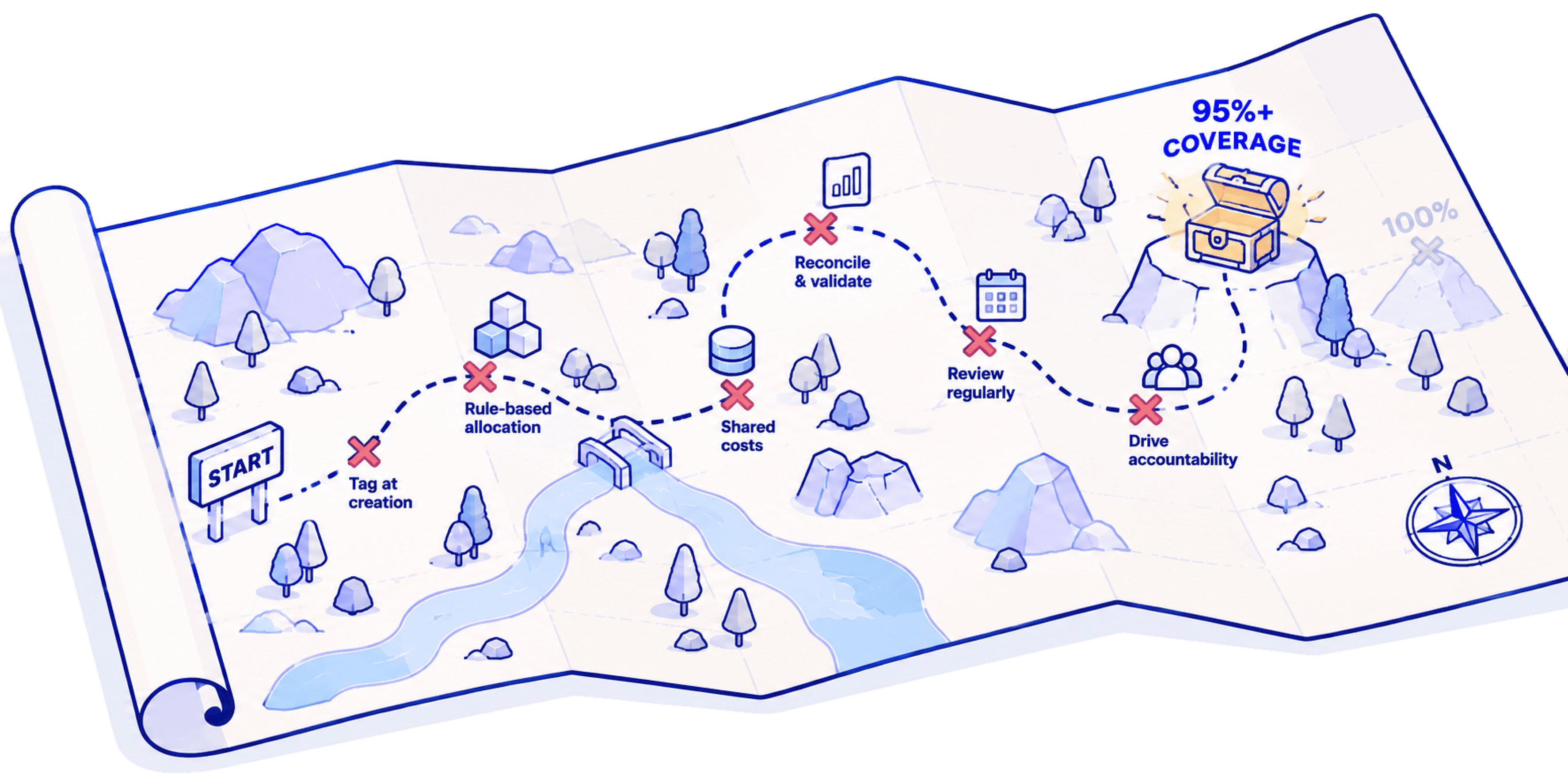
Chasing 100% cloud cost allocation coverage on day one is the wrong goal. The realistic targets scale with FinOps maturity: 70-85% at the Crawl stage (foundational visibility), 85-95% at Walk (active optimization), 95%+ at Run (advanced operations). A team stuck chasing 100% too early usually burns effort on edge cases that don't matter yet, instead of building the tagging habits that compound over time.
2. Enforce Tagging at Creation, Not as a Retroactive Cleanup
Tags applied at resource creation cost nothing. Tags applied after the fact require reconstructing ownership from deployment history and whoever still remembers building the thing. Enforcing required tags through policy (Service Control Policies, tag policies) at creation time is the single highest-leverage practice on this list, everything downstream depends on it.
3. Use Rule-Based Categories for What Tagging Can't Reach
Not every cost can be tagged cleanly, shared logging infrastructure, cross-account networking, platform overhead. AWS Cost Categories solves this at the billing level instead: rule-based grouping across up to 50 categories and 500 rules each, reducing dependence on perfect tagging everywhere. Split-charge rules (even, fixed, or proportional) then distribute genuinely shared costs, logging, support, networking, fairly across the teams that use them, rather than dumping the whole cost on whichever account happens to own the resource.
4. Never Leave Shared Costs Unallocated by Default
The laziest allocation practice is assigning 100% of a shared resource's cost to one team because it's administratively convenient. A Kubernetes cluster running workloads for three product teams shouldn't have its entire cost land on whichever team's account happens to host it, that distorts unit economics and creates the wrong incentives for everyone else. Allocate by measurable usage wherever possible, and fall back to a documented, revisited fixed-percentage split only when usage-based tracking genuinely isn't available yet.
5. Validate That Allocation Reconciles to Actual Spend
This is the step most teams skip entirely: after allocating costs across teams and categories, the sum of allocated amounts should reconcile to within ±2% of actual total spend. If it doesn't, something in the allocation logic is double-counting or dropping cost silently, and nobody finds out until a finance review surfaces the gap. Run this check monthly, not once at setup.
6. Review Allocation Rules on a Fixed Cadence, Not as a One-Time Project
Allocation rules decay the same way tagging does. Teams reorganize, projects get renamed, a shared-cost split negotiated for last year's org chart stops reflecting reality. A quarterly review of allocation rules, not just tags, catches this before the numbers quietly become fiction that nobody questions because the dashboard still shows a number.
7. Pair Allocation With Actual Accountability
Allocation data that sits in a report nobody acts on delivers a fraction of its value. Chargeback or showback, actually billing or reporting spend back to the owning team, is what turns allocation into behavior change: organizations implementing it see a 67% reduction in idle cloud resources. The allocation is the measurement; chargeback is the mechanism that makes the measurement matter.
8. Track Allocation Coverage as Its Own KPI
Allocation coverage isn't just infrastructure for other metrics, it's a metric worth tracking directly, reported alongside spend and utilization, not buried as a one-time project status. A coverage percentage that's trending down quarter over quarter is an early warning that tagging discipline is eroding, well before it shows up as a finance escalation.
What This Looks Like Once Allocation Actually Works
Getting allocation right isn't the finish line, it's what makes everything downstream possible: calculating real cost per customer or per feature only works once allocated costs are trustworthy enough to build unit economics on top of. Best practices aren't a compliance checkbox, they're the maintenance work that keeps every other FinOps metric honest.
Where Opsolute Fits In
Manually re-validating allocation rules every quarter, checking reconciliation against actual spend, and catching coverage drift before it compounds is exactly the kind of ongoing discipline that's easy to specify and hard to sustain by hand. Opsolute connects AWS billing data with live infrastructure context so allocation coverage, and the drift in it, is visible continuously, not rediscovered at the next finance review.
The Bottom Line
The method you choose for cloud cost allocation matters less over time than the discipline you keep around it. A good method with no ongoing validation decays within a quarter. A simpler method, consistently enforced and reviewed, outperforms it every time.
Want to see your actual allocation coverage, and where it's drifting, in real time? Book a 30-minute demo and see how Opsolute keeps allocation accurate as your infrastructure changes.