Somewhere in your organization with an AWS account, there's a resource nobody remembers spinning up right now. A test cluster from a sprint that ended in March. A "temporary" data pipeline that never got torn down.
At $5,000 a month, you'd catch it in five minutes of scrolling. At $50,000 a month, it can sit there quietly compounding for a year, and it's never traveling alone.
Here's the uncomfortable part:
Crossing $50K/month in cloud spend doesn't mean you've outgrown cost problems. It means you've entered the range where they get harder to see, not easier, right as the dollar amount on the line makes them expensive to ignore.
Introduction:
Most companies don't start worrying about cloud costs when they're spending $5,000 a month. They start worrying when the monthly bill crosses $50,000, because that's when cloud cost optimization becomes far more complex than simply reviewing an invoice.
Why did costs suddenly increase?
Which deployment caused it?
Which team owns it?
Was this growth expected, or are we paying for resources we don't need?
At this stage, cloud cost management and infrastructure cost intelligence are no longer about tracking spend; they're about understanding the engineering decisions and infrastructure changes driving that spend.
And it's a challenge many organizations are facing. According to the Flexera 2026 State of the Cloud Report, companies estimate that 29% of their cloud spend is wasted, the highest level reported in the last five years.
As cloud environments grow more dynamic with Kubernetes, AI workloads, autoscaling, and multi-cloud architectures, managing costs becomes increasingly complex. What once worked with spreadsheets and monthly billing reviews simply isn't enough anymore.
Organizations need continuous cloud cost visibility, infrastructure context, and continuous monitoring to catch cost issues early, improve accountability, and make smarter optimization decisions.
Key Takeaways:
Billing data alone isn't enough to understand where money is being spent or provide complete cloud cost visibility.
Shared infrastructure, dynamic workloads, and unclear ownership create hidden costs.
Continuous visibility, infrastructure cost intelligence, and context are essential for proactive cloud cost optimization.
In this article, we'll explore the biggest cloud cost challenges growing companies face—and how leading engineering teams are solving them.
The Hidden Complexity of Managing Cloud Costs Beyond $50K/Month:
As organizations scale, so does their cloud architecture.
Multiple AWS accounts.
Hundreds of Kubernetes workloads.
Shared infrastructure.
Microservices.
Development, staging, and production environments.
Multiple engineering teams deploying every day.
At this point, cloud costs result from thousands of engineering decisions, not just infrastructure usage.
That makes cloud cost optimization significantly more complex. Simply looking at the monthly invoice is no longer enough. Organizations need infrastructure cost intelligence to connect cloud spend with engineering activity.
At around $50K/month, cloud costs stop being driven by a handful of expensive resources and start reflecting thousands of infrastructure decisions across teams, workloads, and deployments.
At this scale, optimization becomes less about finding idle resources and more about answering a much harder question: Why did this cost change? Teams need visibility into the "why" behind every cost change, not just the final number.
7 Reasons Cloud Cost Optimization Gets Harder As You Scale:
1. Knowing the cost, but not understanding the reason behind it
Most organizations know exactly how much they spent last month.
Very few know:
Which deployment increased compute usage
Which Kubernetes workload scaled unexpectedly
Which engineering team owns the spend
Which feature or customer contributed to the increase
Infrastructure cost intelligence answers "Why?"
Engineering teams need answers to "Why?"
Without infrastructure context, cloud cost investigations become slow, manual, and frustrating.
2. Cloud costs are still reviewed too late
Many organizations still discover cloud cost issues only after receiving their monthly invoice.
By then:
Resources have already been running for weeks
Budgets have already been exceeded
Optimization opportunities have already disappeared
Root causes are much harder to identify
Cloud environments change every hour.
Monthly reviews simply can't keep up.
Modern FinOps practices are increasingly shifting toward real-time cloud cost monitoring, continuous visibility, and proactive cost controls rather than end-of-month reporting.
3. Shared infrastructure creates shared confusion and poor cloud cost allocation
Some of the most expensive AWS services don't belong to a single application.
Think about:
Amazon EKS clusters
NAT Gateways
Transit Gateways
Shared RDS clusters
Internal Load Balancers
Data Transfer
Everyone depends on them.
Nobody truly owns them.
When ownership becomes unclear, cloud cost accountability disappears, and optimization usually stops.
Instead of asking,
"How do we reduce costs?"
teams start asking,
"Whose responsibility is this?
4. Too many dashboards, not enough infrastructure intelligence
Most engineering teams already have plenty of tools.
CloudWatch.
Cost Explorer.
Grafana.
Kubernetes dashboards.
Observability platforms.
Billing reports.
Each tool provides valuable information.
None of them tell the complete story.
Engineers often spend hours jumping between dashboards just to understand one unexpected increase in cloud spend.
The problem isn't that engineering teams lack visibility.
It's that every answer lives in a different tool.
Billing data lives in one dashboard.
Kubernetes metrics live in another.
Deployment history lives somewhere else.
Engineers spend more time connecting information than solving the problem.
A spike in EC2 costs might require engineers to check Cost Explorer, Kubernetes events, deployment history, CloudWatch metrics, and even Slack conversations before identifying the root cause. The investigation isn't difficult because data is missing. It's difficult because the data is scattered.
That's where Infrastructure Cost Intelligence becomes valuable, connecting these disconnected signals into a single, contextual story that explains not just what changed, but why it changed, who owns it, and what to do next.
5. Optimization without business and infrastructure context
Not every optimization recommendation should be implemented.
Imagine two recommendations:
Save $4,000/month by rightsizing a customer-facing workload.
Save $2,500/month by shutting down unused development infrastructure.
Both reduce costs.
Only one carries significant business risk.
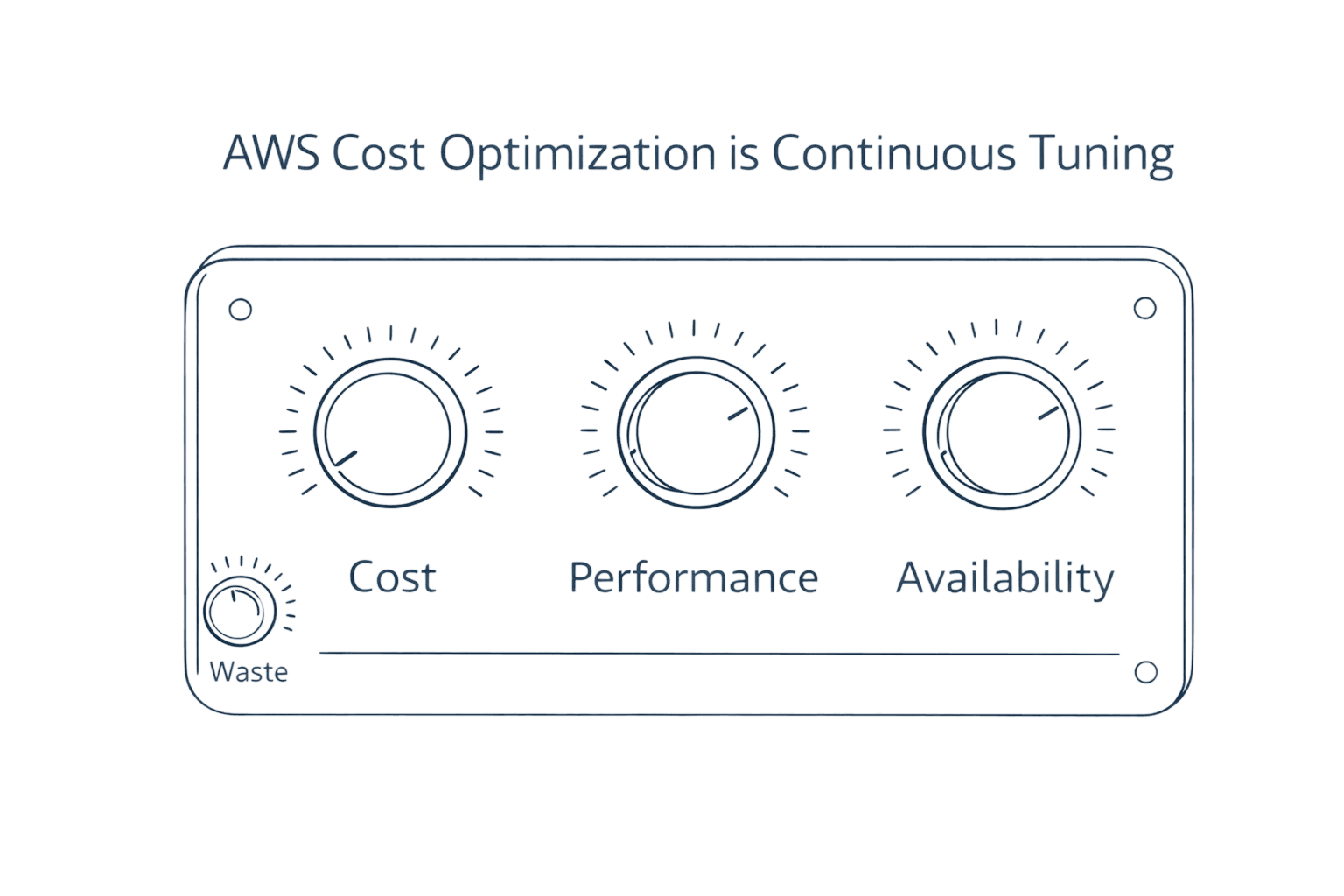
Cloud cost optimization isn't simply about maximizing savings. It's about making infrastructure cost decisions that align with business priorities.
It's about balancing:
Performance
Reliability
Customer experience
Engineering effort
Business impact
The most valuable optimization is rarely the cheapest one.
6. Engineering teams don't see cost until finance does
One of the biggest challenges in cloud cost optimization is timing.
Engineering teams make infrastructure decisions every day.
Finance teams see their impact weeks later.
This delay creates a disconnect between engineering activity and financial outcomes.
Imagine pushing a deployment at 11 AM. And by noon, knowing it increased your monthly cloud spend by $3,200.
Instead of waiting until next month's invoice to find out.
That's the difference between reactive reporting and proactive cost intelligence.
Cloud cost conversations would become significantly more proactive.
7. Cloud costs continue to grow faster than visibility
As organizations adopt Kubernetes, AI workloads, microservices, and multi-account AWS environments, cloud architectures become increasingly dynamic.
Every autoscaling event.
Every deployment.
Every new workload.
Every storage decision.
Every data transfer.
Adds another layer of complexity.
Traditional cost reporting struggles to keep pace with this level of change. Organizations increasingly need infrastructure cost intelligence platforms that continuously connect cloud spend with infrastructure behavior.
That's why modern cloud cost management is shifting toward continuous intelligence instead of static reporting.
What Modern Cloud Cost Optimization Should Look Like:
For organizations spending more than $50,000 per month, cloud cost optimization should go far beyond identifying idle resources.
Instead, engineering teams need the ability to:
Understand why cloud costs changed
Connect infrastructure changes with financial impact
Improve cloud cost allocation
Gain engineering cost visibility
Prioritize optimization opportunities
Detect anomalies
Forecast future cloud costs
Make confident infrastructure decisions
Cloud cost optimization becomes an engineering discipline, not just a finance exercise.
How Opsolute Helps Engineering Teams Stay Ahead of Cloud Costs:
Managing cloud costs at scale isn't about adding another dashboard.
It's about building Infrastructure Cost Intelligence that helps engineering and finance teams make smarter decisions.
Opsolute's Infrastructure Cost Intelligence Platform goes beyond traditional cloud cost management by connecting cloud spend with infrastructure behavior, ownership, dependencies, and business context.
From real-time cloud cost intelligence and anomaly detection to rightsizing recommendations, forecasting, optimization insights, and infrastructure cost analytics, Opsolute helps teams understand what changed, why it changed, and what to do next, all from a single platform.
By bringing together cloud spend, infrastructure changes, workload ownership, and business context, engineers no longer need to switch between billing dashboards, Kubernetes, monitoring tools, and deployment pipelines to investigate cloud cost changes.
Conclusion:
Once your AWS spend crosses $50K per month, cloud cost management changes fundamentally.
The challenge is no longer finding expensive resources.
It's building Infrastructure Cost Intelligence that explains why those resources exist and how they impact the business.
Organizations that treat cloud cost optimization as an ongoing engineering practice, not a monthly finance exercise, are better positioned to control spend, improve accountability, and scale confidently.
The future of cloud cost optimization isn't about reducing every dollar.
It's about combining Infrastructure Cost Intelligence with engineering context to make every cloud dollar count.
Frequently Asked Questions (FAQs)
1. Why do cloud cost challenges increase after $50K per month?
As cloud environments grow, organizations manage more accounts, services, workloads, and engineering teams. This makes cost attribution, ownership, and optimization significantly more complex.
2. What is the biggest challenge in cloud cost optimization and infrastructure cost management?
For large organizations, the biggest challenge isn't visibility. It's understanding why costs changed, who owns the change, and which actions should be prioritized.
3. Why isn't the AWS invoice enough for cloud cost management?
AWS invoices show total spend but don't provide infrastructure context or explain which deployment, workload, team, or architectural change caused the increase. Effective optimization requires infrastructure context alongside billing data.
4. How often should companies review cloud costs?
Waiting for the monthly invoice is no longer sufficient. Organizations should continuously monitor cloud costs using real-time cloud cost monitoring, infrastructure cost intelligence, forecasting, and anomaly detection.
5. How can engineering teams optimize cloud costs without affecting performance?
By evaluating recommendations based on business impact, workload behavior, customer experience, and engineering risk, not just potential savings, teams can make safer optimization decisions.